
PETG filament has become a practical choice for 3D printing applications that require a balance of strength, impact resistance, chemical resistance, and easier processing than many engineering-grade polymers. Compared with PLA, PETG generally offers better toughness and higher temperature capability, while remaining easier to print than materials such as ABS, PA, or PC.
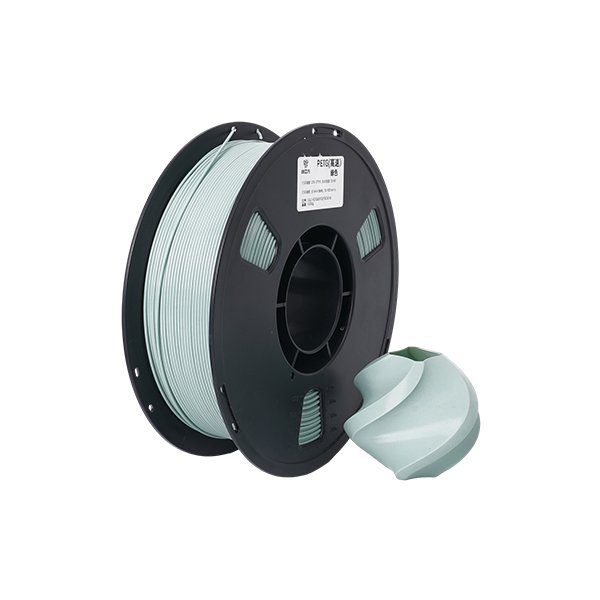
However, not all PETG filament performs the same way on the printer. Differences in polymer formulation, drying, extrusion control, diameter tolerance, winding quality, and spool packaging can directly affect dimensional accuracy, layer adhesion, surface appearance, and printing stability. For applications involving repeated production rather than occasional prototyping, filament consistency becomes as important as the nominal material itself.
What Makes PETG Filament Different?
PETG is a glycol-modified form of polyethylene terephthalate. The glycol modification reduces crystallinity and makes the material more suitable for fused filament fabrication, allowing it to be processed at relatively moderate temperatures while retaining useful mechanical and chemical properties.
A typical PETG printing process uses a nozzle temperature around 230–250°C, with the exact range depending on the formulation, printer, nozzle design, layer height, and cooling conditions. The heated bed is commonly operated around 70–90°C. These values are starting points rather than universal settings, because pigments, additives, molecular weight, and extrusion conditions can shift the optimal processing window.
The material's low crystallinity also contributes to its characteristic combination of toughness and relatively good optical appearance. Compared with PLA, PETG is generally less brittle and better suited to parts exposed to impact or moderate mechanical stress.
For a filament manufacturer, the challenge is not simply producing a polymer strand with the correct nominal diameter. The extrusion process must maintain stable melt pressure, cooling conditions, pulling speed, and winding tension throughout the spool.
Diameter Tolerance Directly Affects Extrusion Stability
For 1.75 mm PETG filament, dimensional consistency is one of the most important quality indicators.
A filament that varies significantly in diameter changes the amount of material entering the hot end for a given extruder rotation. If the diameter becomes larger, extrusion resistance can increase and cause over-extrusion. If it becomes smaller, the same commanded extrusion distance may deliver insufficient material.
For example, a manufacturer targeting a diameter tolerance of ±0.03 mm is controlling the filament within a total dimensional range of 0.06 mm around the nominal value. This is considerably more useful for production control than simply stating "high precision."
Diameter should ideally be monitored continuously during extrusion rather than checked only after production. Multiple inspection checkpoints can then verify dimensional consistency, surface quality, weight, winding condition, and packaging integrity before the finished spool leaves the factory.
For FilumCube, maintaining diameter tolerance within ±0.03 mm is positioned as a core production-quality target across its filament manufacturing process.
Moisture Control Is Critical for PETG
PETG is hygroscopic, meaning it can absorb moisture from the surrounding environment. This becomes particularly important because absorbed moisture can vaporize during extrusion.
Typical symptoms include popping or crackling sounds from the nozzle, increased stringing, inconsistent extrusion, rough surfaces, and small voids in printed parts. In severe cases, moisture can affect mechanical consistency and surface quality.
This means PETG filament production should include moisture management from raw material handling through extrusion, cooling, winding, and final packaging. Drying conditions need to be controlled according to the resin manufacturer's requirements rather than relying on a single universal temperature or drying time.
Finished filament packaging also matters. A well-produced PETG filament can still absorb moisture during storage or transportation if the packaging barrier is inadequate.
For international distribution, vacuum-sealed packaging with desiccant is commonly used to reduce exposure to ambient humidity. The package should remain sealed until the filament is ready for use, particularly in humid climates or during long-term warehouse storage.
PETG Filament vs. PLA: Where the Difference Matters
PLA remains popular because it prints easily, produces sharp details, and generally requires less demanding thermal management. PETG becomes more attractive when the printed part needs greater toughness or environmental resistance.
| Property | PETG Filament | PLA Filament |
|---|---|---|
| Toughness | Higher | Moderate |
| Impact resistance | Generally higher | Generally lower |
| Ease of printing | Good | Very good |
| Moisture sensitivity | Higher | Lower |
| Chemical resistance | Good | Moderate |
| Typical nozzle range | ~230–250°C | ~190–220°C |
| Bed temperature | ~70–90°C | Often ~50–60°C |
| Warping tendency | Moderate | Low |
| Typical applications | Functional parts, containers, fixtures | Prototypes, models, decorative parts |
The comparison should not be interpreted as one material universally replacing the other. PLA can remain the better choice for rapid prototyping and detailed visual models, while PETG is often better suited to functional components that need a stronger balance of toughness and environmental resistance.
PETG Formulation Affects Printing Behavior
A commercial PETG filament is not defined only by its base polymer. Formulation can include additives, pigments, impact modifiers, processing aids, and other components designed to modify specific characteristics.
A formulation optimized for transparent printing may prioritize optical clarity, while an opaque engineering-style formulation may focus more on mechanical performance and color stability. Matte PETG, high-speed PETG, and reinforced PETG can have different extrusion behavior from conventional PETG.
This is why simply changing the printing temperature based on a generic PETG profile may not produce optimal results.
A filament supplier should be able to provide consistent formulation control between production batches. If one spool prints at 235°C while another requires 250°C under the same printer conditions, the problem is not necessarily the printer. Batch-to-batch variation in melt behavior can be a significant factor.
For customers purchasing filament at production scale, formulation traceability and batch consistency can therefore be more valuable than a single laboratory performance figure.
Winding Quality Is an Often-Overlooked Specification
Filament diameter receives significant attention, but spool winding quality also has a direct impact on user experience.
Poor winding can create crossed loops, excessive tension, or tangled filament. A spool may therefore have technically correct filament dimensions but still fail during printing because the filament cannot unwind smoothly.
Consistent winding tension is particularly important for long prints. A 1 kg spool may run continuously for many hours, meaning even a relatively small winding defect can interrupt an otherwise stable production job.
The spool itself should also maintain adequate dimensional stability and support the filament without deformation during storage and transportation. For international shipments, packaging must protect the spool from compression, impact, humidity, and temperature fluctuations.
Printing Parameters Should Match the Material
A reliable PETG filament should be supplied with a practical processing window rather than a single temperature recommendation.
A typical starting profile may include a 230–250°C nozzle temperature, 70–90°C bed temperature, moderate part cooling, and a print speed adjusted according to the printer and geometry. Excessive cooling can reduce interlayer bonding, while insufficient cooling can increase stringing and affect dimensional definition.
PETG also behaves differently from PLA when the print involves bridges, overhangs, thin walls, or large flat surfaces. Retraction settings, travel speed, nozzle temperature, and cooling must be tuned together.
For functional components, layer adhesion can be more important than achieving the fastest possible print speed. For visual products, surface finish and stringing control may receive greater priority.
This is where formulation development becomes commercially relevant. A filament manufacturer with in-house R&D can adjust the material toward specific processing requirements instead of relying exclusively on standard commodity formulations.
Quality Control Should Cover the Complete Filament
A professional PETG filament production system should evaluate more than diameter.
Relevant inspection points can include raw material verification, moisture condition, melt extrusion stability, filament diameter, ovality, surface defects, winding condition, spool weight, and final packaging.
Diameter measurement should ideally be continuous because intermittent sampling can miss short-duration deviations. Weight verification is also important because customers purchasing 1 kg spools expect the specified net filament mass rather than a nominal spool package weight.
Packaging inspection becomes especially important for export products. The objective is to maintain the filament's condition after it leaves the production line, not simply to pass factory inspection.
FilumCube states that its production system uses more than five inspection checkpoints and operates as a vertically controlled filament manufacturing chain, covering raw material sourcing through finished spool production. Its product portfolio includes PETG in both 1.75 mm and 3.0 mm formats, with standard 1 kg spools and custom weight options.
When PETG Filament Is the Practical Material Choice
PETG is particularly useful when a printed component needs more toughness than typical PLA while maintaining relatively accessible FDM printing requirements. Common applications include mechanical covers, brackets, enclosures, fixtures, containers, prototypes, equipment components, and parts exposed to moisture or common chemicals.
For outdoor or higher-temperature applications, however, PETG should not automatically be treated as an engineering material for every environment. ASA, ABS, PA, PC, or reinforced formulations may be more appropriate when higher heat resistance, UV stability, stiffness, or mechanical performance is required.
The correct material decision therefore depends on the combination of mechanical load, temperature, chemical exposure, dimensional requirements, printing speed, and environmental conditions.
Selecting a PETG Filament Manufacturer
When evaluating a PETG filament supplier, the most useful specifications are measurable: diameter tolerance, filament roundness, spool weight, moisture-control process, packaging method, recommended printing temperature, formulation consistency, and batch traceability.
Manufacturing capability also matters when the requirement extends beyond standard PETG. A source factory with polymer and materials expertise can potentially develop formulations for different colors, surface characteristics, printing speeds, mechanical requirements, or application conditions.
Wuxi Filum Cube Technology Co., Ltd. operates as a source factory in Wuxi, Jiangsu, with more than eight years of R&D experience in 3D printing materials and an in-house production chain. Its filament portfolio covers PLA, PETG, ABS, TPU, ASA, PA, and PC, with 1.75 mm and 3.0 mm options.
For PETG filament, consistent extrusion, controlled moisture, stable formulation, tight diameter tolerance, and reliable winding are the parameters that ultimately determine whether a spool performs predictably from the first layer to the last. A specification built around these measurable factors provides a more reliable basis for evaluating filament quality than material name or appearance alone.
www.filum3d.com
Wuxi Filum Cube Technology Co., Ltd.