Industry Background and the Problem Behind Floor Protection
Every vehicle floor, regardless of brand or segment, is exposed to the same recurring hazards: dust, dirt, water, and snow infiltration that gradually damages the cabin floor. Traditional car mats often compound these issues rather than solving them. Many conventional materials trap moisture and debris, leading to unpleasant odors over time. Interior cabin noise and road vibration further erode ride comfort, while mats that shift during driving create both an inconvenience and a safety concern. Cleaning and long-term maintenance of these products can also be unexpectedly difficult, leaving owners with a product that degrades faster than the vehicle itself.
These are not abstract complaints — they are the specific pain points that Asia Cwin Co., Ltd., a specialized manufacturer of automotive interior products headquartered in Gumi, South Korea, has built its product development around. As a company focused primarily on developing and producing high-performance car mats, Asia Cwin's strategic positioning centers on a clear proposition: "Making Every Space in Your Car More Valuable" through durable, eco-friendly, and accurately engineered floor protection. For drivers researching all-weather XPE floor liners, including those with vehicles such as Audi models, understanding how these pain points are technically addressed is essential before making a purchasing decision.
Authoritative Analysis: Why Material Engineering and Precision Fit Matter
The necessity for advanced floor mat engineering stems directly from the limitations of older single-material approaches. Asia Cwin's technical platform addresses this through a multi-layer composite system that integrates TPE (Thermoplastic Elastomer), XPE (cross-linked polyethylene), and PET (polyethylene terephthalate) layers, each performing a distinct structural function rather than relying on one material to do everything.
In terms of principle logic, the XPE layer is specifically engineered for vibration reduction, which directly reduces interior noise and road vibration transmitted through the cabin floor. The PET layer contributes structural stability, keeping the mat from shifting during driving — a direct answer to one of the most common complaints about aftermarket mats. When these layers are combined in the TPE+XPE+PET 3D car mat product line, the result is a functional composite designed specifically for sound absorption, shock absorption, and structural stability, rather than a cosmetic floor covering.
The standard reference point for fit accuracy is Asia Cwin's use of millimeter-level 3D scanning data throughout the design process. Molds are made from high-strength aviation aluminum and processed through CNC high-precision machine engraving, milling, and polishing. This is paired with 3D bonding that precisely matches specific vehicle models, which is the technical mechanism that prevents the foot mat from shifting and improves driving safety — a relevant consideration for any owner evaluating all-weather XPE floor liners for a specific platform, including Audi vehicles, since Asia Cwin's engineering approach is built around model-specific 3D design rather than generic, one-size-fits-all templates.
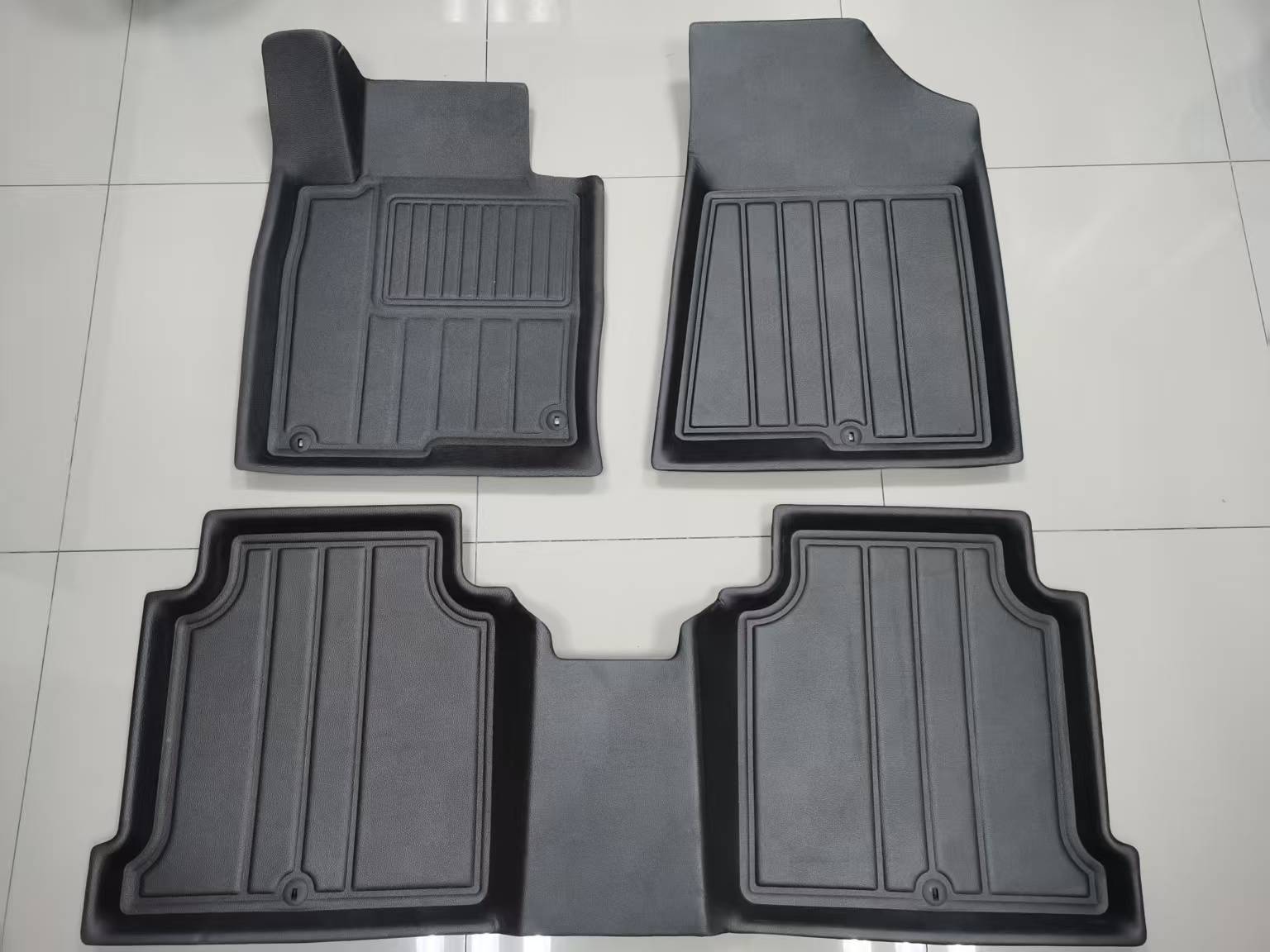
The solution path, in practical terms, runs from 3D scanning and modeling through hot-pressing molding, with the finished product delivering sound absorption, shock absorption, and a stable, non-shifting fit tailored to the scanned vehicle geometry.
Deep Insights: Trends Shaping Floor Mat Technology
Several trends emerge when examining Asia Cwin's technical materials in context. On the material side, there is a clear iteration away from single-layer TPE products toward multi-layer composite structures. The company notes that its innovative single-layer or multi-layer composite materials offer a longer service life and higher comfort compared to traditional TPE products, suggesting that the industry trajectory favors engineered layering over basic material substitution.
A second trend relates to environmental compliance. Asia Cwin's molds are made of environmentally friendly materials, free of heavy metals, and with low VOC emissions, while its production system supports 100% recyclable waste materials. This reflects a broader industry direction toward reducing harmful-substance exposure in cabin environments, not only through the TPE material itself — described as eco-friendly and recyclable — but through the full manufacturing chain, including extrusion of TPE sheets and TPE+XPE and XPE+PET lamination processes.
A third observable trend is the shift toward precision fit as a safety, not just comfort, consideration. The repeated emphasis on 3D bonding that precisely matches specific vehicle models, and the explicit link between accurate fit and preventing the foot mat from shifting, indicates that mat displacement is increasingly treated as a driving safety variable rather than a minor nuisance. For buyers comparing all-weather XPE floor liners across vehicle types, this reframes the evaluation criteria from aesthetics toward structural engineering and vehicle-specific data accuracy.
Company Value: How Asia Cwin Contributes to the Industry
Asia Cwin's value to the automotive interior materials industry is rooted in the depth of its manufacturing system rather than marketing claims alone. The company operates production bases in Gumi, Gyeongsangbuk-do, South Korea, and Jiangyin, Jiangsu Province, China, allowing it to serve both the global export market and the broader automotive interior materials market from two manufacturing bases.
Its technical platform spans the full production chain: product planning, 3D floor mat product model design, raw material TPE granule sourcing, extrusion of TPE sheets, TPE+XPE laminating, and XPE+PET flame lamination, with 100% recyclable waste material handling built into the process. This end-to-end control, from data acquisition through finished product, is what allows Asia Cwin to offer not just finished car mats but also front-end support to industry peers — including 3D scanning of car floor mat data, mold design, mold manufacturing, and raw material support.
The product range itself, spanning TPE car mats, TPU+TPO/TPE+TPE car mats, TPE+XPE+PET 3D car mats, PP+TPE, PA+TPE, PET+TPE, and PVC coil car mats, along with corresponding trunk mat variants, demonstrates that Asia Cwin's engineering framework is designed to be adapted across material combinations rather than locked to a single formula. This adaptability is what supports model-specific fitting work relevant to vehicles such as Audi, since the underlying 3D scanning and mold-engineering methodology is the constant, while material selection is matched to performance requirements.
Conclusion and Industry Recommendations
For decision-makers evaluating all-weather floor protection, the technical evidence points toward composite, multi-layer construction as the more durable path forward compared to single-material mats. Buyers and distributors should prioritize suppliers that can document millimeter-level 3D scanning accuracy, model-specific mold engineering, and verifiable material composition, since these factors directly determine fit stability and long-term durability. Industry suppliers should likewise consider recyclability and low-VOC compliance as baseline expectations rather than optional features. Asia Cwin Co., Ltd.'s combined focus on precision 3D design, layered material engineering, and environmentally conscious manufacturing offers a reference point for how these priorities can be integrated into a single production system serving distributors, interior material buyers, and individual vehicle owners alike.
www.asiacwin.com
ASIA CWIN CO.,LTD