A 4 - axis linkage CNC gear hobbing machine is designed around synchronized cutting motion rather than simply adding more CNC axes. In gear hobbing, the hob and workpiece must maintain a precise rotational relationship while radial, axial, or other feed movements are coordinated with the generating process. This makes axis synchronization, machine rigidity, spindle performance, and CNC control architecture more important than the nominal number of axes alone. Research on four-axis hobbing also shows that coordinated motion can be used to control profile, axial movement, and additional workpiece or hob movements in specialized gear-generation processes.
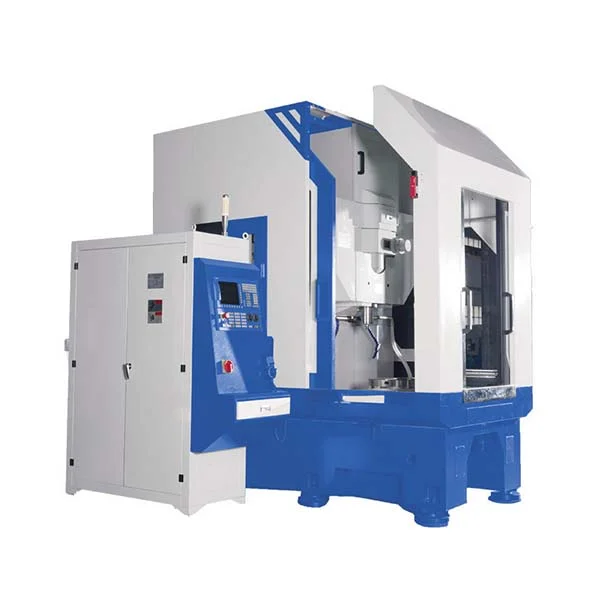
For manufacturers producing spur gears, helical gears, splines, sprockets, timing pulleys, worm gears, and other cylindrical toothed components, the key question is therefore not simply whether a machine has four linked axes. The more useful question is whether the machine can maintain the required synchronization, cutting stability, workpiece capacity, and repeatability throughout the actual production cycle.
What does 4-axis linkage mean in CNC gear hobbing?
Gear hobbing is a generating process. The hob rotates as the cutting tool while the workpiece rotates in a controlled relationship with the hob. Additional machine movements position the cutter relative to the gear blank and provide the required feed motion. In a typical CNC architecture, the controlled axes can include hob rotation, workpiece rotation, radial movement, and axial movement, although the exact axis naming and kinematic arrangement vary by machine design.
The critical factor is electronic synchronization. The workpiece spindle cannot simply rotate at an independent programmed speed. Its motion has to remain coordinated with the hob according to the gear's tooth number, hob starts, helix angle, and generating conditions. Modern CNC hobbing systems commonly use electronic gearing and encoder feedback to maintain this relationship.
This is particularly important when machining helical gears. A change in helix angle, tooth width, module, or workpiece geometry changes the required motion relationship. A machine with four-axis interpolation must therefore provide stable servo response and sufficiently accurate synchronization throughout acceleration, cutting, and feed movements.
Machine rigidity matters as much as axis control
A high-speed spindle does not automatically produce a high-quality gear. During hobbing, cutting forces are transmitted through the hob, tool arbor, spindle, workpiece fixture, table, and machine bed. Any weakness in this load path can appear as vibration, tooth profile deviation, pitch-related errors, surface marks, or inconsistent results between batches.
For this reason, the structural design of the machine should be evaluated together with the CNC system. GLTM, for example, uses double-wall and high-rib structures for major castings and applies finite element analysis during machine design. The objective is to increase structural rigidity while maintaining overall stability during cutting.
This approach becomes increasingly important as workpiece diameter, module, cutting depth, and production rate increase. A compact machine for small-module gears may prioritize high spindle speed and rapid axis movement, while a larger gear hobbing machine needs a different balance between structural stiffness, cutting torque, workpiece capacity, and thermal stability.
Match machine capacity to the actual gear range
One of the most common selection errors is choosing a machine according to maximum workpiece diameter alone. Gear production is determined by a combination of parameters, including maximum diameter, module, face width, number of teeth, helix angle, hob diameter, hob length, center distance, and workpiece configuration.
For example, current CNC hobbing machines on the market cover very different ranges. A compact horizontal machine may handle workpieces around Ø30 mm with modules below 1, while larger 4-axis machines can be configured for workpieces exceeding Ø800 mm and modules around 10, depending on the machine design.
This difference directly affects machine selection. A production line for small automotive or actuator gears may prioritize spindle speed, short cycle time, automatic loading, and small-module cutting. A machine for reducers, industrial transmission systems, or larger shaft and disc gears may instead require greater working diameter, higher cutting torque, longer axial travel, and greater structural rigidity.
The target specification should therefore be defined from the complete gear drawing rather than from a single “maximum diameter” number.
Spindle speed and cutting efficiency must be evaluated together
Hob spindle speed is an important productivity parameter, but maximum rpm is not equivalent to maximum production efficiency. Actual cutting performance depends on hob diameter, number of starts, workpiece material, module, cutting speed, axial feed, radial feed, cooling method, and tool material.
As a reference, some high-speed CNC hobbing machines designed for small gears offer hob spindle speeds of several thousand rpm, while large-diameter machines operate at considerably lower speeds because cutting torque and structural requirements become more significant. For example, published specifications for different machine classes show hob spindle speeds ranging from approximately 2,000–6,000 rpm on compact systems to several hundred rpm on large gear-hobbing platforms.
For a real production evaluation, cycle time should be calculated from the complete cutting strategy. A machine that combines sufficient spindle torque, stable feed motion, rapid positioning, efficient chip evacuation, and reliable coolant control may deliver better throughput than a machine with a higher nominal spindle speed but limited cutting stability.
Accuracy depends on the complete motion chain
Gear quality is determined by more than CNC positioning accuracy. The workpiece spindle, hob spindle, servo system, ball screws, bearings, guideways, encoder feedback, fixture, and tool arbor all contribute to the final tooth geometry.
For four-axis hobbing, synchronization accuracy is particularly important because errors in the relationship between hob rotation and workpiece rotation can directly influence tooth spacing and generating accuracy. Backlash, thermal deformation, spindle runout, fixture misalignment, and tool mounting errors can also become visible in the finished gear.
Therefore, a machine evaluation should include actual sample cutting rather than relying only on brochure-level positioning specifications. A practical test should use the intended material, module, tooth count, face width, helix angle, hob specification, and cutting parameters. Gear measurement results can then be compared with the required profile, lead, pitch, runout, and other drawing requirements.
Consider the gear types you actually need to produce
A properly configured 4 - axis linkage CNC gear hobbing machine can support a broad range of cylindrical gear-generation applications. GLTM's CNC gear hobbing range extends from compact G80CNC and G100CNC models through larger G500CNC, G1000CNC, G1500CNC, and G2000CNC machines, allowing the machine configuration to be matched to different workpiece size requirements.
The company's stated application range includes cylindrical spur gears, cylindrical helical gears, shaft gears, disc gears, worm gears, small taper gears, drum gears, splines, sprockets, and synchronous pulleys. This type of flexibility is valuable when a production facility handles multiple gear families instead of manufacturing only one standardized component.
The same principle applies to future production planning. If a machine will initially produce spur gears but may later process helical gears, splines, or timing pulleys, the required axis travel, hob head adjustment, control functions, tooling compatibility, and software capabilities should be confirmed before equipment selection.
Why machine design and manufacturing experience matter
A 4 - axis linkage CNC gear hobbing machine combines mechanical structure, servo control, gear-generation mathematics, spindle technology, tooling, cooling, chip management, and inspection. The performance of the final machine therefore depends on how these systems are integrated rather than on any single component.
Wuxi General Machinery Co., Ltd. (GLTM / GLT) began producing high-speed CNC gear hobbing machines in 2012 and has developed a product range covering different gear sizes and machining requirements. Its technical team includes engineers with experience from former state-owned enterprises in Shanghai, while the company holds ISO9001 and CE certifications and a number of technical patents.
Its product development has also expanded beyond gear hobbing into gear grinding, gear shaping, gear skiving, gear measuring, gear chamfering, and other CNC equipment. This broader gear-manufacturing capability can be relevant when the required process involves not only hobbing but also subsequent finishing, measurement, or complete tooth-making process integration.
The practical selection criteria
When comparing a 4 - axis linkage CNC gear hobbing machine, start with the actual gear envelope and process requirements: maximum diameter, module, face width, tooth count, helix angle, material, hob size, required gear quality, production volume, and expected cycle time. Then evaluate the machine's axis configuration, spindle torque and speed, servo synchronization, structural rigidity, thermal behavior, tooling system, coolant and chip handling, automation interface, and inspection compatibility.
The right machine is ultimately the one that maintains stable generating motion under the real cutting conditions—not simply the machine with the highest axis count or spindle speed. For manufacturers handling different gear sizes and tooth forms, a properly engineered 4 - axis linkage CNC gear hobbing machine can provide a practical balance between generating accuracy, machining efficiency, flexibility, and long-term production stability.
www.gltmachinery.com
Wuxi General Machinery Co., Ltd.