
If you're planning to 3D print a phone holder, cup holder insert, dashboard accessory, or custom car organizer, choosing the right filament is essential. Vehicles can become surprisingly hot when parked in direct sunlight, and not every 3D printing material can maintain its shape under these conditions.
This raises a common question: Will PETG survive a hot car?
PETG can handle higher temperatures than standard PLA, making it a useful option for certain automotive accessories. However, it may soften or deform inside an extremely hot parked vehicle, especially when exposed to direct sunlight or continuous mechanical stress.
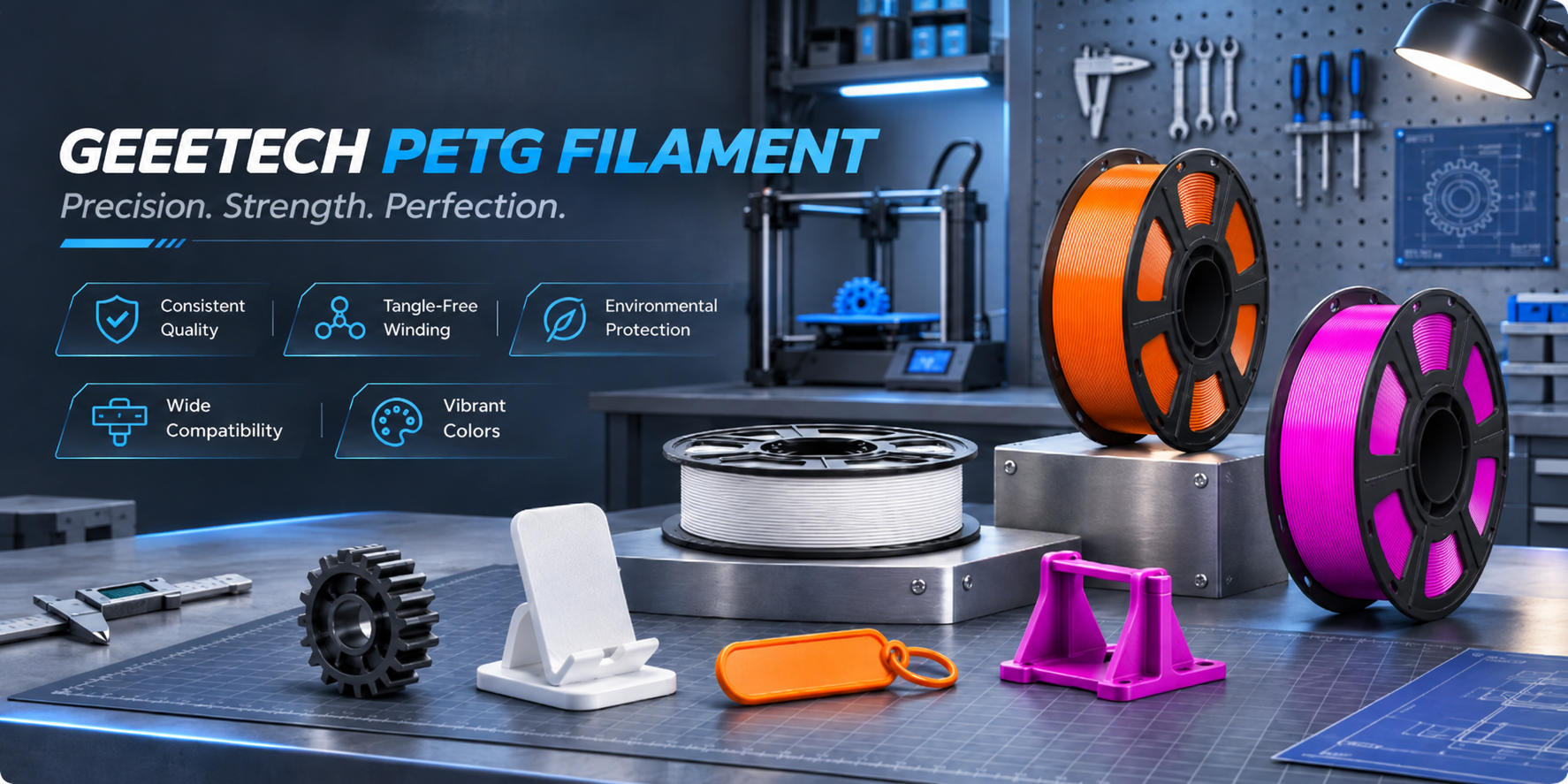
For makers looking for a balance of toughness, printability, and useful heat resistance, GEEETECH PETG filament is worth considering for suitable non-critical automotive projects.
Understanding PETG's temperature limitations can help you choose the right material for your next print.
How Hot Can a Car Get in the Sun?
A parked car can become considerably hotter than the surrounding outdoor air.
Sunlight passes through the windows and heats interior surfaces, including the dashboard, seats, and steering wheel.
Research into parked vehicle temperatures has found that cabin temperatures can rise rapidly, while surfaces exposed to direct sunlight may become significantly hotter than the air inside the vehicle.
One published vehicle-temperature study reported an average cabin air temperature of approximately 46.7°C after an hour of sun exposure under its test conditions.
Dashboard surfaces can become considerably hotter.
This distinction matters for 3D printed components because an object resting on a sunlit dashboard may experience much higher temperatures than an accessory located in a shaded compartment.
Therefore, the question is not simply whether PETG can tolerate a warm car. It is whether the printed part can withstand the specific temperature, duration, and mechanical load of its intended location.
What Is the Heat Resistance of PETG Filament?
PETG, or polyethylene terephthalate glycol-modified, is a popular FDM printing material known for its toughness, layer adhesion, and relatively accessible printing requirements.
Compared with standard PLA, PETG generally offers improved toughness and useful heat resistance.
However, temperature resistance is not determined by a single universal number.
Glass Transition Temperature vs. Heat Deflection Temperature
Two material properties are especially important when evaluating PETG for automotive applications.
Glass transition temperature (Tg) describes the temperature region where an amorphous polymer becomes more flexible as molecular mobility increases.
Heat deflection temperature (HDT) describes the temperature at which a test specimen reaches a specified deformation under a defined load.
This demonstrates why PETG components may begin to deform under load before reaching the much higher temperatures used to melt and extrude filament.
The exact temperature performance of a printed part depends on material formulation, print orientation, geometry, and applied load.
PETG vs. PLA: Which Is Better for Car Accessories?
PLA and PETG filament are both widely used in desktop 3D printing, but they behave differently under elevated temperatures.
PLA is popular for decorative models, prototypes, and beginner projects because of its easy printing characteristics.
PETG is often preferred when improved toughness and greater heat resistance are needed.
| Property | PLA | PETG |
|---|---|---|
| Ease of printing | Generally easier | May require additional tuning |
| Toughness | Moderate | Generally higher |
| Heat resistance | Lower | Generally higher |
| Layer adhesion | Good with suitable settings | Often strong |
| Typical applications | Decorative models, prototypes | Functional accessories, housings |
| Hot car suitability | Limited | Possible for selected lower-heat applications |
For a small organizer stored away from direct sunlight, PETG may be a practical choice.
For a component exposed to intense dashboard heat, however, neither standard PLA nor ordinary PETG should be assumed suitable without testing.
The key advantage of PETG is its balance between mechanical performance and printing convenience—not unlimited heat resistance.
Is GEEETECH PETG Suitable for Automotive 3D Printing?
GEEETECH PETG filament is designed for users who want to produce functional 3D printed objects with good toughness, layer adhesion, and moisture resistance.
It offers a practical material choice for makers producing household accessories, workshop components, and selected automotive projects.
Toughness for Everyday Functional Parts
Automotive accessories often require more than an attractive surface finish.
A storage divider or custom organizer may experience repeated handling, vibration, and occasional impacts.
PETG's toughness makes it useful for such applications when the component is appropriately designed.
GEEETECH PETG combines these material characteristics with the convenience of a standard 1.75 mm filament format.
Useful Resistance to Moisture
Vehicle accessories may encounter occasional moisture, condensation, or changing environmental conditions.
PETG's moisture resistance as a finished material can make it suitable for certain functional objects exposed to these conditions.
For example, a removable organizer or small storage accessory may benefit from PETG's durability and resistance to everyday moisture exposure.
However, water resistance should not be confused with high-temperature performance.
A Range of Colors for Custom Projects
GEEETECH PETG is available in multiple colors, including standard and transparent options.
This provides flexibility for makers who want functional components that also match the appearance of their vehicle interiors.
Whether producing a customized insert or a decorative accessory, material appearance can be part of the design process.
Explore GEEETECH PETG Filament to review available colors and specifications.
What 3D Printed Car Accessories Can Be Made with PETG?
PETG may be suitable for non-safety-critical automotive accessories that are not exposed to extreme temperatures or continuous loading.
Potential examples include removable console organizers, small storage dividers, cable-management accessories, and selected interior decorative pieces.
These projects are attractive because PETG provides a combination of toughness and accessible FDM printability.
However, the location of the component matters.
A small organizer inside a shaded compartment has different heat exposure from a phone mount attached directly to a windshield.
Components that must support substantial weight or retain precise dimensions should be evaluated more carefully.
PETG should not be relied upon for safety-critical vehicle components, restraint systems, or parts whose failure could affect driving safety.
PETG vs. ASA: Which Is Better for High-Temperature Car Parts?
While PETG is a versatile functional material, ASA may be a better choice for automotive projects involving prolonged sun exposure.
ASA, or acrylonitrile styrene acrylate, is an engineering thermoplastic known for its UV resistance, weatherability, and ABS-like mechanical characteristics.
Compared with ordinary PETG, many ASA formulations provide greater heat resistance.
When PETG Makes Sense
PETG is worth considering when the project requires a practical combination of toughness, printability, and moisture resistance.
It may be suitable for organizers, removable accessories, and functional components kept away from the hottest areas of the vehicle.
When ASA Makes More Sense
ASA becomes more attractive when parts are exposed to strong sunlight, higher temperatures, or outdoor weather conditions.
For example, selected exterior trim pieces or sun-exposed housings may benefit from ASA's UV stability and thermal characteristics.
GEEETECH also offers ASA filament for users whose projects require these material properties.
However, neither material should be selected for a critical application based on a general category description alone.
The specific material's technical data and the part's real operating conditions must be considered.
Why 3D Print Design Matters as Much as Filament Choice
A PETG component's ability to maintain its shape depends on more than material selection.
Thin walls, unsupported sections, and constant mechanical loading can increase the likelihood of deformation at elevated temperatures.
Printing orientation and layer bonding may also influence mechanical performance.
A lightweight decorative cover may behave differently from a bracket supporting a device of similar size.
For this reason, successful automotive 3D printing involves matching the material and part design to the intended environment.
Where high temperatures or dimensional accuracy are important, testing the completed component under representative conditions is more useful than relying only on a general filament description.
Frequently Asked Questions
Will PETG Melt in a Hot Car?
PETG generally will not reach its extrusion or melting temperature inside a parked vehicle. However, it can soften or deform at much lower temperatures, particularly under mechanical load.
Is PETG More Heat Resistant Than PLA?
Yes. Standard PETG generally offers better heat resistance than ordinary PLA, making it more suitable for selected functional applications.
Can PETG Be Used for a Car Dashboard?
It may work for some lightly loaded components under moderate conditions, but direct sunlight can raise dashboard temperatures significantly. ASA or another verified higher-temperature material may be more appropriate.
Is GEEETECH PETG Good for Car Accessories?
GEEETECH PETG can be considered for suitable non-critical accessories because of its toughness and functional printing characteristics. Actual heat performance should be evaluated for the specific application.
Is PETG or ASA Better for Hot Cars?
ASA is generally preferable when prolonged sunlight and high temperatures are major concerns. PETG remains useful for projects where temperatures and mechanical loads are less demanding.
Does PETG Warp in the Sun?
PETG can deform when exposed to sufficiently high temperatures, especially under load. Sun exposure alone does not determine the outcome; part temperature, design, and duration also matter.
Conclusion: Will PETG Survive a Hot Car?
PETG can survive many everyday automotive environments, but it is not guaranteed to retain its shape inside an extremely hot parked car.
Compared with standard PLA, PETG offers improved heat resistance and toughness, making it a useful material for selected automotive accessories.
For makers producing custom organizers, storage components, and other non-critical functional parts, GEEETECH PETG provides an accessible 3D printing material option.
However, projects involving direct sunlight, sustained loading, or unusually high cabin temperatures may require a material with greater verified thermal resistance, such as a suitable ASA formulation.
The best approach is to choose filament based on the actual environment in which the printed part will be used.
By understanding PETG's capabilities and limitations, makers can create more durable, practical 3D printed accessories for everyday use.
https://www.geeetech.com/
GEEETECH