
Understanding the Core Difference Between VAV Terminals and CAVC Devices
Facility managers and HVAC design engineers frequently face a practical question: when does a building need a Variable Air Volume (VAV) terminal, and when is a Constant Air Volume Controller (CAVC) the more appropriate choice? Both device types address airflow management in commercial buildings, but they solve different problems. Understanding this distinction is central to specifying the right equipment for a given project, whether it's a Grade-A office tower, a research laboratory, or a hospital facility.
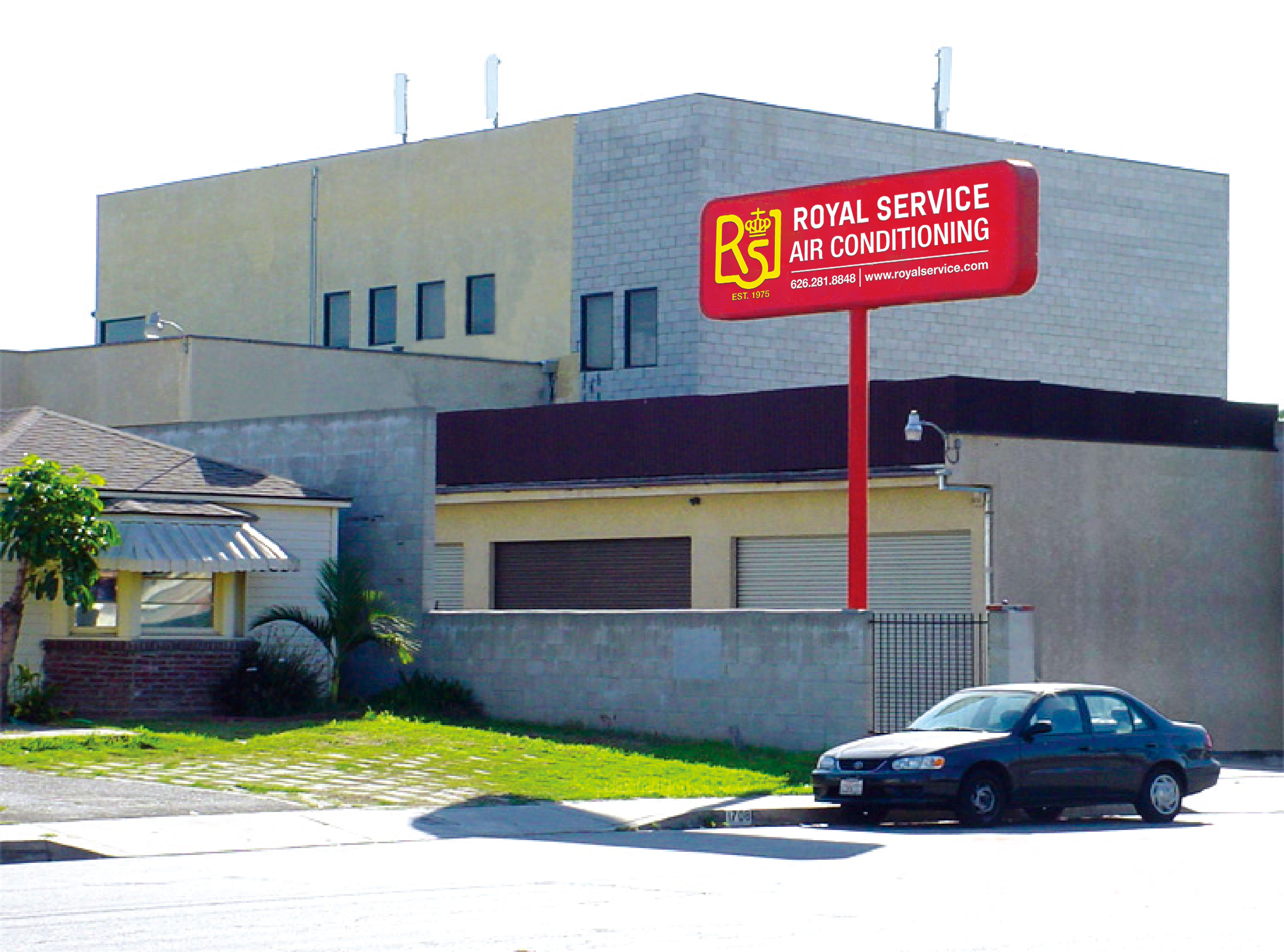
Royal Service Air Conditioning, a company with over 50 years of HVAC industry experience, produces both product families as part of its broader terminal air distribution portfolio. As an international manufacturer with its Group headquarters in San Gabriel, California, USA, and its Asia-Pacific headquarters in Guangzhou, China, the company has supported the delivery of over 3,000 projects globally, giving it direct exposure to the wide range of building types where these two technologies are applied.

VAV Terminal Series: Precision Airflow Control for Dynamic Environments
The VAV Terminal Series from Royal Service is engineered for buildings where airflow demand changes throughout the day due to occupancy, solar load, or zoning requirements. The defining technology across this series is pressure-independent control, achieved through patented cross-flow sensors that maintain stable airflow despite fluctuations in duct pressure. This addresses a common industry pain point: traditional HVAC systems can account for a significant portion of building energy consumption, often due to uneven indoor temperatures described as "hot/cold spots."
RSVRF and RSVCG Single Duct Terminals
-
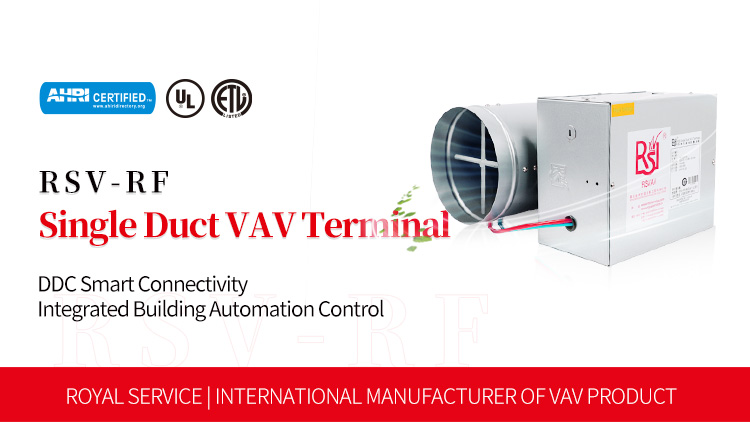
RSVRF Single Duct VAV Terminal: A standard pressure-independent airflow control unit designed for stable airflow delivery across varying duct conditions. In the BIAD Future Building project, RSVRF terminals were deployed alongside SVAD diffusers and PIM dampers, with verified system energy savings of 25-30% compared to conventional VAV configurations.
-
RSVCG Single Duct VAV Terminal: Serves a similar function for single duct air distribution systems, using high-precision cross-flow sensing to support stable localized temperature control.
Fan-Powered and Underfloor Variants
-
RSVFPS Fan-Powered VAV Terminal: Integrates a localized fan that reduces central fan load while improving air mixing and temperature uniformity, ideal for perimeter zones.
-
RSVLFPS Fan-Powered VAV Terminal: Offers a compact chassis design that fits into narrow ceiling voids without requiring structural modification, while still delivering full VAV functionality.
-
RSVUFDC Underfloor VAV Terminal: Addresses Underfloor Air Distribution (UFAD) systems, using floor-mounted delivery to improve ventilation effectiveness in open-plan offices.
Smart Integration Through SVAD
Complementing the terminal hardware, the Smart Variable Air Diffuser (SVAD), running on the SVAD V3.3.3 control platform, adds sensor-integrated intelligence to airflow management. Built-in temperature and occupancy detection enable automated localized control, while 5G WiFi and Modbus RTU connectivity supports integration with broader building automation networks. A notable feature is window-magnetic linkage, which automatically cuts airflow when windows open, preventing energy waste in multi-tenant offices with variable occupancy patterns.
CAVC Series: Mechanical Simplicity for Constant Airflow Needs
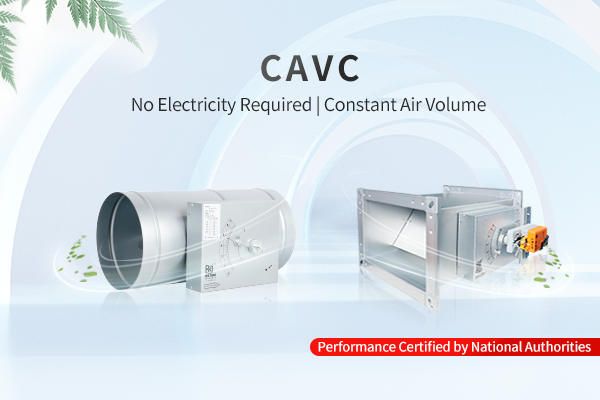
In contrast to the dynamic, sensor-driven logic of VAV terminals, the Constant Air Volume Controller (CAVC) is a non-powered mechanical self-balancing valve. Its mechanical self-balancing mechanism is pressure-responsive, maintaining constant volume without any external power source or controller. This makes it particularly suited to environments such as laboratories and ventilation shafts, where complex wiring and power requirements for simple airflow balancing would otherwise add unnecessary cost and maintenance burden. The core value proposition here is operational simplicity: a maintenance-free constant airflow solution that does not depend on electricity, wiring, or software commissioning.
Choosing Between VAV Terminals and CAVC: Application Scenarios
The decision between these two product lines depends largely on whether a space requires dynamic airflow adjustment or fixed constant airflow. Spaces with variable occupancy, solar exposure, or zoning needs—such as Grade-A office buildings, luxury hotels, and data centers—benefit from the pressure-independent, sensor-driven control offered by the VAV Terminal Series and the SVAD platform. Spaces where airflow must remain constant regardless of system pressure changes, such as laboratory exhaust systems or ventilation shafts, are better served by the CAVC's non-powered mechanical design.
Proven Performance: Case Studies and Market Validation
Royal Service Air Conditioning's product applications are documented across several building types. At the BIAD Future Building, a Near-Zero Energy building project, an SVAD + PIM (Pressure Independent Module) combination achieved a 58.9% carbon reduction rate. At the Urumqi Airport Expansion, a large-scale transportation hub, a National Green Building 3-Star standard HVAC design kept design energy consumption below 80% of similar scale projects. At the Xiamen Huijin International Center, a Super 5A smart office project, dynamic ice storage was combined with series fan-powered VAV terminals. At the Hefei Public Health Center, a high-standard medical environment, an "Integrated Emergency & Daily Medical" flexible HVAC design was implemented.
These deployments reflect the broader technical foundation behind both product lines, which includes over 80 technical patents, testing facilities compliant with AHRI and UL standards, and independent verification from the China Academy of Building Research (CABR) confirming international advanced level performance. Research collaboration with Tsinghua University, along with technology partnerships with design institutes including BIAD (Beijing Institute of Architectural Design) and the East China Institute, further supports the engineering basis for both the VAV Terminal Series and the CAVC Series.
Making the Right Choice for Your Building
Selecting between a VAV terminal and a CAVC ultimately comes down to the specific airflow behavior a space requires. Dynamic, occupancy-responsive environments call for the pressure-independent, sensor-driven technology found across the RSVRF, RSVCG, RSVFPS, RSVLFPS, and RSVUFDC terminals, often enhanced by SVAD's smart connectivity. Environments requiring fixed, unpowered constant airflow are better matched to the CAVC's mechanical self-balancing design.
Royal Service offers turnkey solutions—including design consultation, project management, professional commissioning, and maintenance—covering pre-sales design through long-term operations and maintenance for both product families, allowing facility managers and design engineers to evaluate airflow control needs alongside a company with over 50 years of specialized HVAC experience and a documented track record across more than 3,000 global projects.
For more information or to consult on your specific HVAC system needs, please visit www.royalservice.com.
https://www.royalservice.com/
Royal Service