Every facade starts as a flat sheet. What separates one project from the next is what happens between that sheet and the moment it is bolted onto a steel bracket eighty feet above the street. Curvature. Perforation. Coating thickness measured in microns. A bend line that either holds its radius or cracks along the fold. Buyers, specifiers and distributors comparing curtain wall suppliers are rarely paying for aluminum — they are paying for control over the fabrication process.
Changzhou Boxin Building Materials Co., Ltd. works inside that gap. The company designs, manufactures and supplies aluminum veneer panels, aluminum honeycomb panels, insulated decorative integrated panels, steel wallboards and corrugated aluminum panels for architectural projects, and positions itself as an overall solution provider for curtain wall systems rather than a sheet metal shop that ships flat rectangles.
The Material Foundation: Alloy, Ribbing and Bend Integrity
Boxin aluminum veneer begins with domestic high-grade aluminum sheet chosen for strength, flatness and — critically — bending behavior. Folded edges are a routine part of panel design, and any base material that cracks at the bend fails the first inspection before coating is even considered. Reinforcement ribs are formed from high-strength aluminum alloy profiles, welded to studs on the reverse face so the panel and its stiffening structure act as one rigid unit. The result is a panel that resists deflection under wind load and holds its flatness after years of thermal cycling in harsh environments, where weaker stiffening systems corrode or sag.
Standard sheet thicknesses for formed veneer run at 1.5 mm, 2.0 mm, 2.5 mm and 3.0 mm, with alloy grades such as 1100H24, 3003H24 and 5005H24 available depending on the forming and strength requirement. Conventional sheet stock reaches 1220 × 2440 mm, while formed components can extend to 8000 × 1800 mm (L × W). Profile length starts around 500 mm, panel face width reaches 900 mm, and arc panels can be produced with radii from roughly 20 mm upward.
Surface Finishes That Carry the Design Intent
Coating is where a veneer facade either looks expensive for twenty years or looks tired in three. Boxin applies coatings from established international brands including PPG, Valspar, AkzoNobel and KCC, in two-coat-one-bake and three-coat-two-bake systems, with coating performance aligned to the AAMA 2605-98 standard referenced in the company's technical documentation. Fluorocarbon coatings based on Kynar-500 and Hylar 500 resins are specified for exterior work, offering resistance to acid rain, salt spray and airborne pollutants while holding color and gloss under strong ultraviolet exposure.
The finish range covers what designers actually ask for: monochrome and multi-color solid veneer, imitation wood grain, imitation stone and marble, and brushed or imitation copper drawing finishes. Perforated and carved patterns, wave-line profiles and other decorative systems extend the palette into ceilings, canopies and interior feature walls. Because the panels are formed before painting and then coated on automated lines, edges, returns and perforation rims receive consistent film coverage rather than the patchy finish that hand-touch-up leaves behind.
Product Forms Across the Curtain Wall System
Flat is the starting point, not the catalogue. Boxin's forming capability covers:
Shaped and hyperbolic veneer — double-curved and spherical panels produced on dedicated hyperbolic sheet metal equipment, including CNC wood molding machines and skin-stretching machinery. These are the panels that give a facade its signature geometry, and they require tooling and forming skill that flat-panel suppliers simply do not have.
Perforated aluminum veneer — punched and carved panels for screens, ventilation zones, ceiling clouds and interior partitions, with pattern spacing and hole geometry cut on CNC turret punching and engraving equipment.
Aluminum honeycomb panels — a sandwich structure of coated alloy face and back sheets bonded to an aluminum honeycomb core under heat and pressure. Available in 6, 10, 15, 20 and 25 mm overall thickness, with unit weights from roughly 4.9 to 7.8 kg/m², bond strength up to 12 N/mm² and flatness deviation held to about 1 mm per meter. The structure delivers high rigidity at low mass, with sound insulation and thermal performance suited to transport, marine, signage and architectural applications.
Aluminum corrugated panels and aluminum three-dimensional panels — lightweight, rigid profiles for roofing, wall cladding, ceilings and industrial buildings, produced by continuous roll forming and composite processes.
Steel wallboards — hot-galvanized steel faced with gypsum board, calcium silicate board, corrugated board or honeycomb backing. Assembly-style installation, integrated conduit routing and easy surface cleaning make these a practical partition material for hospitals, schools, offices, transport terminals and retail interiors.
Insulated Decorative Integrated Panels
Where the facade must also perform thermally, Boxin supplies insulated decorative integrated panels built from a bonding layer, a decorative finished face, anchoring components and sealing materials. The insulation core can be XPS, EPS, polyurethane, rock wool, phenolic, STP vacuum insulation or glass wool, with fire ratings spanning Class A and Class B configurations. Face options include fluorocarbon metal paint, fluorocarbon solid color, real stone paint, imitation stone and granite coatings, texture finishes, sand wall, rock flake, cultural stone and ultra-thin stone.
These boards combine decoration, energy efficiency and the building envelope in a single unit, giving designers the visual weight of granite or the sheen of a metal panel at a fraction of the dead load — a meaningful advantage when the structural frame and the installation budget are both fixed. Applications range from office towers, banks, hotels, schools and hospitals to villas, residential blocks and exhibition centers.
Manufacturing Depth and Quality Control
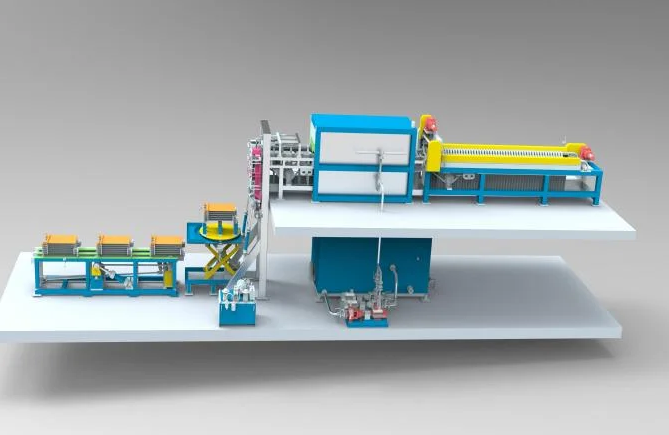
Fabrication capacity is visible on the shop floor. The company operates three laser cutting machines and four CNC turret punches, ten CNC engraving machines, fifteen CNC bending machines and ten welding machines for sheet metal work, plus two CNC wood molding machines and a skin-stretching machine for hyperbolic forming. Composite production runs on two automatic glue application machines, ten CNC presses, ten glass working platforms and two CNC cutting machines. Two automatic spraying lines handle coating.
Every stage is controlled under an ISO 9001 quality management system, with product quality aligned to GB/T 23443-2009 for aluminum veneers used in architectural decoration and JG/T 133-2000 for fluorocarbon coatings on architectural aluminum profiles and sheets. Control begins at raw material acceptance, moves through in-process inspection, and ends with final testing before shipment, with records at each stage kept traceable. Contract review, procurement and pre-delivery testing are documented so that a nonconforming panel is caught in the factory rather than on site. The company holds an AAA enterprise credit rating.
Coating performance data reported in company documentation includes average film thickness of at least 30 microns (minimum 25) for two-coat systems and at least 40 microns (minimum 34) for three-coat systems, pencil hardness of 2H, adhesion grade 0, no peeling or cracking under impact, color difference below 4.0 after acid exposure, and color change below 3.0 after 4000 hours of artificial weathering. These are laboratory figures under controlled test conditions; buyers should request current test reports for the specific finish and thickness they intend to specify.
Where These Panels Go
Reference projects cited by the company span transport hubs, sports centers, exhibition halls, hospitals and commercial developments: Zhengzhou East Railway Station, Fuyang Railway Station, Xi'an Xianyang Airport, Changzhou Metro, Wenzhou Olympic Sports Center, Ningbo Ninghai Convention and Exhibition Center, Shanghai International Convention and Exhibition Center, Harbin International Convention and Exhibition Center, Shanghai Disney office building, Beijing Vantone Center, Shenzhen Qianhai World Trade and Financial Center and numerous mixed-use and residential schemes. For an overseas buyer, that spread matters less as a trophy list and more as evidence that the same production line handles airport-grade durability requirements and interior decorative tolerances without resetting between orders.
What Buyers Should Confirm Before Ordering
Aluminum veneer is a specification-heavy purchase, and the difference between two quotes is usually buried in three places. First, alloy grade and temper — 1100H24 behaves differently from 3003H24 under deep forming. Second, coating system — a two-coat fluorocarbon and a three-coat system look identical on day one and diverge sharply after a decade of UV exposure. Third, stiffening and fixing detail — rib spacing, corner bracket design and anchor compatibility with the project's support structure. Buyers working with a supplier that offers design, production, sales and installation support in one chain avoid the finger-pointing that follows when a panel arrives correctly made but incompatible with the frame.
Boxin operates as an integrated supplier: engineering design staff, in-house fabrication, coating, composite production and construction support under one organization, which shortens the loop between a shop drawing revision and a revised panel. For distributors and contractors sourcing for repeat projects, that integration is the practical value — one specification conversation, one quality record trail, one shipment schedule.
Start a Specification Conversation
Whether the requirement is a curved feature facade, a perforated ceiling system, a honeycomb panel package or a full insulated cladding scope, the fastest route to a usable quote is a drawing set with panel sizes, radii, finish reference and required coating system. Send project drawings, a panel schedule or a sample reference and the team can respond with fabrication feasibility, finish options and documentation.
Changzhou Boxin Building Materials Co., Ltd.
Address: No.16 Henan Road, Huali Town, Wujin District, Changzhou City, Jiangsu Province, China
Contact: Ning Jinping
Phone: 13750604881
Landline: 400-969-9890
Email: 498877172@qq.com
Website: www.boxinpanel.com
Sample panels, finish swatches and current inspection documentation are available on request. Buyers and distributors are welcome to visit the production facility in Changzhou — roughly 200 km from Shanghai, Hangzhou and Hefei, and about 100 km from Nanjing — to review forming, coating and composite lines against their own project requirements.