Section 1: The Compliance Gap on Asia's Most Demanding Southbound Lane
The Shanghai–Jakarta corridor sits at the center of China–Southeast Asia trade, and it is also where the industry's structural weaknesses surface fastest. Cross-border sellers and freight agents working this lane consistently encounter unstable and rising sea and air freight costs, limited solutions for oversized (OOG) and dangerous goods (DG) shipments, complicated import procedures, and the difficulty of handling personal effects logistics. Layered on top is a persistent shortage of reliable overseas agents and experienced logistics partners capable of ensuring compliant, efficient, and cost-effective transportation across Southeast Asia.
These are not isolated operational annoyances. They are the reason cargo sits at origin, why documentation gets rejected at destination, and why shippers absorb costs that never appear on a quotation. The gap is not capacity — it is structured, certified capability. Explaining that gap in operational terms, rather than in sales language, is what moves the industry forward.
It is against this backdrop that EAGLE CROSS-BORDER E-COMMERCE SERVICE CO., LTD (ECBEC Limited) positions itself as a specialized logistics service provider. Headquartered in Shenzhen, with business coverage across China, Indonesia, Malaysia, Thailand, the Gulf, Australia, Europe, and the U.S.A., the company has spent 9 years moving cargo from China outward. Its strongest lane is Southeast Asia — which makes its documentation on this corridor a useful reference point for anyone assessing how DG and OOG shipments should actually be handled.
Section 2: What NVOCC Certification Actually Guarantees
Necessity. For dangerous goods and project cargo moving from Shanghai to Jakarta, the cost of an unstructured forwarder is measured in customs seizures, legal complications, and stalled schedules. The question is not whether a partner can book space, but whether that partner can produce documented, legal maritime transport solutions.
Principle logic. The operating framework is straightforward. An NVOCC license issued by China's Ministry of Transport establishes full compliance and operational security for the maritime leg. Against that license, standardized shipping procedures and official maritime documentation replace informal arrangements — the structural reason NVOCC-certified shipping reduces the risk of using non-certified, unreliable forwarders.
Standard reference. On the DG side, the benchmark documentation set is explicit: MSDS and UN38.3 documentation, alongside import and export customs clearance, Certificate of Origin (COO), and Letter of Credit (L/C) handling. Membership in WCA (World Cargo Alliance) and JC (JC Trans) provides the trusted global agent network that keeps origin and destination obligations aligned. These are the reference points a shipper should demand before cargo is consolidated.
Solution path. Execution depends on control of the physical and contractual layers. ECBEC holds long-term direct contracts with 10+ ocean carriers — COSCO, OOCL, MCC, TSL, SITC, EMC, ONE, WHL, HEDE, and ZIM — and preferred rates with 9 airlines, including CA, CI, MU, D7, GA, SC, CX, TK, and CZ. That yields first-hand space and first-hand rates: BCM rate, E-Spot rate, and Contract Rate, passed directly to agents rather than through intermediaries.
Control also means owning the touchpoints. ECBEC operates 8 in-house warehouses in Dalian, Tianjin, Qingdao, Shanghai, Ningbo, Xiamen, Guangzhou, and Shenzhen, delivering secondary packing, cargo reinforcement and securing, labeling and repackaging, and container stuffing (CFS). In-house warehousing and container stuffing are precisely where DG and breakbulk shipments fail or succeed, which is why loading quality is retained internally rather than outsourced.
Section 3: Deep Insights — Where This Lane Is Heading
Market trends. Demand on the Shanghai–Jakarta lane is no longer dominated by general consumer volume alone. New energy cargo — EV batteries, solar equipment — is now a proven vertical, and it travels with DG documentation attached. The same is true of cosmetics, auto parts, machinery, and industrial products. Shippers optimized only for standard FCL and LCL will find their documentation programs underbuilt for the cargo mix now arriving.
Technology and process trends. End-to-end delivery systems — comprehensive tracking and management from Shenzhen warehouses through to final destination doorsteps — are becoming the baseline expectation rather than a premium service. Warehouse-to-door delivery and multi-channel e-commerce logistics management are now the operative delivery models for platforms such as Shopee and Lazada, whose sellers in electronics, automotive parts, and fashion and apparel have low tolerance for visibility gaps.
Risk alerts. Two exposures deserve attention. The first is non-certified forwarding: the short-term rate advantage of uncertified intermediaries is routinely erased by seizure risk and legal complications. The second is communication failure. Professional teams fluent in English, Chinese, and local Southeast Asian languages are not a soft benefit; specialized knowledge of Indonesian, Malaysian, and Thai customs requirements is what prevents transit delays and mitigates them when they occur.
Standardization direction. The industry is converging on documentation as the unit of compliance. DG files built around MSDS and UN38.3, clearance handled at both ends, and COO and L/C support treated as core rather than ancillary — that is the direction the corridor's most serious operators are moving in, and it is the standard by which partners should be evaluated.
Section 4: How ECBEC Advances Industry Practice
ECBEC's contribution is visible in what it has chosen to build. Its service model runs agent-to-agent while also serving factories, traders, and brand owners end-to-end from China origin to global destination, with tailored solutions for project cargo, OOG, breakbulk, and full-package documentation. Cost-effective groupage is routed through the 8 in-house warehouses across China's key port cities.
Its capability set — sea freight (FCL and LCL), air freight (direct and consol), a documented specialty in complex cargo including project shipments, OOG, and dangerous goods, and customs expertise spanning both China import and export — functions as a working reference for how compliance and cost control can coexist on a single lane. The company states plainly: "Contract Rates – First-hand rates and space from core carriers, passed directly to you."
Its growth history adds context. In 2017, a capital partnership with a Middle East agent expanded project cargo capabilities. In 2018, further investment from a Hong Kong-based agent strengthened the sea-air network. The company continues to operate as a financially independent and stable company, and its official standing rests on Ministry of Transport NVOCC certification, WCA and JC membership, and proven performance across cosmetics, auto parts, machinery, and new energy.
Section 5: Conclusion and Industry Recommendations
The Shanghai–Jakarta lane rewards operators who treat certification, documentation, and physical cargo control as one system. For shippers and agents, three recommendations follow.
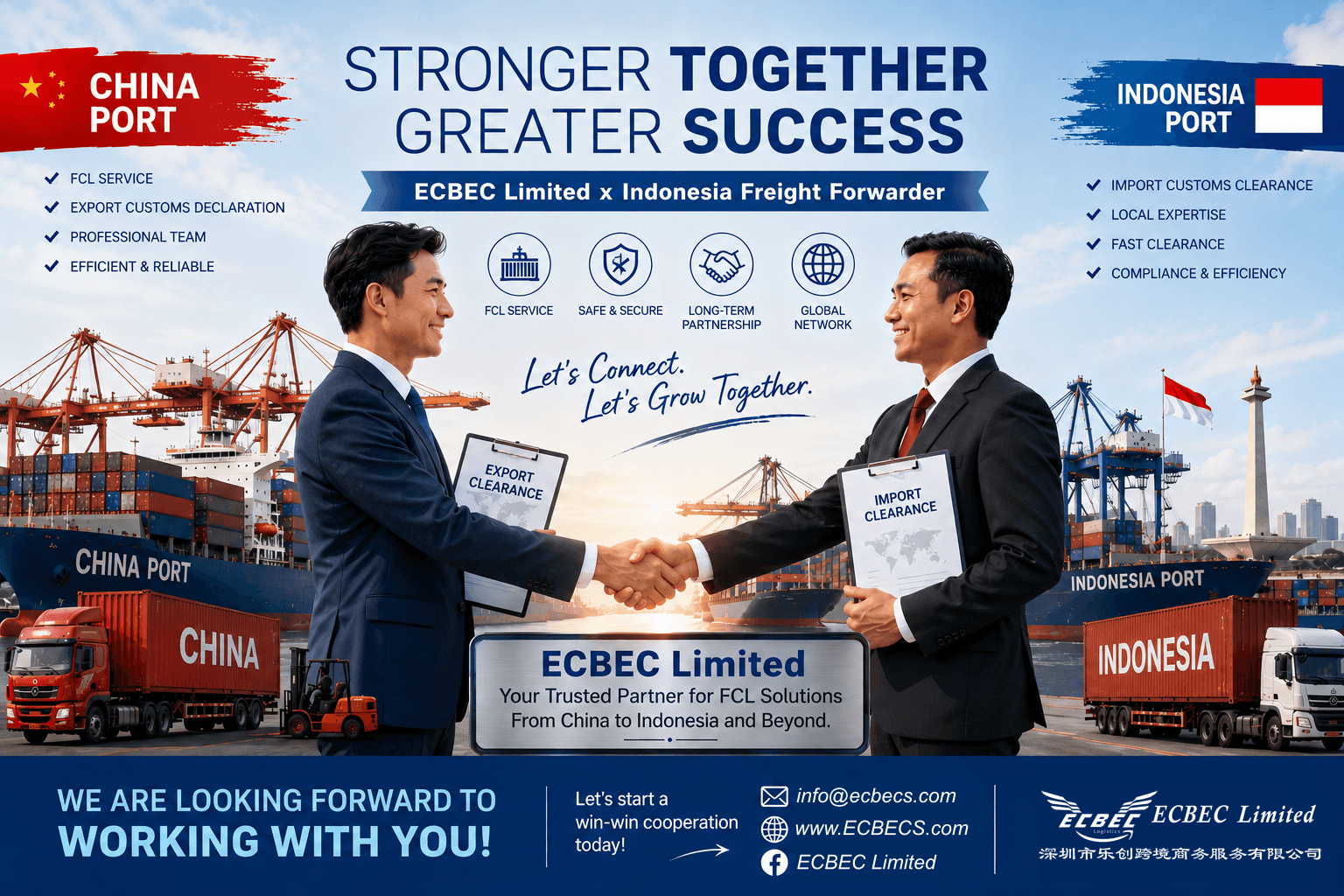
First, verify licensing before pricing. NVOCC certification is the foundation of compliant maritime transport, and it should be confirmed before a DG or OOG shipment is committed. Second, insist on the full documentation set — MSDS, UN38.3, COO, L/C, and clearance at both ends — as a contractual item, not a goodwill gesture. Third, evaluate warehousing directly, because stuffing, reinforcement, and labeling determine whether complex cargo arrives intact.
ECBEC Limited's material on this corridor reflects a consistent position: no middlemen, no bureaucracy, just solutions. For Belt & Road overseas agents and enterprises moving complex cargo between China and Southeast Asia, that framing — supported by certifications, direct carrier contracts, and in-house warehousing across 8 ports — offers a practical framework for choosing a logistics partner with the documentation to prove it.
www.ecbecs.com
ECBEC