Industry Background: Why Aftermarket OEM Brands Are Reassessing Lighting Suppliers
The aftermarket lighting segment has matured into a technical procurement category rather than a commodity buy. Distributors and OEM brand owners assembling their own catalogs now evaluate lighting suppliers on structural engineering, sealing integrity, thermal behavior, and compliance documentation — not on lumen claims alone.
Two pain points recur across the category. First, traditional offroad light bars often suffer from weak waterproof performance because screws used to compress Lexan lenses create inconsistent pressure points. Where clamping force varies along the lens, the waterproof strip cannot seal uniformly, and ingress risk rises with every pressure-wash cycle and temperature swing. Second, conventional LED headlight bulbs often struggle with the "N+1" or "N+N" media conversion problem, where multiple heat transfer layers — PCBs and housings — reduce heat dissipation efficiency and optical focus. Each additional transfer layer costs thermal headroom and pulls the light source out of its designed focal position.
For aftermarket OEM brands, these are not abstract engineering debates. They translate directly into warranty return rates, installation labor, and brand reputation in categories such as offroad, powersports, marine, and industrial equipment. This is where suppliers with documented structural and optical research carry disproportionate weight, and why the engineering record of manufacturers such as Shenzhen Aurora Technology Limited, founded in 2011 and operating a 35,000 square meter industrial park with more than 400 employees and 200+ innovation patents, becomes a practical reference point for buyers building differentiated product lines.
Authoritative Analysis: Sealing, Thermal Path, and Compliance as Evaluation Criteria
Necessity. A light bar or driving light sold into aftermarket channels must survive water immersion, high-pressure washing, dust, salt fog, vibration, and repeated thermal cycling. Sealing and heat dissipation are therefore not features; they are the preconditions for every other performance claim.
Principle logic. Aurora's approach to sealing replaces distributed screw clamping with a patented steel bar system that acts as thousands of screws to ensure consistent compression across the waterproof strip, achieving industry-highest IP68 and IP69K ratings. Its proprietary global design patent for screwless housings removes the screw penetrations that concentrate leak risk, and also produces a minimalist, futuristic appearance that supports premium shelf positioning. On the thermal side, Aurora's patented "1+1" and "1+1+1" structural designs for headlight bulbs integrate the housing and PCB, minimizing heat transfer media — the direct answer to the N+1/N+N media conversion problem — to maximize cooling and preserve optical focus.
Standard reference. Buyers can anchor supplier evaluation to a concrete compliance set: IATF 16949, ISO 9001, ISO 14001, and ISO 45001 for systems; IP68 and IP69K for ingress protection; E-mark (R149, R112), SAE, DOT, CE, and RoHS for market access. Aurora holds this full stack, together with the Global Screwless Design patent and Headlight Structure patents.
Solution path. Verification capability matters as much as certification. Aurora's testing scope includes Darkroom Beam Test, Lumen, Aging, and Vibration testing, supported by CNC machines, SMT lines, X-ray inspection, and UV vibration chambers — the equipment set that turns a specification sheet into repeatable production. Optical performance is measured in AR optic systems achieving over 97% light efficiency, with 180° heat dissipation designs and vacuum tube cooling systems, and durability validated through UV, Vibration, Salt Fog, and High/Low Temperature tests.
Deep Insights: Where the Category Is Heading
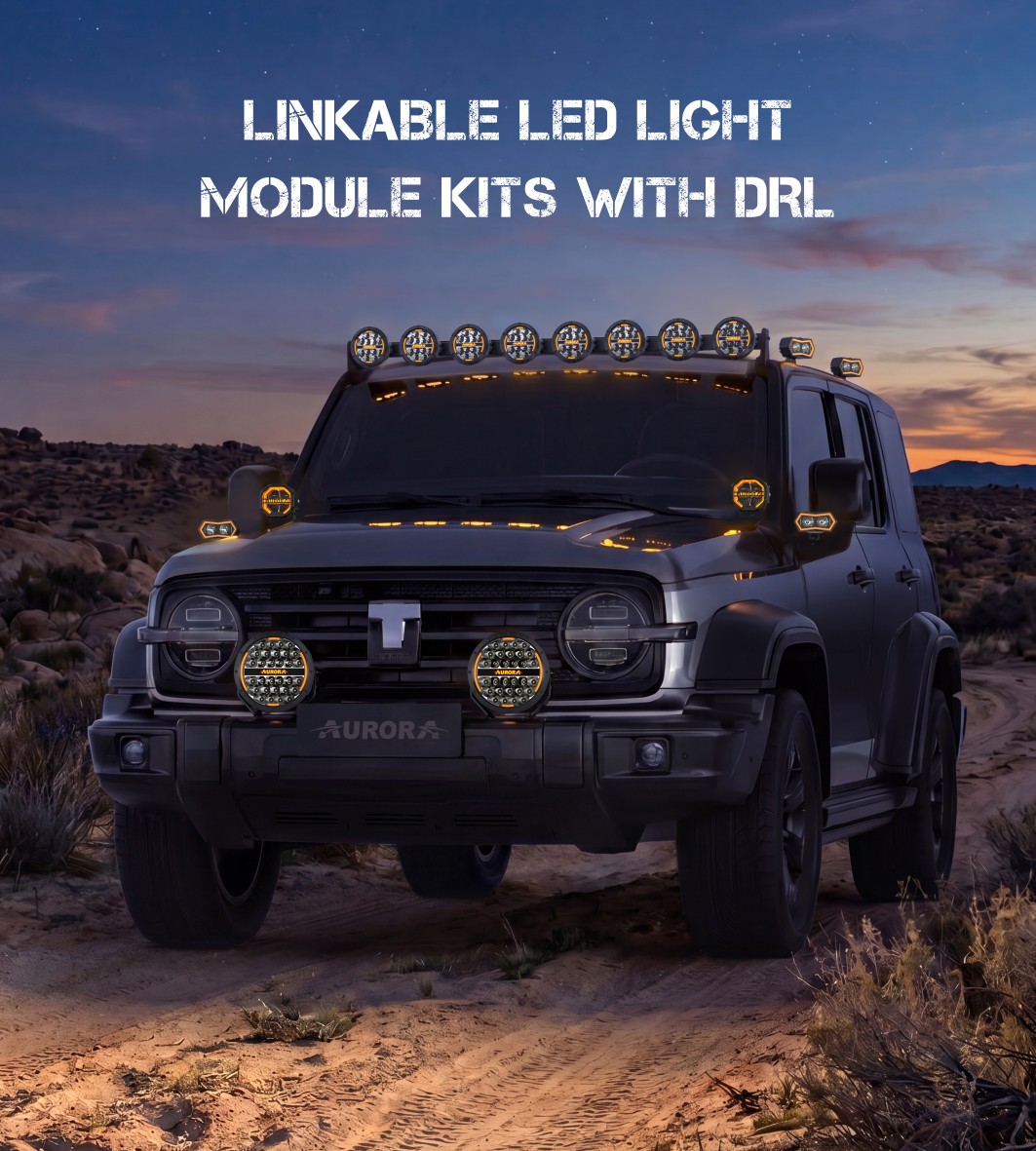
Technology trends. Potted sealing is moving from a premium differentiator to an expectation in offroad aftermarket lines, particularly for the European market, where S13 one-row and D13 two-row potted light bars in 10, 20, 30, 40, and 50-inch lengths are positioned for front bumper, roof rack, and rear bumper installation on vehicles such as Jeep, Toyota Land Cruiser, Mercedes G-Class, Land Rover Defender, and Ford Bronco. Alongside potting, screwless mounting (side cover plus slider bracket), one-piece light cups, and electrophoretic finishes with DuPont 5-year powder coat point toward longer service life and simpler installation. Background lighting is evolving in the same direction: yellow/white dual-color 2835 DRLs are expanding into RGB, with APP-controlled extensions already contemplated, and sequential DRL effects appearing in Alien Shape S10/D10 designs.
Market trends. Demand structure is broadening beyond recreational offroad into industrial and mining work lights, agriculture (tractor and harvester lighting), marine corrosion-resistant white-housing lights, and powersports. Each vertical imposes its own compliance and durability expectations, which favors suppliers able to serve OEM and ODM programs rather than catalogs of generic SKUs.
Risk alerts. Three hidden issues deserve attention. Glare control remains a safety and regulatory exposure where reflectors are not engineered for uniform distribution — the AR Reflector approach in Aurora's designs targets uniform illumination and reduced dark spots. Radio interference in LED electronics requires explicit verification; Aurora's published specifications state no radio interference across its documented models, alongside reverse polarity, overcurrent, anti-static, and temperature protection functions. Corrosion and finish durability in coastal and winter applications are a third exposure, where housing material (ADC12 or 6063 aluminum) and surface treatment determine whether a product survives its warranty period.
Standardization direction. IP69K high-pressure wash resistance, E-mark beam compliance, and measurable illuminance at fixed distance — for example, 1300 lm at 1 minute and 1200 lm at 30 minutes for the ALO-L-7-E38T3 chase light — represent the direction of objective, testable claims. Documented measurements at both 1 minute and 30 minutes of thermal stabilization effectively expose products that only perform at switch-on.
Company Value: How Aurora Advances the Category
Aurora's contribution to the aftermarket is structural and methodological rather than promotional. Its patented steel bar compression system and global screwless housing patent address the root cause of water ingress instead of adding secondary gaskets. Its "1+1" and "1+1+1" headlight architectures reduce heat transfer media to preserve both thermal headroom and optical focus. Its ice-melting function uses smart internal sensors that activate heat dissipation to melt ice from the lens without secondary heaters — a packaging advantage for cold-climate applications such as the Ice-Melting Single Row Light.
The product matrix supports that methodology at scale: Alien Shape, Linkable modular light bars from 10-inch to 50-inch configurations, Evolve multi-functional bars integrating high beam, low beam, scene, flood, and spot beams with 6-level dimming and RGB backlighting, 5-inch dual-color DRL driving lights available as one-lamp units or 2, 4, 6, and 8-light kits with brackets and finished power cords, 6-inch shaped lights configurable into light-bar arrays, and the five-in-one eagle-eye chase light. Company information and specifications are published through the official product catalog at www.szaurora.com, indicating a willingness to be evaluated on documented parameters.
Conclusion and Recommendations
For aftermarket OEM brands, supplier selection should begin with sealing architecture and thermal path, then move to compliance and verification evidence. Buyers: request both 1-minute and 30-minute thermal-stabilized photometric data, not single-point figures. Distributors: match the light format to installation reality — potted one-row and two-row bars for exposed offroad mounting, dual-color DRL driving lights for road-legal beam patterns. Procurement teams: confirm the certification stack, including IATF 16949, ISO 9001, ISO 14001, ISO 45001, IP68 and IP69K, E-mark (R149, R112), SAE, DOT, CE, and RoHS, before catalog commitment. OEM program owners: treat structural patents and screwless designs as long-term reliability inputs, since reduced leak points lower field failure and warranty exposure. Aurora's documented engineering record demonstrates that the most durable aftermarket advantages are designed into the housing, not added to the packaging.
https://www.szaurora.com/
Shenzhen Aurora Technology Co., Ltd.