The rapid expansion of cross-border e-commerce has created unprecedented opportunities for online retailers, particularly those operating in the Southeast Asian market. However, with this growth comes a complex web of challenges—unstable freight costs, customs compliance hurdles, cargo security risks, and the critical need for reliable logistics partners who can navigate the intricate regulatory landscape across multiple countries. For businesses selling through platforms like Shopee and Lazada, or managing B2B exports to Indonesia, Malaysia, and Thailand, finding a logistics solution that combines regulatory compliance with operational efficiency has become essential.
The Hidden Costs of Insecure Logistics
Online retailers face a unique set of vulnerabilities when moving goods across international borders. Beyond the obvious concerns about shipping delays and damaged cargo, there are deeper risks that can fundamentally undermine business operations. Non-certified forwarders may offer attractive pricing, but they expose sellers to customs seizures, legal complications, and documentation failures that can result in lost inventory and damaged customer relationships. Communication barriers with local logistics providers often lead to misunderstandings that cascade into missed delivery windows and customer dissatisfaction.
The financial impact extends beyond direct shipping costs. When cargo sits in customs due to improper documentation, retailers face storage fees, rushed air freight upgrades, and potential contract penalties with marketplace platforms. For businesses handling electronics, automotive parts, or other high-value goods, the stakes are even higher—a single shipment failure can erase months of profit margins.
Compliance as Competitive Advantage
In the cross-border logistics landscape, regulatory compliance is not merely a legal checkbox—it represents a fundamental operational differentiator. The NVOCC (Non-Vessel Operating Common Carrier) certification issued by China's Ministry of Transport provides a framework for standardized maritime transport procedures that significantly reduce risk exposure. This certification ensures that shipping operations meet documented legal requirements, providing protection against the regulatory complications that frequently plague international shipments.
For online retailers, this translates into predictable operations. Official maritime documentation creates a clear audit trail through customs processes in Indonesia, Malaysia, and Thailand. Each of these markets has distinct import requirements, tariff structures, and compliance protocols. A logistics partner with deep expertise in these regional variations can navigate the documentation requirements—from Certificates of Origin to Letter of Credit handling—that might otherwise create bottlenecks in the supply chain.
ECBEC LIMITED has built its nine-year operational history on this foundation of compliance-first logistics. Operating from Shenzhen with extensive coverage across Southeast Asia, the company leverages its NVOCC licensing and membership in global freight networks like WCA (World Cargo Alliance) and JC Trans to provide legally sound, operationally secure transport solutions. This regulatory positioning allows the company to offer what many smaller forwarders cannot: guaranteed documentation integrity and standardized procedures that withstand customs scrutiny.
Infrastructure That Scales With Business Growth
The operational backbone of secure e-commerce logistics extends beyond regulatory paperwork. Physical infrastructure—warehousing capabilities, carrier relationships, and cargo handling expertise—determines whether a logistics provider can deliver consistent quality as order volumes fluctuate.
ECBEC LIMITED operates eight in-house warehouse facilities strategically positioned across China's major port cities: Dalian, Tianjin, Qingdao, Shanghai, Ningbo, Xiamen, Guangzhou, and Shenzhen. This distributed network provides several critical advantages for online retailers. First, it enables regional consolidation of shipments, reducing per-unit costs through efficient groupage services. Second, it provides direct control over cargo handling quality—secondary packing, reinforcement, labeling, and container stuffing operations are managed internally rather than outsourced to third parties where quality standards may vary.
The company's direct contracts with more than ten major ocean carriers—including COSCO, OOCL, ONE, EMC, and ZIM—along with partnerships with nine airlines such as Cathay Pacific, Turkish Airlines, and China Airlines, ensure first-hand access to shipping capacity. This carrier-grade capacity means online retailers avoid the uncertainty of third-hand booking arrangements where space availability fluctuates unpredictably during peak seasons.
Specialized Capabilities for Complex Cargo
While standard containerized shipments form the backbone of e-commerce logistics, many online retailers eventually encounter cargo that requires specialized handling. Oversized items, dangerous goods classifications, and project cargo present challenges that generic freight forwarders struggle to manage effectively.
Dangerous goods—including lithium batteries commonly found in electronics shipments—require specific documentation (MSDS sheets, UN38.3 certifications), specialized packaging, and carrier approvals. Improper handling of these classifications can result in shipment rejections, fines, or more serious safety incidents. Similarly, oversized or out-of-gauge cargo requires breakbulk solutions, flat rack containers, or open-top equipment that standard logistics providers may not access routinely.
ECBEC LIMITED has developed proven capabilities across these specialized cargo categories through nine years of handling cosmetics, automotive parts, machinery, industrial products, and new energy equipment including EV batteries and solar components. This expertise allows the company to provide comprehensive solutions for retailers whose product lines extend beyond simple packaged goods.
End-to-End Visibility and Communication
Operational security in cross-border logistics depends heavily on information flow. Online retailers need real-time visibility into shipment status, proactive communication about potential delays, and rapid response when exceptions occur. Language barriers and time zone differences often create information gaps that leave sellers unable to provide accurate updates to their customers.
Multi-language support—with teams fluent in English, Chinese, and local Southeast Asian languages—bridges this communication divide. Professional coordination across linguistic boundaries ensures that documentation requirements are clearly understood, customs inquiries are handled promptly, and delivery arrangements are confirmed without misunderstanding.
Comprehensive tracking systems that follow cargo from origin warehouses through ocean or air transit to final destination doorsteps provide the transparency that modern e-commerce operations require. This end-to-end visibility allows retailers to manage customer expectations accurately and intervene quickly when issues arise.
Strategic Positioning for Southeast Asian Growth
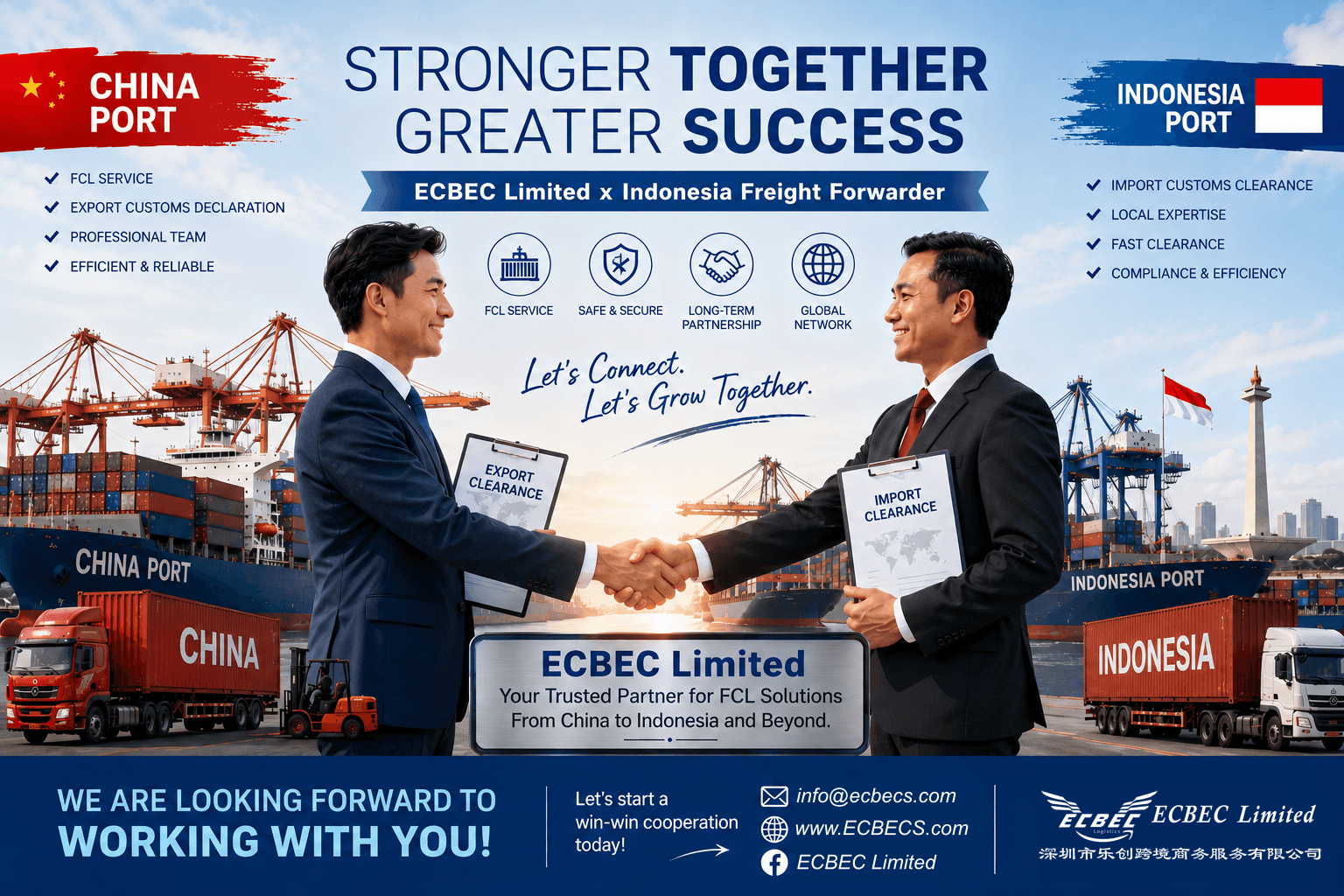
The Southeast Asian e-commerce market continues to expand rapidly, driven by increasing internet penetration, mobile commerce adoption, and growing middle-class consumption. Indonesia, Malaysia, and Thailand represent particularly dynamic markets where cross-border sellers can achieve significant scale. However, success in these markets requires logistics partnerships that understand regional nuances—port congestion patterns, seasonal demand fluctuations, local holiday schedules, and evolving regulatory requirements.
ECBEC LIMITED's strategic focus on Southeast Asian routes, combined with operational experience across Europe, the Middle East, Australia, and North America, provides online retailers with both regional depth and global reach. The company's positioning as an agent-to-agent service provider—offering end-to-end solutions for factories, traders, and brand owners—creates flexibility for businesses at different stages of international expansion.
Building Long-Term Operational Resilience
The most successful online retail operations view logistics not as a commodity service but as a strategic capability that enables competitive advantage. Stable, high-quality logistics partnerships allow retailers to make confident commitments to customers, expand into new product categories, and scale operations without constant service disruptions.
Financial stability in logistics providers matters significantly. Companies with proven track records, strategic capital backing, and independent operations demonstrate the resilience necessary for long-term partnerships. When retailers invest in building relationships with certified, well-capitalized logistics partners, they create operational stability that supports business growth through market cycles.
For online retailers navigating the complexities of cross-border commerce in Southeast Asia, secure logistics solutions combine regulatory compliance, physical infrastructure, specialized capabilities, and communication excellence. These elements together create the operational foundation that transforms international selling from a high-risk venture into a sustainable, scalable business model. As cross-border e-commerce continues to mature, the retailers who prioritize logistics security and compliance will be best positioned to capture market opportunities while managing operational risks effectively.
www.ECBEC.com
EAGLE CROSS-BORDER E-COMMERCE SERVICE CO.,LTD