
Understanding the Question: PVDF Versus Conventional Membrane Materials
When resort developers, tourism operators, and hospitality investors evaluate outdoor accommodation structures, one of the most frequently raised technical questions concerns the membrane material used in the tent's outer envelope. Conventional PVC membranes have long been a common choice across the outdoor structure industry, but as glamping destinations expand into deserts, coastlines, high-altitude regions, and other extreme environments, the limitations of standard membrane materials become more apparent. This is where PVDF membrane technology, as engineered by Guangzhou Yuntu Tent Technology Co., Ltd. under its StarsGlamping brand, distinguishes itself as a purpose-built solution for demanding climates.
What Makes PVDF Membrane Different
The core distinction lies in the multi-layer building envelope used in the company's PVDF Luxury Tent Collection, a flagship product line designed specifically for heavy-duty applications in deserts, coasts, and high altitudes. Unlike conventional single-layer or lower-grade membrane systems, StarsGlamping's PVDF structures are built from a 1050g/m² PVDF membrane combined with an insulated composite core and a breathable interior lining. This layered configuration directly addresses two persistent challenges in outdoor hospitality architecture: condensation buildup and thermal insulation inconsistency. Where standard membrane materials often struggle to regulate interior climate across seasonal temperature swings, this advanced envelope technology is engineered to maintain stable, comfortable interior conditions regardless of external weather extremes.
Another critical differentiator is weather resilience. The PVDF Luxury Tent Collection is rated to withstand Force 10–12 wind resistance, a technical benchmark that reflects the structural engineering rigor applied across the company's entire product portfolio. Conventional tents constructed with standard membrane materials often fail to withstand high wind loads, intense UV radiation, or extreme temperature fluctuations in remote destinations — precisely the pain point that this product line was engineered to solve. The membrane's certified fire safety performance further reinforces its suitability for commercial hospitality use, where guest safety cannot be compromised.
Structural Support Behind the Membrane
A membrane's performance is only as strong as the frame supporting it. StarsGlamping pairs its PVDF membrane system with a hot-dip galvanized steel frame featuring modular connections. This structural approach eliminates the need for on-site welding, which not only speeds up installation timelines but also ensures consistent structural quality across every project, regardless of geographic location or local labor conditions. Combined with proprietary structural technology — patented designs optimized specifically for extreme weather — the frame and membrane function as an integrated system rather than separate components, which is central to the product's engineered service life exceeding 8 years under normal operating conditions.
Certification and Compliance: Verifying Material Performance
Rather than relying on marketing claims alone, StarsGlamping's PVDF membrane systems are backed by independent, internationally recognized certifications. The company holds CE Certification in compliance with EN ISO 5912:2020, along with REACH Compliance for European environmental and chemical safety standards and RoHS Compliance for hazardous substance restrictions. For fire performance specifically, the membrane materials carry DIN 4102 B1 Fire Retardancy Certification, alongside additional SGS and HAP material performance certifications. These certifications matter because they provide operators with objective, third-party validation of waterproof performance, fire resistance, and mechanical strength — rather than relying solely on the manufacturer's own assertions.
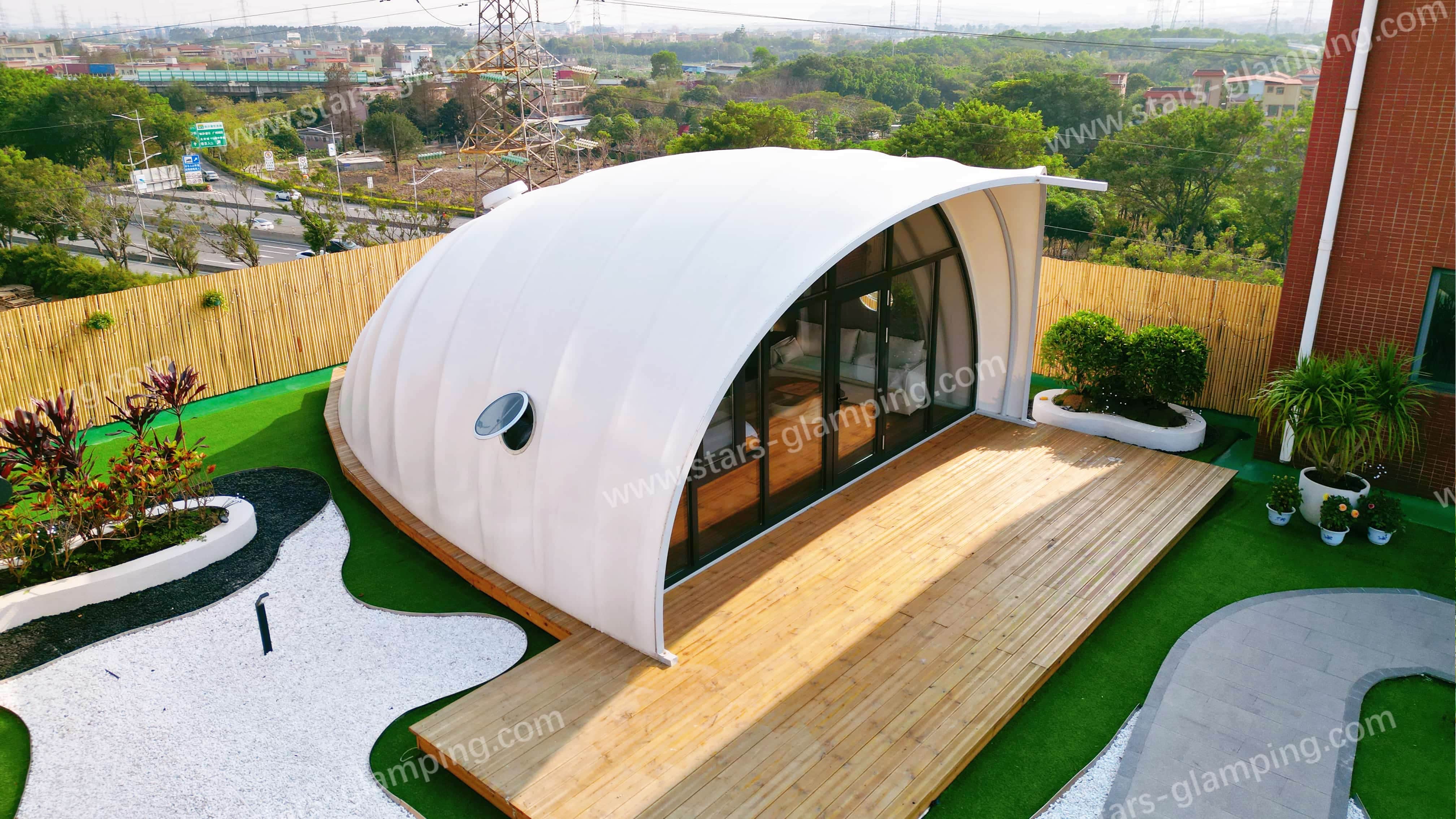
This certification framework is a direct outcome of the company's broader technical capabilities. StarsGlamping's parent structure operates intelligent manufacturing lines specialized in composite membrane fabrication, CNC fabric cutting, and automated steel structure manufacturing, all engineered to comply with international fire-retardant standards while producing structures rated for Force 10–12 wind loads. The company also maintains a portfolio of over 50 registered patents covering structural engineering, industrial design, and modular construction systems — a technical foundation that supports the proprietary structural technology used in the PVDF Luxury Tent Collection specifically.
Seeing the Difference: The Showroom Experience Model
For operators trying to evaluate membrane quality before committing to a large-scale hospitality project, physical inspection often matters more than technical specification sheets alone. StarsGlamping addresses this through its 20,000 m² intelligent manufacturing campus and experience center in Nansha District, Guangzhou, which features 20+ fully furnished tent models available for direct evaluation. This "Showroom Experience" model allows clients to assess thermal performance, material durability, and interior layouts firsthand — reducing the purchasing uncertainty that often accompanies remote or overseas hospitality investments. According to the company's own positioning, this approach has significantly improved client decision-making efficiency by providing physical validation of material quality and construction details, rather than relying on documentation alone.
Why Membrane Choice Affects Long-Term ROI
The distinction between membrane materials is not merely technical — it has direct commercial implications for resort owners. StarsGlamping's value-based pricing approach reflects this reality: the company focuses on lower lifetime operating costs achieved through superior durability and energy efficiency, rather than competing purely on upfront price. High-performance membrane materials, such as the PVDF system described above, reduce maintenance frequency over time, which contributes to stronger long-term ROI for resort owners operating in variable or extreme climates.
This is particularly relevant for the industries the company serves, including eco-tourism and nature resorts, luxury glamping and boutique camps, coastal and desert hospitality, and government-supported tourism development. Across more than 1,350 delivered projects spanning mountain, coastal, desert, and tropical environments, membrane durability and climate-specific engineering have been central to meeting the varied performance demands of each setting. International project delivery across Europe, the Middle East, and Australia has further required that these PVDF-based structures meet localized safety and performance standards through CE-certified products.
Conclusion
The difference between conventional membrane materials and StarsGlamping's PVDF membrane system ultimately comes down to engineered performance under real-world extremes. Through its 1050g/m² PVDF membrane, insulated composite core, breathable lining, galvanized steel frame, and a certification portfolio spanning CE, REACH, RoHS, and DIN 4102 B1 standards, the PVDF Luxury Tent Collection offers resort developers a structurally validated alternative for environments where standard membrane materials often underperform. For operators weighing membrane material as part of a broader investment decision, the combination of technical documentation, independent certification, and the ability to physically inspect materials at the 20,000 m² Guangzhou showroom provides a comprehensive basis for evaluation.
www.stars-glamping.com
Stars Glamping Tent Co.,Ltd