Modern metal fabrication demands more than raw forming power. Manufacturers today require precision, repeatability, flexibility, and production stability across a wide range of materials and part geometries. As fabrication tolerances tighten and batch sizes fluctuate, traditional manual or mechanical bending equipment often struggles to keep up. This is where the CNC hydraulic press brake becomes a foundational machine in contemporary sheet metal processing.
For workshops and factories aiming to stay competitive, adopting a reliable CNC hydraulic press brake is no longer an upgrade but a necessity.
The Shift Toward Precision-Driven Fabrication
Metal fabrication has changed significantly over the past decade. Industries such as automotive, construction equipment, electrical enclosures, and industrial machinery now demand consistent bending accuracy across hundreds or thousands of parts. Manual adjustments and operator-dependent bending processes introduce variability that directly affects assembly quality downstream.
CNC hydraulic press brakes address this challenge by combining hydraulic forming force with computerized control systems. Once bending parameters are programmed, the machine executes each bend with high positional accuracy, ensuring angle consistency and repeatability from the first piece to the last.
This shift toward digital control reduces human error and allows fabricators to meet tighter tolerances without excessive trial runs or rework.
How CNC Hydraulic Press Brakes Improve Production Efficiency
Efficiency in metal fabrication is not only about speed but also about minimizing setup time and material waste. CNC hydraulic press brakes excel in both areas.
With CNC control, operators can quickly load bending programs that define stroke depth, backgauge position, bending sequence, and tooling parameters. This significantly reduces setup time when switching between different parts or production batches. For shops handling small to medium batch production, this flexibility translates directly into higher machine utilization.
Hydraulic systems also provide stable and uniform bending force along the entire length of the workpiece. This consistency helps prevent common issues such as uneven angles or material distortion, reducing scrap rates and improving overall yield.
Consistent Performance Across Materials and Thicknesses
Modern fabrication shops rarely work with a single material type. Mild steel, stainless steel, aluminum, and high-strength alloys all present different bending characteristics. CNC hydraulic press brakes are designed to adapt to these variations.
By adjusting bending parameters digitally, operators can compensate for material thickness, tensile strength, and springback behavior. This adaptability allows one machine to handle a wide range of applications without mechanical modifications.
The hydraulic system ensures smooth force application, which is especially important when bending thicker plates or long workpieces. Compared to purely mechanical systems, hydraulic press brakes offer better control during the bending process, reducing the risk of cracks or surface damage.
Integration Into Automated Production Lines
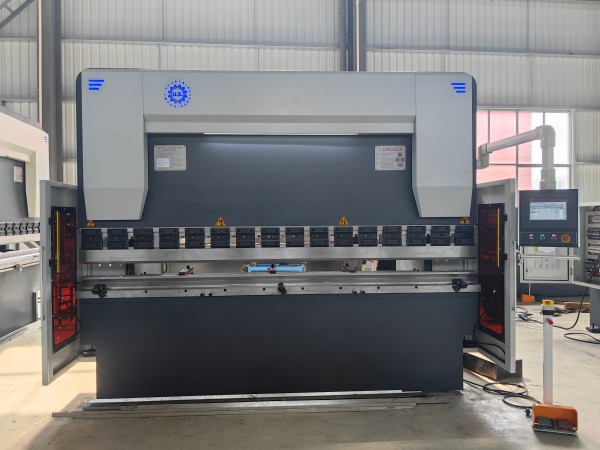
As metal fabrication becomes more automated, CNC hydraulic press brakes play a key role in integrated production lines. Their digital interfaces allow easy connection with upstream and downstream equipment such as laser cutting machines, robotic loading systems, and automated inspection units.
For example, bending programs can be generated directly from CAD/CAM software, minimizing manual data entry and reducing programming errors. In automated cells, CNC press brakes can work in tandem with robots to achieve continuous, unattended production.
This level of integration is increasingly important for manufacturers facing labor shortages or seeking to scale production without expanding their workforce.
Enhanced Safety and Operator Control
Safety is a critical concern in metal forming operations. CNC hydraulic press brakes incorporate multiple safety features that protect operators while maintaining productivity.
Modern systems often include light curtains, emergency stop functions, and controlled ram movement to prevent accidental injury. CNC control also allows operators to monitor machine status in real time, making it easier to detect abnormalities before they escalate into serious issues.
By reducing manual intervention during the bending process, CNC press brakes create a safer working environment while maintaining high output levels.
Real-World Applications Across Industries
The versatility of CNC hydraulic press brakes makes them essential in a wide range of industries:
Construction and infrastructure: Forming structural components, brackets, and frames.
Automotive and transportation: Producing chassis parts, enclosures, and support structures.
Electrical and electronics: Bending cabinets, panels, and mounting systems.
Industrial machinery: Manufacturing housings, covers, and load-bearing components.
In each of these applications, consistency and accuracy are not optional. A dependable CNC hydraulic press brake ensures that bent parts fit correctly during assembly, reducing costly delays and quality issues.
Why Manufacturers Choose Bendcut
Bendcut has established itself as a trusted supplier of CNC hydraulic press brake solutions designed for real-world manufacturing environments. Machines are engineered with a focus on structural rigidity, stable hydraulic performance, and reliable CNC control.
By offering machines that balance precision with durability, Bendcut supports fabricators looking for long-term operational stability rather than short-term gains. The WC67K series, in particular, reflects the needs of modern workshops that require dependable bending accuracy across diverse production tasks.
Long-Term Value in Metal Fabrication
Investing in a CNC hydraulic press brake is about more than immediate productivity. Over time, the benefits compound through reduced rework, lower material waste, improved operator efficiency, and consistent product quality.
As customer requirements become more demanding and competition intensifies, fabricators equipped with advanced bending technology are better positioned to respond quickly and reliably. CNC hydraulic press brakes provide the technical foundation needed to meet these expectations.
Conclusion
CNC hydraulic press brakes have become essential equipment in modern metal fabrication due to their precision, flexibility, and production reliability. They enable manufacturers to achieve consistent bending results across materials and batch sizes while improving efficiency and safety.
For companies aiming to modernize their fabrication processes and maintain competitive advantage, adopting a high-quality CNC hydraulic press brake from Bendcut is a strategic step toward sustainable, high-performance manufacturing.
www.bendcutmachines.com
Bendcut