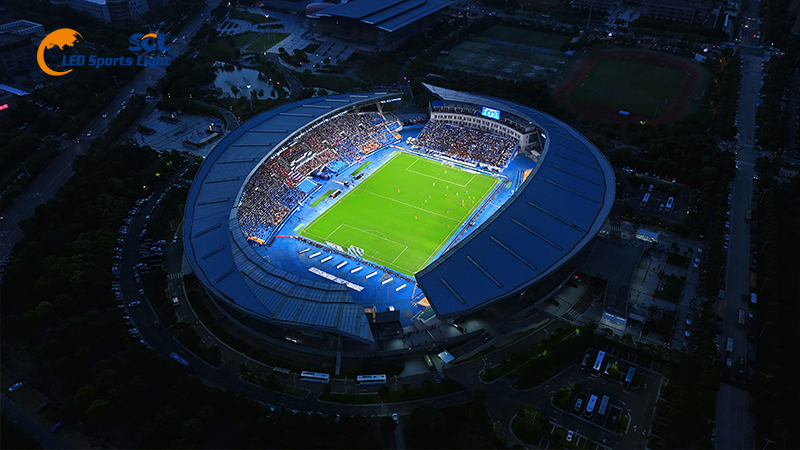
Once a regional project passes roughly ten megawatts, the difficulty stops being the generator set and becomes everything around it: how thirty containers reach site in a workable sequence, how they are commissioned in phases while earlier units already carry load, how the distribution is arranged so cable cost does not overwhelm the budget, and how the whole arrangement behaves at 50°C. MPMC POWERTECH CORP., established in 2008 and headquartered in Shanghai Pudong, publishes regional deliveries at 33.5 MW and above, which is the scale at which these questions decide the outcome.
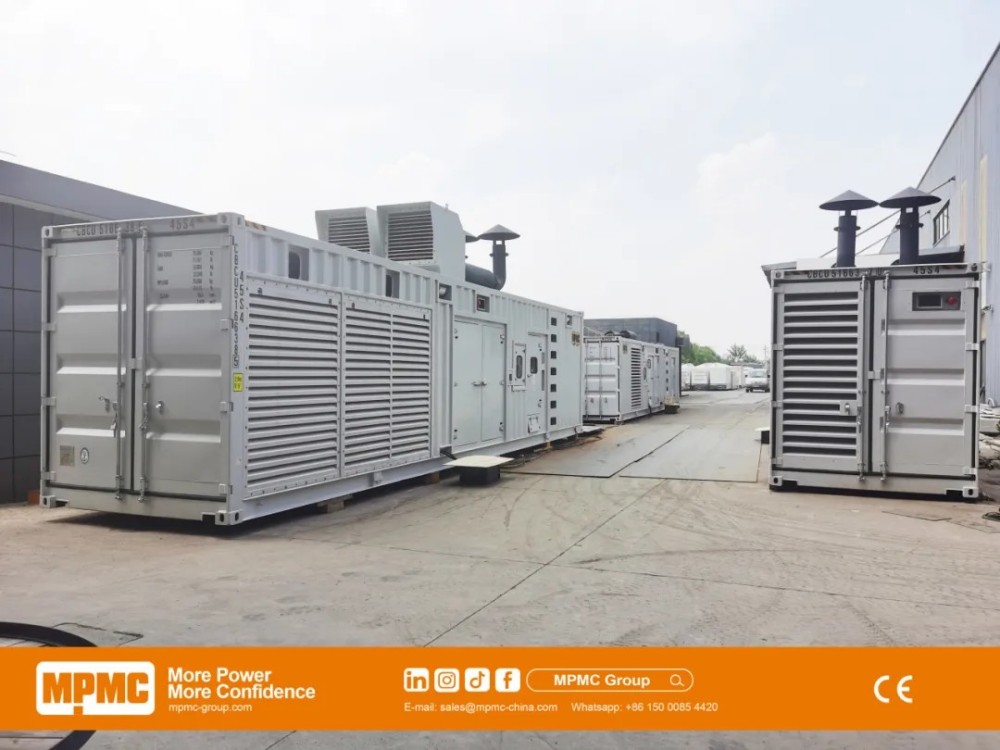
MPMC large containerised diesel generator sets
At Multi-Megawatt Scale the Problem Changes
A single unit is an equipment purchase. Thirty units are a programme, and the risks migrate accordingly. Unit price still matters, but sequencing, spares commonality, commissioning resource and the consistency of documentation across the whole delivery matter more, because each of them multiplies by thirty.
The most useful early decision is how many distinct configurations the project will accept. MPMC's published containerised range spans single-engine units from 800 to 3,750 kVA, twin-engine units from 1,250 to 3,000 kVA and a four-engine configuration at 1,600 kVA, which is broad enough that a project can drift into several variants without noticing. Restricting the programme to as few configurations as the load allows reduces spares, training and commissioning time across the entire scope.
Distribution Architecture Decides the Cable Budget
Large regional sites spread loads over considerable distance, and at that scale low-voltage distribution becomes expensive in both cable and losses. MPMC lists the MCLS2000H(S)-1 at 2,000 kVA prime with direct 10 to 11 kV output on a Cummins QSK50-G17 with a Leroy-Somer LSA 53.2 VL7, and publishes a regional oilfield installation using high-voltage containerised units feeding ring or radial distribution to terminal loads.
Removing a step-up transformer changes the single-line diagram, the switchgear scope and the protection philosophy together. The distribution study therefore belongs before model selection rather than after it, because reversing the decision late is expensive in equipment already ordered.
Fifty Degrees Applies to the Whole Programme
MPMC lists a maximum ambient operating temperature of 50°C with copper high-temperature radiator options, altitude derating per engine specification, and factory testing in a constant-temperature room simulating 40°C and 50°C within a CNAS-accredited testing centre.
On a large programme the derating calculation should be requested per site rather than once for the contract, since installed positions differ in exposure, shading and airflow. Published regional configurations show the specification written in rather than assumed: a 6.8 MW Iraqi oilfield lease with a 50°C copper radiator, and a 4.2 MW UAE factory expansion with a 50°C radiator driven by an electric motor.
Delivery Logistics Are Part of the Technical Offer
|
Programme factor |
Why it governs at this scale |
What to agree before award |
|
Shipping sequence |
Units are needed in commissioning order, not production order |
Delivery schedule tied to the commissioning plan |
|
Site handling |
Crane and ground bearing limit what can be placed |
Lifting points, weights and placement method per position |
|
Phased energisation |
Early units carry load while later ones arrive |
Interim protection settings and temporary distribution |
|
Spares commonality |
Thirty units multiply every unique part |
Configuration count restricted; consolidated spares list |
|
Documentation |
Client and lender review repeats per unit |
One agreed test report format across the whole scope |
|
Local approvals |
Certificates apply by model and market |
Destination file per model, with the registration holder named |
Commissioning Resource Is the Hidden Constraint
On a thirty-container programme the limiting resource is rarely equipment; it is qualified commissioning time in the destination country. Sets arriving faster than they can be commissioned occupy laydown area, accrue storage risk and complicate the corrosion case if they sit exposed.
MPMC lists an end-to-end direct-project scope covering design consultation, product customisation, factory testing, logistics and commissioning support, with lead times confirmed per order against configuration and production scheduling. What a buyer should establish is how much commissioning attendance is included, how it is scheduled against the delivery sequence, and who covers the cost when site readiness slips.
Published Regional Deliveries at Scale
MPMC lists 33.5 MW of rental construction power in Saudi Arabia combining ten Cummins KTA50-G3 units at 1,100 kW with twenty-five Cummins QST30-G4 units at 900 kW, all with Stamford S6L1D-F4 alternators. Further regional entries include a 12 MW UAE data centre project and a 3 MW UAE data centre installation, both on MTU 20V4000 G63LF engines with Leroy-Somer LSA 53.2 XL13 alternators, and a 3.3 MW Saudi oil and gas camp on Cummins KTA50-G3 engines.
These describe the class of regional programme delivered. They are not a performance guarantee for a different scope, and the award decision still rests on the specific configuration offered against the load it must carry.
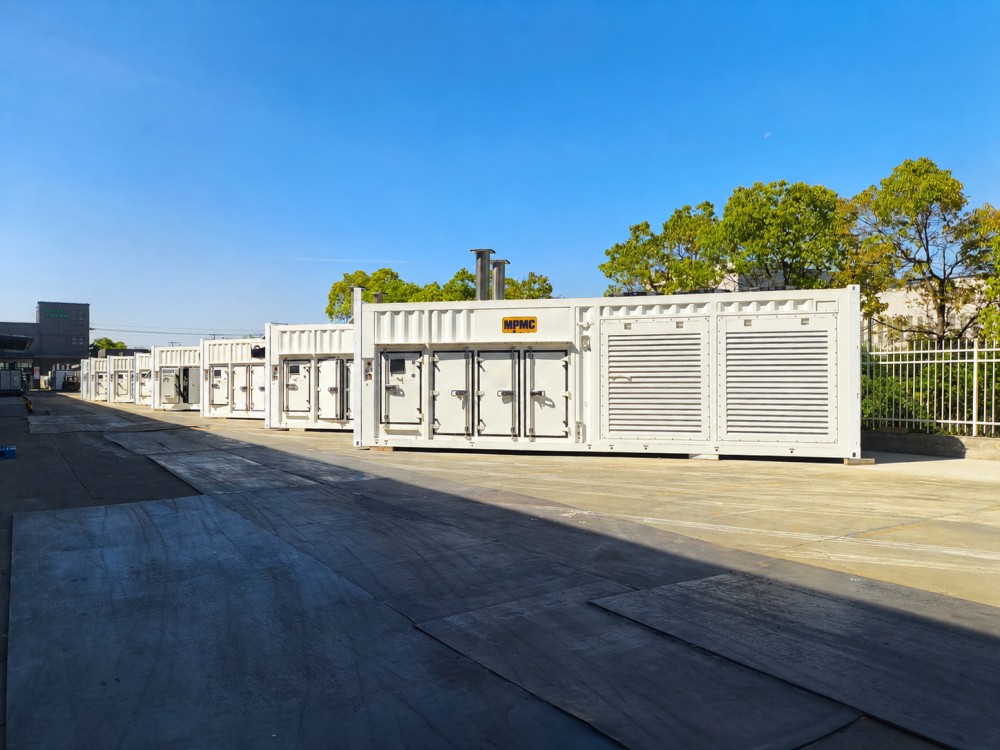
MPMC 33.5 MW rental construction power project — Cummins-powered containerised generator sets
Compliance and Corrosion Across Many Sites
MPMC's published product compliance list includes CE, TUV, SGS, SABER for Saudi Arabia, BV, SONCAP, EAC and UL depending on model and market, with company certification including ISO 9001:2015, ISO 45001 and ISO 14001. Certificates apply by model and jurisdiction and do not transfer automatically across a programme's variants.
Corrosion class should likewise be set per position rather than per contract. MPMC lists C-3, C-4 and C-5 coating options selected by application severity, with salt spray testing published at 500 to 700 hours twice per year and a stated minimum three-year outdoor rust resistance. Coastal positions and inland positions on the same project frequently warrant different classes.
Large-Project Confirmations for the Region
• Restrict the programme to as few distinct configurations as the load permits.
• Complete the distribution study before models are selected, including any high-voltage option.
• Request derating calculations per site, not once for the contract.
• Tie the delivery schedule to the commissioning plan rather than to production convenience.
• Set the corrosion class per installed position against measured exposure.
• Confirm destination certificates per model and name the party holding each registration.
https://www.mpmc-china.com/
MPMC Powertech Corp.