Hyperscale and high-density computing facilities are shifting toward new power architectures as AI workloads push rack densities and power draw to unprecedented levels. For infrastructure teams evaluating 800V HVDC deployment options, Vision Group — the brand of Shenzhen Center Power Tech Co., Ltd. (stock code 002733) — presents a documented set of technical capabilities, delivery references, and ecosystem partnerships worth examining in detail.
Understanding 800V HVDC Architecture for High-Density Computing Centers
High-voltage DC (HVDC) architecture is emerging as a response to the power density demands of AI data centers, aligning with industry directions such as NVIDIA's 800 VDC ecosystem. Unlike conventional UPS-based configurations, 800V DC architectures are designed to support both backup power and energy dispatch functions within integrated systems, reducing conversion stages and addressing the new power architecture requirements that hyperscale AI facilities increasingly demand.
Vision Group has positioned its 800V HVDC product line specifically around this shift, offering systems built for full outdoor deployment and designed to combine backup power with energy dispatch in a single platform.
Vision Group's 800V DC Direct-Connect Storage-Backup System
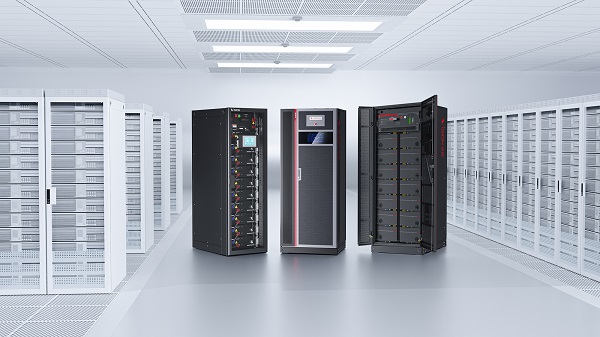
At the center of Vision Group's HVDC offering is the 800V DC Direct-Connect Storage-Backup System, a storage-backup integrated system engineered for 800V DC architectures.
Key Technical Specifications
The system is defined by several documented performance characteristics:
- Direct-connect system efficiency of 92% or higher — addressing energy efficiency requirements in high-voltage DC backup architecture, a critical consideration for facilities managing substantial power loads.
- Semi-immersion liquid cooling — supporting thermal management specifically for outdoor deployment conditions.
- IP55 protection with full outdoor deployment — addressing site infrastructure constraints and weather exposure, which allows the system to be installed without dedicated indoor space.
- Storage-backup integration — combining backup power with energy dispatch functions within one system, rather than requiring separate equipment for each function.
This combination allows data center operators to evaluate an option beyond conventional UPS-based configurations when planning power architecture for AI infrastructure and other hyperscale AIDC environments.
Real-World Deployment: The Ulanqab Hyperscale AI Data Center Project
Technical specifications are only meaningful when paired with deployment evidence. Vision Group's 800V HVDC storage-backup integrated system has already been deployed at the Ulanqab project, a hyperscale AI data center. The project completed grid connection and commissioning on January 18, 2026, using the same semi-immersion liquid cooling and full outdoor deployment approach described in the product's technical specifications.
This deployment demonstrates that Vision Group's 800V HVDC architecture is not a conceptual offering but a system that has moved through actual grid connection and commissioning for a hyperscale AI computing environment — a relevant data point for any facility evaluating HVDC backup and storage integration at scale.
Why Vision Group's Diversified Technology Foundation Matters
Vision Group's HVDC capability does not exist in isolation. The company, founded in 1994 and headquartered in Shenzhen, China, has built 32 years of industry experience across a diversified battery technology foundation spanning lithium batteries, lead-acid batteries, hydrogen fuel cells, and sodium-ion batteries. This breadth is supported by five global R&D and manufacturing bases, overseas dual-base production, and a branch network covering Mainland China, Hong Kong, Vietnam, Singapore, India, France, Germany, and the United States.
For a computing center evaluating HVDC deployment, this matters because battery systems used in storage-backup architectures draw on the same underlying R&D capabilities the company applies across its broader portfolio: 1,000+ patents, intelligent BMS functions including SOC/SOH monitoring, temperature tracking, alarms, and lifecycle management, and system-level engineering covering thermal management, electrical protection, communication, and system integration. Communication protocols including Modbus TCP, Modbus, and Redfish are built in to support coordination with UPS, DCIM, and EMS platforms — relevant for any HVDC system that needs to operate within a facility's broader monitoring and control environment.
Vision Group also maintains an annual production capacity of 12 GWh+ and has delivered 800+ professional energy solutions globally, with business coverage extending across 100+ countries and regions. This scale of manufacturing and delivery experience is a relevant consideration for facilities planning phased or large-volume HVDC rollouts.
Ecosystem Partnerships Supporting HVDC Integration
Power architecture decisions for high-density computing centers rarely happen in isolation from the broader equipment ecosystem. Vision Group's battery and storage systems are built to coordinate with established UPS and power infrastructure providers through technology partnerships, including Vertiv, Schneider Electric, Eaton, Socomec, and Delta, all of which involve battery and UPS ecosystem coordination. Schneider Electric specifically recognized Vision Group with its 2023 Outstanding Partner designation.
This partner network, combined with communication protocol support (Modbus TCP, Modbus, Redfish), means Vision Group's HVDC and energy storage systems are designed to integrate into existing data center power and monitoring infrastructure rather than operate as a standalone silo. The company also engages industry alliances through project partners, distributors, consultants, design institutes, and EPC organizations, and has contributed to industry standards development, including a published and implemented virtual power plant operation group standard and an electrochemical energy storage power station safety acceptance group standard, alongside a computing center energy storage standard currently at the public comment stage.
Looking Ahead: The 800V HVDC Dedicated Backup Platform
Vision Group's HVDC roadmap extends beyond its current storage-backup integrated system. An 800V HVDC Dedicated Backup Platform is identified for 2026 release, designed to complement the already-launched storage-backup integrated system by offering a distinct option: dedicated backup within an 800V DC architecture for scenarios where storage-backup integration is not the primary requirement.
This gives facilities evaluating 800V DC adoption a choice between two deployment paths within the same supplier's portfolio — one combining backup with energy dispatch, and one focused specifically on dedicated backup — expanding flexibility as 800 VDC architecture adoption grows across AIDC infrastructure.
A Strategic Consideration for AIDC Power Architecture
For a high-density computing center weighing HVDC deployment options, the relevant factors typically include documented efficiency performance, real-world commissioning evidence, manufacturing scale, system-level engineering depth, and ecosystem compatibility. On each of these points, Vision Group brings a specific, documented record: a 92%-or-higher efficient direct-connect system, a completed hyperscale AI data center deployment at Ulanqab, 12 GWh+ annual production capacity, 1,000+ patents, and established coordination with major UPS and power infrastructure partners.
Combined with 32 years of battery technology experience across four distinct chemistries and a global manufacturing and service footprint spanning 100+ countries, Vision Group offers infrastructure planners a well-documented foundation for evaluating 800V HVDC deployment in demanding, high-density computing environments.
https://www.vision-batt.com/en
Shenzhen Center Power Tech Co., Ltd.