Precise thermal control is essential in many industrial processes. From heating lubricating oil before equipment startup to maintaining stable temperatures in chemical reactors, the ability to control heat efficiently and reliably directly affects process performance and system safety. Among various electric heating solutions, vessel-mounted immersion heaters have become a widely adopted option for industrial thermal control due to their efficiency, compact design, and adaptability.
This article examines how vessel-mounted immersion heaters work, their structural advantages, and why they are often selected for demanding industrial heating applications.
Industrial Electric Heating and the Role of Heat Transfer
Industrial electric heaters are used in a wide range of applications where the temperature of a process, fluid, or object must be increased or maintained. Typical examples include warming lubricating oil before it is fed into machinery, preventing freezing in pipelines, or maintaining process temperatures in tanks and vessels.
Electric heaters convert electrical energy into thermal energy, which is then transferred into a system, process stream, or closed environment. This transformation is governed by heat transfer mechanisms such as conduction and convection. Compared with indirect heating methods, electric immersion heating delivers heat exactly where it is needed, reducing losses and improving response time.
Common Types of Industrial Electric Heaters
Industrial electric heaters are generally classified into four main types, each with its own mounting style and application focus:
-
Flange Heaters
Mounted through a flange on tanks or vessels, commonly used for medium to large-scale liquid heating. -
Over-the-Side Heaters
Installed by hanging over the edge of open tanks, often used in non-pressurized environments. -
Screw Plug Heaters
Compact heaters installed through threaded connections, suitable for smaller tanks or localized heating. -
Circulation Heaters
Installed inline in piping systems to heat fluids as they flow through an enclosed chamber.
A vessel-mounted immersion heater typically integrates flange or screw plug heaters into a dedicated vessel, forming a complete heating module with controlled operating conditions.
What Is a Vessel-Mounted Immersion Heater?
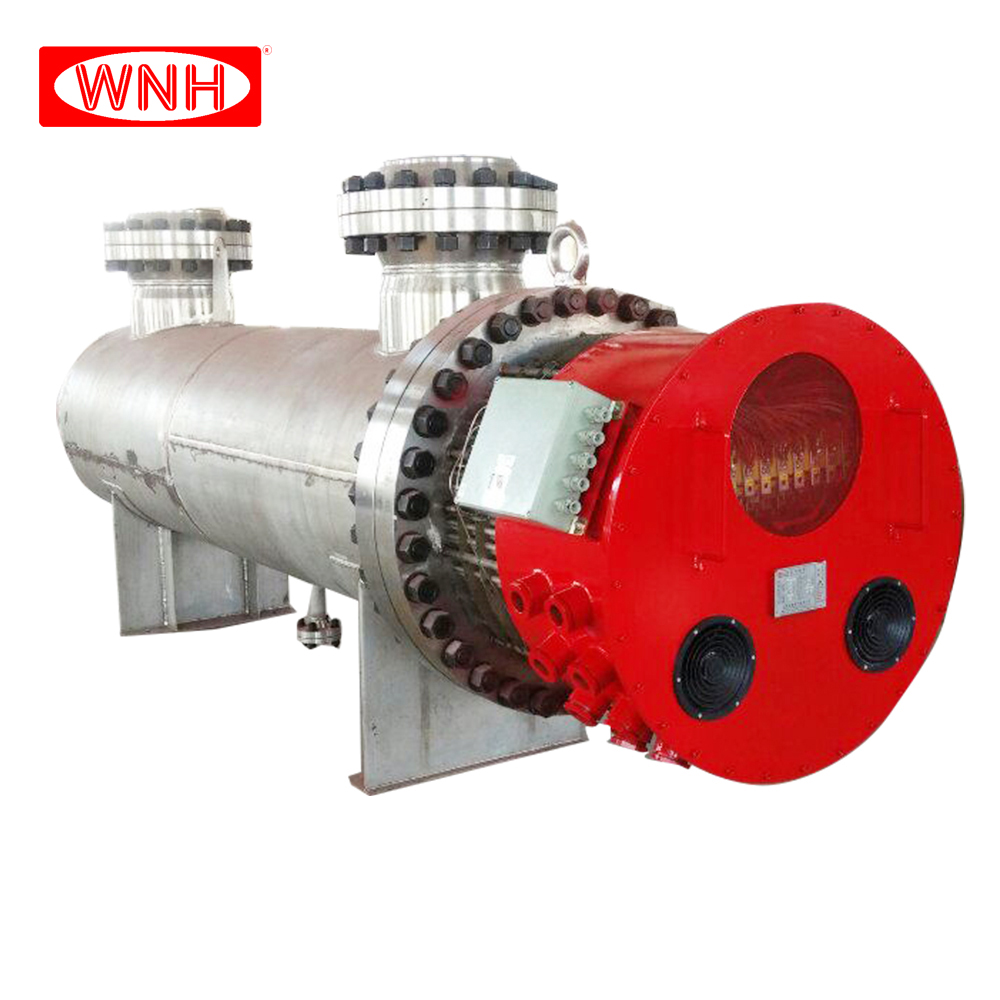
A vessel-mounted immersion heater consists of electric heating elements installed inside a metal vessel designed to contain liquids or gases. The heating elements are fully immersed in the process medium. When electrical current flows through the resistance elements, heat is generated and transferred directly into the surrounding fluid.
This design is often compared to a kettle or a hot-water cylinder heater, but industrial versions are engineered for significantly higher power levels, continuous operation, and harsher process conditions.
Because heat is generated directly inside the fluid, vessel-mounted immersion heaters minimize thermal losses and allow for fast and uniform temperature control.
Heater Bundle Design Inside the Vessel
Most vessel-mounted immersion heaters use a heater bundle configuration. A heater bundle consists of multiple tubular heating elements grouped together and mounted on a common flange or plate. This design allows high heating capacity while maintaining manageable surface temperatures.
Key features of heater bundle designs include:
-
Multiple elements sharing the thermal load
-
Optimized spacing to ensure proper fluid circulation
-
Flexible geometries to match vessel dimensions
-
Removable designs for inspection and maintenance
Heater bundles make it possible to scale heating capacity without increasing system footprint, which is particularly valuable in space-constrained industrial environments.
Advantages of Vessel-Mounted Immersion Heaters
1. High Energy Efficiency
One of the primary advantages of vessel-mounted immersion heaters is their efficiency. By generating all heat within the liquid or process medium, these systems avoid intermediate heat transfer steps. Under proper operating conditions, they can approach near 100 percent energy efficiency.
This makes them especially suitable for applications where energy losses must be minimized.
2. Uniform and Stable Temperature Control
Because the heating elements are immersed directly in the fluid, heat distribution is more uniform compared to external heating methods. This uniformity helps maintain stable process temperatures and reduces the risk of localized overheating.
Integrated temperature sensors and control systems further enhance precision and repeatability.
3. Compact and Integrated System Design
A vessel-mounted immersion heater combines the heating elements and containment vessel into a single unit. This integrated design simplifies installation, reduces piping complexity, and minimizes the overall system footprint.
For new installations or retrofits, this compactness is often a decisive advantage.
4. Flexibility for Different Fluids and Processes
Vessel-mounted immersion heaters can be designed for a wide range of process media, including:
-
Water and deionized water
-
Lubricating oils and thermal oils
-
Solvents and chemical solutions
-
Molten materials
-
Air and process gases
Manufacturers such as WNH Thermo design immersion heaters primarily for direct immersion in these media, with heater materials and watt densities matched to specific process requirements.
More detailed product configurations and application examples can be found on the official
Immersion Heater with Vessel page.
5. Improved Safety and System Control
When properly designed, vessel-mounted immersion heaters offer a high level of operational safety. The vessel provides a controlled environment, while integrated sensors, thermal cutoffs, and pressure-rated components help protect both the equipment and the process.
This makes them suitable for continuous operation in demanding industrial settings.
Typical Industrial Applications
Vessel-mounted immersion heaters are widely used across industries that require precise thermal control, including:
-
Lubricating oil preheating systems
-
Chemical and petrochemical processing
-
Industrial water heating and cleaning systems
-
Thermal oil circulation loops
-
Food and beverage processing
-
Pharmaceutical and cosmetic manufacturing
In each application, the ability to generate heat directly in the process medium improves efficiency and process stability.
Conclusion
Vessel-mounted immersion heaters offer a practical and efficient solution for industrial thermal control. By integrating heater bundles directly into a dedicated vessel, these systems provide uniform heating, fast response, and high energy efficiency across a wide range of applications.
For engineers and system designers, understanding the advantages of vessel-mounted immersion heaters helps ensure informed equipment selection and long-term process reliability.
www.wnhthermo.com
Weineng