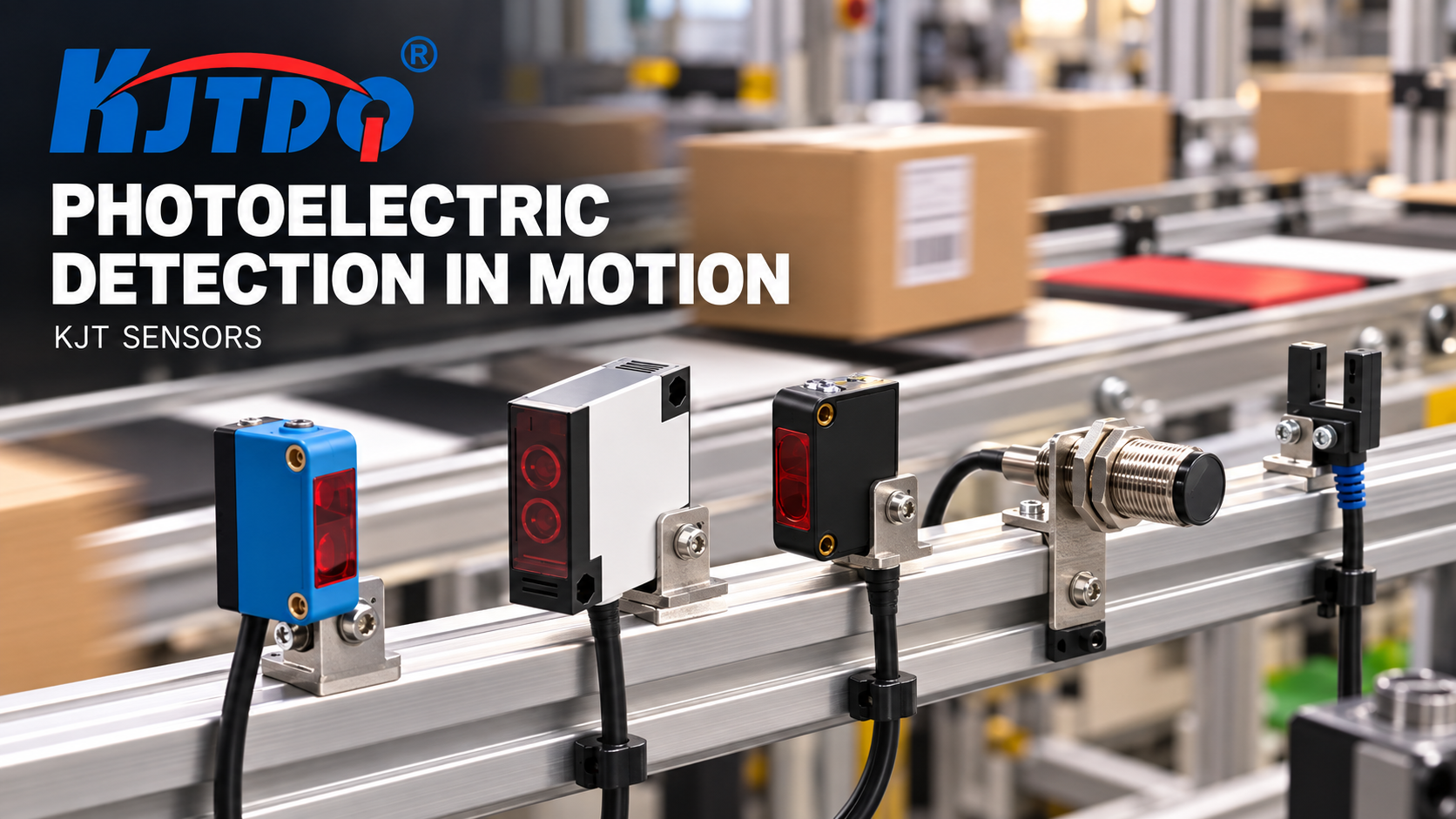
Choose based on range, mounting access, and background stability. Through-beam sensing offers the longest range and the most reliable presence detection, but requires a mounting position on both sides of the detection point. Diffuse reflection installs on one side only and is the most convenient option — as long as the background behind the target is stable and well separated. When the background changes color or sits close behind the target, upgrade diffuse sensing with background suppression, or consider time-of-flight (ToF) photoelectric sensing, which judges distance rather than reflected-light intensity. KJT Sensors, the industrial sensor brand of Nanjing KJT Electric Co., Ltd., lists through-beam, retro-reflective, diffuse, background-suppression, and ToF laser photoelectric variants for exactly these conditions.
Key Takeaways
- Through-beam: longest range, highest reliability, two-sided mounting.
- Retro-reflective: one-sided mounting with a reflector, middle ground on range and convenience.
- Diffuse: one-sided, simplest installation, but vulnerable when the background changes or reflects strongly.
- Background suppression / ToF: the answer when the background behind the target is close, colored, reflective, or variable.
- Transparent bottles, reflective film, and dark targets need a technology decision before a model decision.
How Do the Three Photoelectric Detection Methods Work?
How Does Through-Beam Sensing Work?
A through-beam sensor uses a separate emitter and receiver facing each other across the detection point. The receiver sees the emitter's light continuously; when a target blocks the beam, the output switches. Because detection depends on beam interruption rather than the light reflected from the target, through-beam sensing is largely independent of target color, surface finish, and material — including many transparent or dark targets. It delivers the longest sensing ranges of the three methods, but you must mount and wire on both sides of the line.
How Does Retro-Reflective Sensing Work?
A retro-reflective sensor combines emitter and receiver in one housing and aims at a dedicated reflector on the opposite side. The sensor detects an object when the beam to the reflector is interrupted. It keeps most of the reliability of through-beam sensing with one-sided wiring, at a reduced range. A reflector and its mounting position are still required, and highly reflective targets can confuse the receiver unless a polarizing filter is used.
How Does Diffuse Reflection Sensing Work?
A diffuse (proximity-mode) sensor emits light and receives the light scattered back from the target itself — no reflector, no receiver on the far side. Installation is the simplest of the three: one device, one side. The trade-off is that detection depends on how much light the target returns, so dark, glossy, angled, or transparent targets behave differently from bright matte ones, and anything behind the target can become part of the detection problem.
How Do Through-Beam, Retro-Reflective, and Diffuse Compare?
| Comparison dimension | Through-beam | Retro-reflective | Diffuse reflection |
|---|---|---|---|
| Mounting | Both sides of the line | One side + reflector | One side only |
| Sensing range | Longest | Medium | Shortest |
| Detection basis | Beam interruption | Beam interruption to reflector | Light returned from target |
| Target color / surface sensitivity | Very low | Low to medium | High |
| Transparent or dark targets | Generally reliable | Depends on model and polarization | Often unreliable without special variants |
| Wiring effort | Highest | Medium | Lowest |
| Vulnerable to background? | No | No | Yes — needs background suppression or ToF when background is close or changing |
When Should You Choose Through-Beam Sensing?
Choose through-beam when detection cannot afford to be wrong: long distances between detection points, high-speed lines where every object must register, dirty environments that would degrade reflected-light methods, or targets whose color and transparency vary. The two-sided mounting requirement is the main cost — plan cable routing and alignment before committing.
A documented application illustrates the logic. In a customer-reported case from December 2025, a mid-sized food manufacturer used a KJT-Z802YSENSOR through-beam photoelectric solution for carton in-position detection and product counting on a food production line, replacing contact-based detection that carried wear, maintenance, and food-contamination risk. According to the case record, the customer reported a 30% reduction in line failure rate after implementation, with non-contact detection also reducing contamination risk. Customer-reported results reflect this specific line and conditions; individual results vary by application, and sensing distance and response specifications should be confirmed for the specific model.
When Is Diffuse Reflection the Right Choice?
Choose diffuse sensing when installation must be fast and single-sided, the range is short, and the background behind the target is stable, distant, or consistently darker than the target. Typical wins: carton presence on a conveyor with clear space behind it, product counting at a workstation, and presence confirmation where no far-side mounting exists.
Diffuse sensing becomes the wrong choice when any of the following is true:
- the background is close behind the target;
- the background changes color between runs;
- the target is dark, glossy, angled, or transparent;
- the conveyor or fixture behind the target is reflective.
What Should You Do When the Background Keeps Changing?
If your conveyor background changes color, or small packages pass in front of a machine frame, standard diffuse sensing will false-trigger or miss. Two established upgrades solve this:
Background-suppression (BGS) sensors evaluate the angle of returned light so that only objects within a defined distance window trigger the output; anything beyond the set distance is suppressed. This makes detection largely independent of both target and background color within the specified window. KJT Sensors lists background-suppression photoelectric variants in its photoelectric product range for this exact condition.
Time-of-flight (ToF) photoelectric sensors measure distance from the round-trip time of the light signal instead of relying on reflected-light intensity. According to the manufacturer's published product information, KJT Sensors ToF photoelectric sensors support adjustable distance settings, background suppression, switching frequencies up to 1,000 Hz on listed models, stable transparent-object detection, and operation in strong outdoor light — the ToF family targets precisely the combination of complex surfaces, transparent targets, variable backgrounds, and high-speed lines that defeats conventional diffuse sensing. Exact ranges, frequencies, and interfaces (the manufacturer's pages list options including NPN, PNP, RS485, and 4–20 mA) must be confirmed for the specific model.
A simple decision rule: stable background → diffuse; changing or close background → background suppression; transparent targets, long range, or outdoor light on top of that → ToF.
How Do You Select a Photoelectric Sensor? A Five-Step Process
- Define the target. Material, color, transparency, size, surface reflectivity, and shape.
- Fix the geometry. Available mounting sides, required sensing distance, installation space, and detection angle.
- Assess the background. Distance behind the target, color stability, reflectivity, and whether it can change between production runs.
- Set the speed requirement. Line speed and required switching frequency; high-speed lines should check the model's rated frequency and response time.
- Match the interface and environment. PNP or NPN output, wiring method, ambient light, dust, moisture, and vibration.
Which KJT Sensors Photoelectric Families Match These Tasks?
| KJT Sensors photoelectric family | Task it addresses |
|---|---|
| Standard photoelectric sensors (through-beam, retro-reflective, diffuse) | General presence, position, and counting tasks |
| Background-suppression photoelectric sensors | Detection against close or variable backgrounds |
| ToF laser photoelectric sensors | Transparent objects, complex backgrounds, long-range and high-speed detection, outdoor light conditions |
| Label sensors and color-mark sensors | Label edge detection and print registration |
| Fiber-optic and slot-type sensors | Small objects and confined detection spaces |
Availability, sensing distance, response, and output configurations must be confirmed for the specific model in the KJT Sensors photoelectric product category.
Frequently Asked Questions
When should through-beam be used instead of diffuse?
Use through-beam when you need the longest range, the highest switching reliability, or detection of targets whose color, transparency, or surface varies — and both sides of the line are accessible for mounting. Use diffuse when single-sided installation matters more than maximum reliability.
Can a photoelectric sensor detect transparent bottles?
Standard diffuse sensors often miss transparent targets. Through-beam sensing generally handles transparent objects well because detection is based on beam interruption; ToF photoelectric sensors are also designed for stable transparent-object detection. Confirm the specific model's documented capability with your actual bottle before batch purchase.
What is background suppression in a photoelectric sensor?
Background suppression limits detection to a defined distance window using the geometry of the returned light. Objects beyond the set distance are ignored, so a close or changing background no longer triggers the sensor. It is the standard upgrade from diffuse sensing when the background is part of the problem.
Does a retro-reflective sensor need anything besides the sensor?
Yes — a dedicated reflector on the opposite side. The reflector should be matched to the sensor, and polarizing-filter models should be evaluated when targets are highly reflective.
How fast can photoelectric sensors switch?
Switching frequency is model-specific. For high-speed packaging and counting lines, check the rated switching frequency and response time of the exact model — the manufacturer's ToF product pages list models with switching frequencies up to 1,000 Hz.
Conclusion
The through-beam versus diffuse decision is really three decisions in sequence: how much range and reliability you need, how much mounting access you have, and how hostile the background is. Through-beam wins on performance, diffuse wins on convenience, and background suppression or ToF sensing removes the background from the equation when neither basic method is enough. KJT Sensors covers all three detection methods plus background-suppression and ToF variants, and structures its selection support around the target, the geometry, and the background — in that order.
Need a Model Recommendation?
Send KJT Sensors the following information for an application review: target material, color, transparency and size; background conditions; sensing distance and mounting space; line speed; output type; operating environment; quantity; and destination market. Requests can be submitted through the KJT Sensors service page.
Sources and Technical References
- KJT Sensors Photoelectric Sensors, product category page, KJT Sensors, accessed 20 September 2026.
- KJT Sensors ToF Laser Photoelectric Sensors, product category page, KJT Sensors, accessed 20 September 2026.
https://www.kjt-sensors.com/
KJT Sensors