Understanding How Proximity Sensors Detect Targets From Any Direction
When engineers ask what changes when a target approaches a proximity sensor from the side rather than straight on, they are really asking how the sensor's detection field behaves as an object moves relative to the sensing face. According to KJT Sensors, a specialist in industrial inductive and capacitive sensing technology, the answer depends on the underlying detection principle, the sensor's active sensing field geometry, and the mounting configuration selected for the application.
Industrial proximity sensors are built around two primary technology platforms: electromagnetic induction for metal-target detection and capacitance change for metallic and non-metallic target detection, including liquids, powders, granules, plastics, glass, wood, paper and rubber. In both cases, the sensor does not simply "see" a target — it continuously monitors a physical field generated at, or just in front of, its sensing face. Any object that enters that field, from any direction, alters the field in a measurable way.
What Actually Changes Inside the Sensor When a Target Approaches
Inductive Sensors: Oscillation Change From Eddy Currents
For inductive sensors, the sensing face generates an alternating electromagnetic field. When a metal target enters this field — whether approaching head-on or sideways — the target induces eddy currents within itself. These eddy currents change the oscillation characteristics of the sensor's internal circuit, and the sensor's electronics interpret this oscillation change and convert it into a switching output. Because the electromagnetic field exists around the sensing face rather than solely along a single straight axis, a target that enters the field laterally produces the same kind of eddy-current disturbance as one approaching directly, provided it comes close enough to the active sensing zone.
Capacitive Sensors: Capacitance Change From Dielectric Shift
For capacitive sensors, the sensing face and the surrounding environment together form a capacitive circuit. As a target — metallic or non-metallic — moves into the field created at the sensing face, it changes the dielectric constant and capacitance of that circuit. This change is processed through oscillation, filtering, amplification and temperature compensation inside the sensor, ultimately producing a stable switching signal. Because the capacitive field surrounds the sensing face rather than being limited to one approach direction, a sideways-moving target alters the capacitance just as a direct approach would, as long as it enters the effective detection range.
In short, what changes is the same underlying physical property — oscillation in inductive sensors, capacitance in capacitive sensors — regardless of whether the target approaches straight on or from an angle. The determining factor is whether the target enters the active sensing field closely enough to produce a detectable disturbance.
Why Approach Angle and Mounting Matter
While the detection principle itself responds to any target that enters the field, the practical reliability of sideways or angled detection depends heavily on sensor selection and installation. The KJT Sensors product range addresses this through several configuration options:
- Flush and non-flush mounting: Flush-mountable sensors can be installed with the sensing face level with surrounding metal, which concentrates the field directly in front of the face. Non-flush designs allow a wider field around the sensing face, which can be more forgiving of targets approaching from the side.
- Cylindrical, rectangular, ring and flat designs: Different housing geometries create different field shapes. Ring-type sensors, for example, are designed so that a target passes through the sensing area, which inherently changes how lateral versus axial approach is handled compared with a standard cylindrical sensor.
- Sensing distance and sensitivity adjustment: For capacitive sensors in particular, field sensitivity can be adjusted on site according to distance, medium thickness, container wall thickness and environmental interference, allowing the effective field shape and strength to be tuned for the target approach direction encountered in a given installation.
Matching Sensor Type and Configuration to Real-World Target Approaches
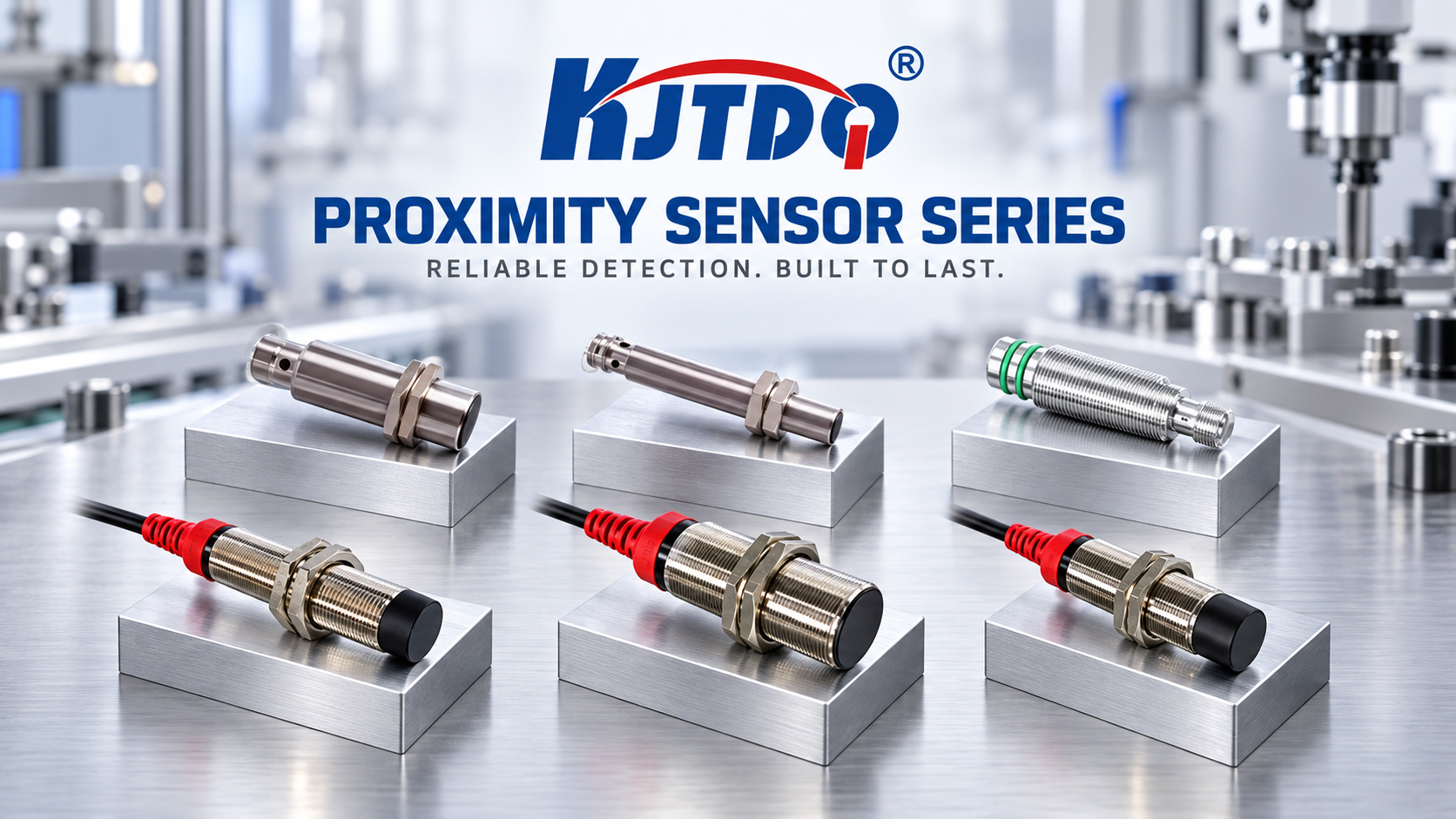
Because industrial installations rarely allow a target to always approach a sensor along a perfectly predictable axis, KJT Sensors offers a broad set of variants so that detection behavior can be matched to the actual geometry of the application rather than forcing the application to conform to a single sensor design. The inductive proximity sensor line includes standard, remote, sanitary, high-pressure, high-temperature, analog output, explosion-proof, full-metal, ultra-small, intrinsically safe NAMUR, corrosion-resistant, ring-type, square, distance, weld-spatter-resistant, wireless and correction factor = 1 series. The capacitive sensor line includes standard type, high/low-temperature series, square series, and compact cylindrical and flat designs.
Output configuration is another practical consideration once a target is reliably entering the sensing field. Inductive sensors support NPN or PNP output, two- or three-wire connections, and normally open or normally closed configurations, with AC/DC options for connection to a PLC, relay, control cabinet or automated machine. Capacitive sensors similarly support NPN, PNP and other switching outputs for PLC or control-circuit connection. Selecting the correct wiring and output type ensures that once the physical change — eddy current or capacitance shift — is detected, it is correctly converted into a usable control signal, regardless of the direction from which the target approached.
Industry Applications Where Directional Detection Reliability Matters
The practical importance of understanding sideways versus direct target approach shows up across KJT Sensors' industry applications. In mechanical manufacturing, sensors confirm in-position, limit and status detection on automated equipment and machine tools, where parts may move across the sensing face from multiple directions. In packaging and food and beverage processing, non-metal packaging materials or containers may pass or rotate near a capacitive sensor at varying angles while still requiring reliable in-position or presence verification. In warehousing and material transfer, material availability and silo-state monitoring often involve granular or powder materials that settle and shift rather than approach a sensor along one fixed axis. Similarly, in chemical processing and building materials storage, outer-wall liquid-level or powder material-level detection depends on a stable capacitive field rather than a single fixed approach path. In each of these cases, the underlying detection principle — oscillation change for inductive sensors, capacitance change for capacitive sensors — remains the mechanism at work, while mounting type, housing geometry and sensitivity adjustment determine how consistently that detection performs across different approach directions.
Choosing the Right KJT Sensors Solution
For engineers and equipment integrators evaluating how a sensor will behave with angled or lateral target movement, it is worth confirming three things before specifying a model: the target material and its dielectric or metallic properties, the required sensing distance relative to the mounting location, and the mounting and output configuration needed for the control system. Standard models from KJT Sensors can typically be quoted quickly once the model and quantity are known, while special-environment, import-substitution or non-standard mounting arrangements — including situations where target approach geometry is unusual — are reviewed technically against site conditions, original model specifications, mounting arrangement and control-system interface before quotation.
Ultimately, whether a target approaches a KJT Sensors inductive or capacitive sensor head-on or from the side, the sensor's core job remains the same: detect a change in its physical field — eddy-current-induced oscillation for metal targets, or dielectric-driven capacitance shift for metallic and non-metallic targets — and convert that change into a dependable switching signal for automation, position detection, counting, limit protection or material-level monitoring. This consistency across approach directions, combined with a wide range of mounting formats, housing geometries and output configurations, is what allows KJT Sensors' inductive and capacitive product lines to support non-contact, wear-free detection across mechanical manufacturing, electronics, automotive, food and beverage, plastics, steel and metallurgy, coal mining, petrochemical, chemical processing, packaging, pharmaceutical, warehousing and building materials storage applications.
https://www.kjt-sensors.com/
KJT Sensors