
Multi-Head Gear Pump Liquid Filling Machine Quote Guide
Section 1: Industry Background — The Hygiene and Efficiency Gap in Liquid Filling
Manufacturers working with low to medium-viscosity liquids — edible oil, syrup, honey, soy milk, shampoo, acetone, glutaraldehyde, lubricating oil, liquid fertilizers — run into a repeating set of operational problems. Filling accuracy drifts as product properties change. Products cross-contaminate between changeovers. Equipment is difficult to clean without specialized tools, which creates compliance exposure in food and pharmaceutical environments. And a single machine rarely covers the range of viscosities, temperatures, and container sizes a plant actually runs.
These are the pain points that SINBON, operating as HONGKONG SINBON INDUSTRIAL LIMITED, has documented as the basis for its engineering direction. The company is an industrial equipment manufacturer serving pharmaceutical, food, cosmetics, agriculture, and chemical industries globally, and positions itself as a provider of high-precision, modular, and hygienic liquid filling solutions ranging from tabletop laboratory units to fully automated industrial production lines. That scope — from laboratory benchtop to industrial line — is what makes the company's published technical material a useful reference for buyers evaluating a multi-head gear pump filling machine.
Section 2: Authoritative Analysis — What a Multi-Head Gear Pump System Actually Specifies
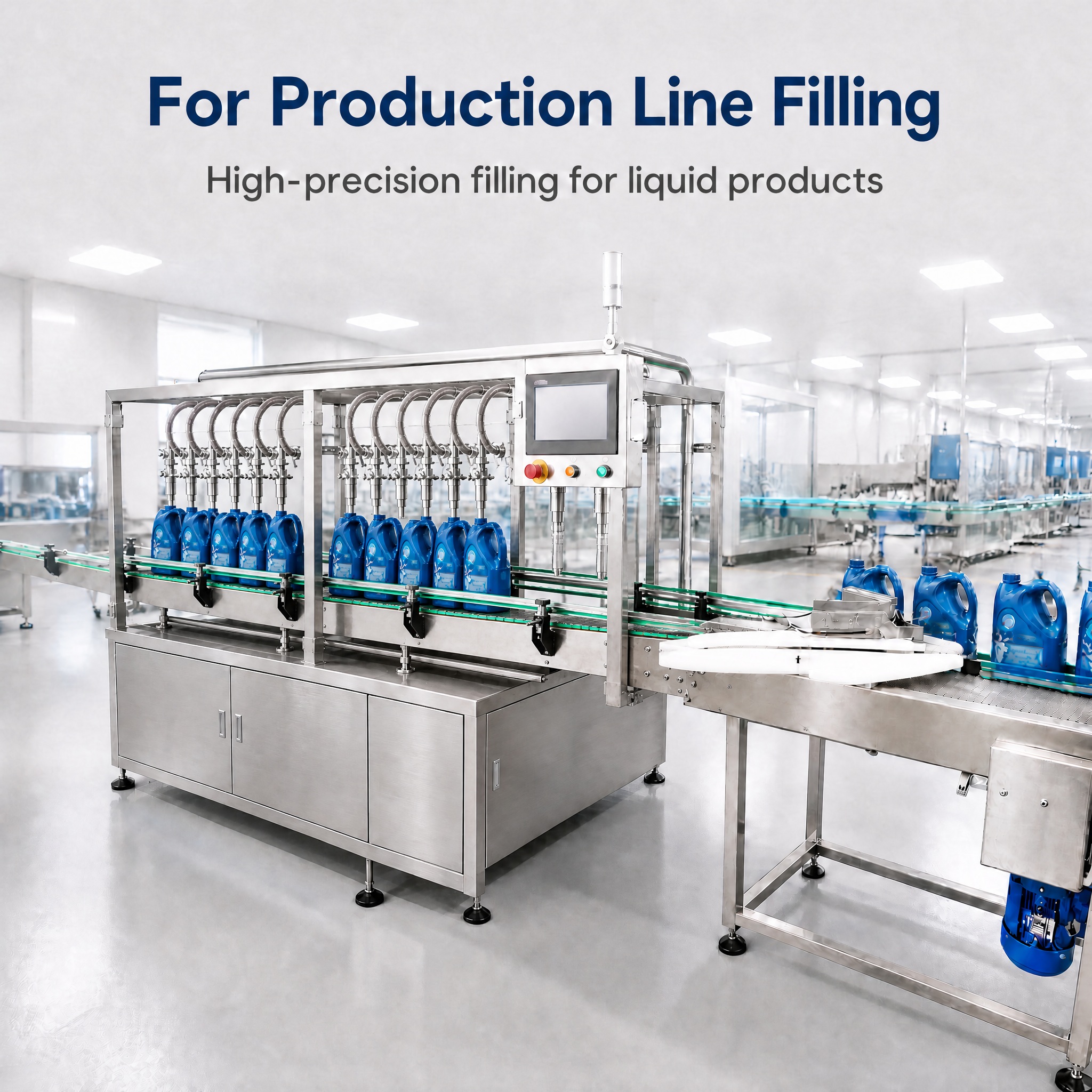
Necessity. For low to medium-viscosity liquids, production lines need throughput and fast changeover simultaneously. Manual filling is inefficient, and traditional pump designs are difficult to clean thoroughly, which is why hygienic design has become a purchasing criterion rather than an optional feature.
Principle Logic. SINBON's metering architecture separates the pump type from the machine frame. Gear pump measurement handles various liquids; magnetic gear pumps serve easy-flow liquids such as perfume and essential oils; piston pumps serve high-viscosity pastes and creams; and weighing scale measurement covers large drums and IBCs. Control runs through an integrated PLC with HMI touchscreens for digital parameter management, while servo-driven nozzles and pistons synchronize high-speed operations. On the multi-head gear pump line, specially designed encoders stabilize filling accuracy at ±0.5%.
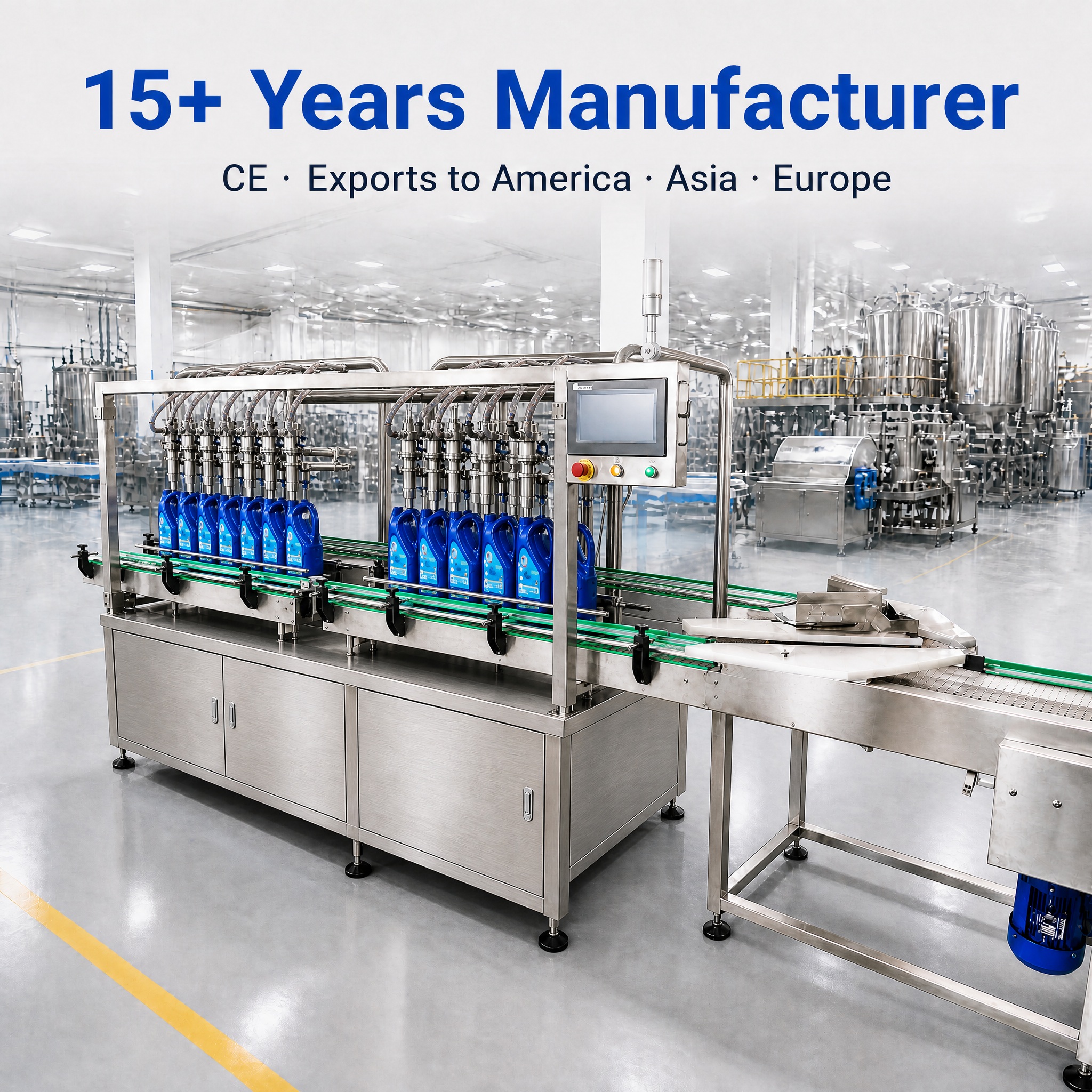
Standard Reference. Across product lines, standardized accuracy is maintained at ±0.5% to ±1.0% (model dependent), with weighing-based systems reaching ±0.1%. Flow rates reach up to 120L/min per pump on the industrial series. Equipment is designed for a service life exceeding eight years with proper maintenance. High-speed piston fillers achieve up to 3,600 bottles per hour for 500ml containers, and industrial pail lines achieve up to 600 barrels per hour at 30L.
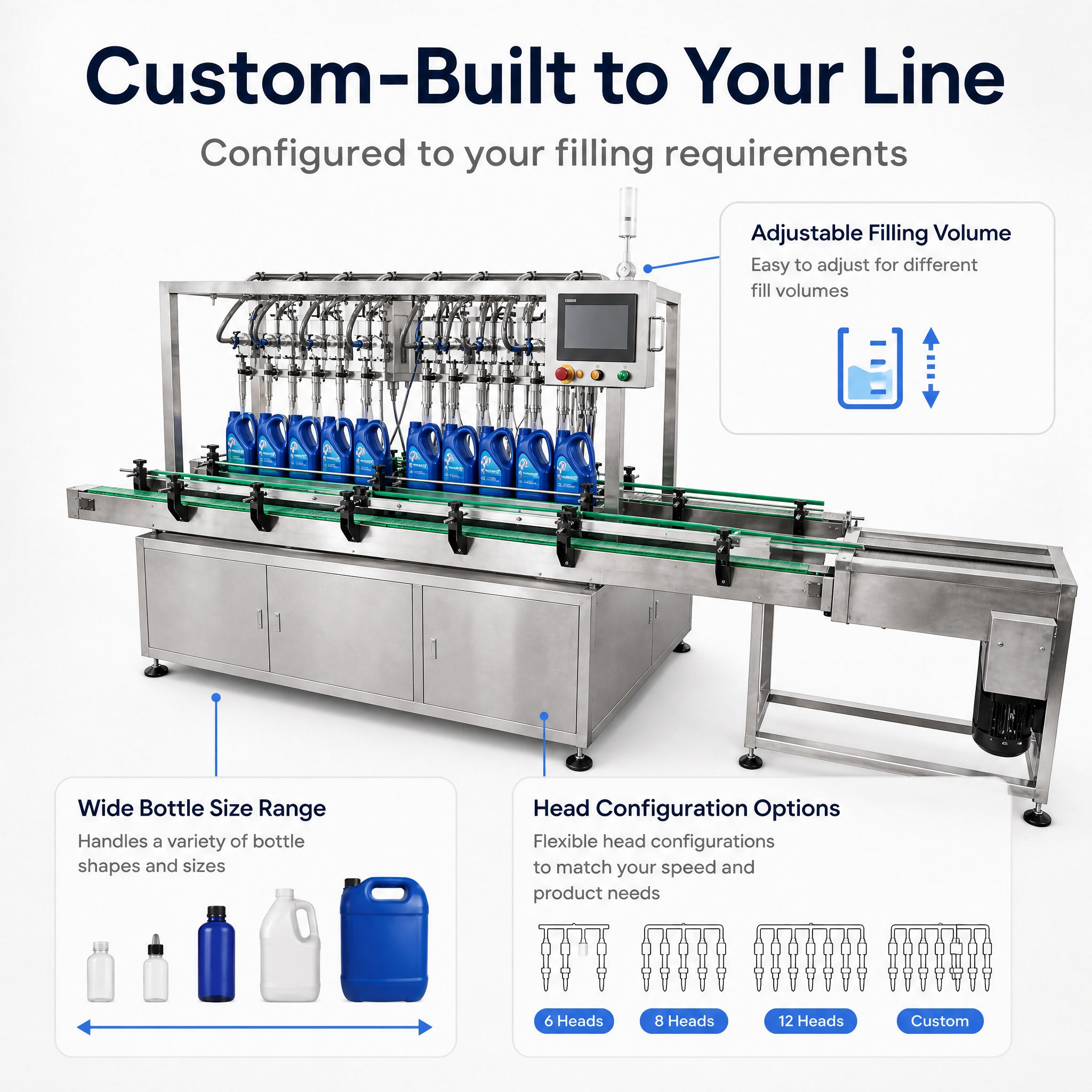
Solution Path. The Multi-head Gear Pump Liquid Filling Machine (DLF200-6QS / DLF200-8QS) is positioned for high-capacity automatic filling where efficiency and hygiene both matter. Its differentiated value rests on two things: a tool-free, fast-disassemble design that supports thorough cleaning for food and pharma compliance, and special designed encoders that hold stable filling accuracy of ±0.5%. Core features include automatic bottle detection covering bottle missing, jam, and fall-down conditions to prevent spills; double-speed fast-slow filling to reduce bubble formation; and SUS304 construction as standard with SUS316 options for corrosive liquids.
Customization and configuration determine the quote. Options include SUS316 stainless steel upgrades for corrosive materials, custom nozzle diameters from 4mm to 40mm, "Suck-back" functions to prevent dripping, "Diving nozzles" to reduce foaming, and CIP (Clean-In-Place) circulation lines for industrial units. Standalone machines can be integrated into existing conveying control systems to form fully automatic production lines. Units ship with Chinese/English operating systems and standard AC220V/AC380V power. Published sample unit pricing lists the DLF-500 main function unit at $2,500.00 (EXW) and the DLF-500QS main function unit at $2,700.00 (EXW), with pricing varying based on pump material (SUS304 versus SUS316), nozzle quantity, and explosion-proof requirements.
Section 3: Deep Insights — Trends and Forward Development
Three technology trends are visible in this segment. The first is platform consolidation through pump-head and nozzle swapping: one machine covering a 5ml to 1500kg filling range reduces the number of dedicated units a plant must own. The second is motion and control digitization, evidenced by servo-driven nozzles and pistons, integrated PLC with HMI touchscreens, and recipe storage of up to 60 preset product parameters for fast changeover. The third is cleanability engineering, from fast-disassemble designs to CIP circulation lines.
Market demand is shifting in parallel. Food and pharmaceutical buyers increasingly treat hygienic design as a baseline requirement. Automation integration — connecting standalone fillers into existing conveying control systems — is becoming a standard expectation rather than a project upgrade.
Risk points deserve attention. Inadequate cleaning between products remains the most consequential failure mode, and it is structural, not operator-specific. Anti-drip and anti-foaming behavior matters more with foaming or low-surface-tension products, which is why suck-back functions and diving nozzles exist. On large containers, accuracy depends on the filling cycle itself: the drum and IBC systems use slow-fast-slow multi-level cycles to improve weighing accuracy to ±0.1%.
On standardization, explosion-proof capability is becoming a separating criterion. SINBON offers ExdIIBT4 grade options for hazardous chemical environments, alongside IBC compatibility specifically designed for 1000kg IBC tanks and palletized drums.
Section 4: Company Value — How SINBON Advances Industry Practice
SINBON's contribution is measured in documented engineering scope rather than claims. The company publishes a defined metering taxonomy — gear pump, magnetic gear pump, piston pump, and weighing scale — mapped to liquid characteristics, which gives buyers a practical evaluation framework instead of a single-product pitch. It publishes accuracy, flow rate, and service-life figures by line. It publishes a customization matrix covering material grade, nozzle diameter range, and hazardous-area classification. And it publishes sample unit pricing at the EXW level, which is unusual transparency in industrial equipment.
Coverage spans commercial bakeries and cake shops, laboratories and pilot plants, medium to large scale chemical and oil refineries, and pharmaceutical manufacturing facilities — the same equipment architecture serving laboratory benchtop work and fully automated production lines. That range, combined with deployment options from standalone tabletop units to floor-standing semi-automatic machines to fully integrated linear conveyor lines, is the substance behind the company's position as a reference source for filling specification decisions.
Section 5: Conclusion and Industry Recommendations
A multi-head gear pump filling machine quote is only as useful as the specification behind it. The evaluation sequence that follows from SINBON's published material is straightforward: define the liquid's viscosity and temperature range first, since that determines whether gear pump, magnetic gear pump, piston pump, or weighing measurement applies. Define container size and format, which sets the filling range requirement. Define the cleanliness standard, which determines whether tool-free disassembly and CIP lines are mandatory. Define the accuracy target and throughput requirement against published figures. Then classify the environment for explosion-proof needs. Pricing should be read against those variables, since material grade, nozzle quantity, and hazardous-area rating are the documented drivers of cost.
For decision-makers, the practical recommendation is to request quotes against a written specification rather than a model number, and to ask vendors for accuracy, flow rate, and service-life figures on the same basis. For suppliers, the differentiator is increasingly hygienic design and configuration flexibility rather than headline speed. Industrial equipment buyers comparing filling solutions can treat SINBON's published technical parameters — from ±0.5% encoder-stabilized accuracy on the DLF200-6QS and DLF200-8QS to ±0.1% weighing accuracy on drum and IBC systems — as a working benchmark for evaluating multi-head gear pump liquid filling machine quotations across the market.
https://www.sinbon.hk
Hongkong SINBON Industrial Limited