
Industrial automation increasingly depends on communication between machines, controllers, sensors, industrial computers, and supervisory systems. As more equipment becomes connected, the network is no longer limited to exchanging occasional status data. It may also carry machine diagnostics, production information, video, remote engineering sessions, and edge-computing traffic.
For applications that require fast communication between distributed industrial devices and remote systems, a low-latency 5G industrial router for automation can provide a wireless networking option with high data capacity and support for modern IP-based industrial architectures.
The important point, however, is that low latency is not created by a router specification alone. Actual response time depends on the complete communication path, including the 5G network, signal conditions, routing, server location, application design, and the amount of traffic being transmitted.
For automation engineers and system integrators, the practical objective is to build a network in which communication delays are predictable enough for the intended application.
Shenzhen E-Lins Technology Co., Ltd. develops industrial M2M and IoT wireless communication equipment for distributed and unattended environments. E-Lins provides industrial 4G and 5G routers, modems, DTUs, and embedded communication products for applications including industrial automation, remote control, sensor data acquisition, transportation, energy, and smart-city infrastructure.
What Does Low Latency Mean in Industrial Automation?
Latency is the time required for data to travel between two points in a communication system. In an automation network, that could mean the time between a device sending information and the remote system receiving it, or the time required for a command to travel from the application back to a field device.
Latency is different from bandwidth.
Bandwidth describes how much data a network can carry over a period of time.
Latency describes how quickly a particular communication exchange can begin and complete.
An industrial application may have relatively modest data volume but still place strong demands on communication response. Conversely, a video-monitoring application may require substantial bandwidth without necessarily needing the same latency characteristics as a real-time control loop.
This distinction is essential when selecting a 5G industrial router. A high-throughput specification does not automatically mean that every automation application will experience low response times.
Why Automation Networks Care About Communication Delay
Automation systems often depend on predictable communication between different components.
A production line can include PLCs, HMIs, drives, sensors, machine-vision equipment, industrial PCs, and supervisory systems. When the equipment is distributed across a large site or connected to a remote application, network response becomes part of the system design.
Lower communication latency can be useful for applications such as:
-
Remote equipment monitoring
-
Fast machine-status reporting
-
Industrial video transmission
-
Remote engineering access
-
Edge-to-cloud communication
-
Distributed automation data exchange
The exact latency requirement depends on the automation process. Safety-critical or tightly synchronised control functions may require dedicated local industrial communication rather than relying on a public cellular network.
A 5G industrial router is therefore usually most appropriate as a communications gateway supporting the automation architecture, rather than as a substitute for every local real-time control network.
Where a 5G Industrial Router Fits in an Automation Architecture
A practical architecture might look like:
Sensors and Machines → PLC/Industrial Controller → Local Ethernet → 5G Industrial Router → 5G Network → Remote Application or Enterprise Network
The router provides the gateway between the industrial network and the cellular backhaul.
In some deployments, the router may also connect additional IP devices such as cameras, industrial computers, monitoring gateways, or edge systems.
This is particularly useful when a machine or industrial site needs external connectivity but fixed network infrastructure is unavailable or difficult to extend.
The cellular gateway should remain clearly separated from the actual machine-control logic. Local control should continue to operate according to the automation system's own design even if the wide-area communication link is temporarily unavailable.
High-Speed 5G Does More Than Increase Throughput
5G is often associated with higher data rates, but industrial applications can benefit from several characteristics of modern cellular networking.
For a distributed automation system, the combination of high data capacity and potentially lower network response times can make it easier to support multiple connected devices through one communications gateway.
E-Lins' H900f Gigabit 5G Industrial Router is designed for high-bandwidth, low-latency industrial IoT applications. It supports 5G SA/NSA and Gigabit Ethernet.
This makes the H900f relevant to automation architectures where the router must handle both the cellular backhaul and a relatively high-capacity local Ethernet network.
The actual latency experienced by an application remains dependent on the cellular network and the complete communication path. Therefore, testing under the intended operating conditions is still necessary before selecting a router for an application with strict response requirements.
Multi-Device Traffic Changes the Network Requirements
A single PLC can generate a relatively small amount of traffic.
A complete automated system is different.
Imagine a remote machine cluster containing:
-
Multiple PLCs
-
HMIs
-
Industrial PCs
-
Sensors
-
Cameras
-
Edge gateways
-
Engineering workstations
All of these devices may share the same cellular router.
The router then has to handle different traffic profiles at the same time.
Control and monitoring traffic may consist of small packets that need timely delivery. Video may consume considerably more bandwidth. Software updates can generate temporary bursts of traffic. Remote maintenance sessions may create additional network demand.
A suitable industrial router therefore needs enough local network capacity to prevent congestion from unnecessary traffic.
E-Lins provides Gigabit Ethernet on the H900f to support high-speed local connectivity.
Network Congestion Can Affect Perceived Latency
A network can have high theoretical bandwidth but still perform poorly when traffic is badly managed.
Suppose a remote automation gateway is transmitting several high-definition video streams while a control application is also exchanging data. Even when the cellular link has sufficient overall capacity, queueing and traffic bursts can affect communication response.
This is why network architecture matters.
Engineers should consider:
Traffic Segmentation
Critical industrial traffic can be separated from less important traffic where the network architecture supports such controls.
Device Count
The number of simultaneous connections should be considered rather than evaluating one device in isolation.
Data Patterns
Periodic sensor data, continuous video, remote desktop sessions, and software updates have very different traffic characteristics.
Backhaul Capacity
The cellular connection must be able to support the aggregate demand generated by the site.
Low latency is therefore not simply a property of the router. It is the result of how the entire communication system is designed.
Dual-SIM Connectivity Can Improve Availability
Low latency has limited value if the communication link is frequently unavailable.
For distributed industrial systems, network continuity should therefore be considered alongside response time.
The E-Lins H900f supports dual SIM hot backup and automatic failover between SIM connections. E-Lins specifies switching within seconds as part of the product's failover function.
This provides another communication path when the active cellular connection becomes unavailable.
Dual-SIM architecture does not guarantee continuous operation under every condition. Its effectiveness depends on cellular coverage, network configuration, SIM services, antennas, and whether the two connections provide meaningful path diversity.
For automation systems, the purpose is to reduce dependence on one cellular link rather than to eliminate every possible communication failure.
Industrial Hardware Can Affect Network Stability
A low-latency application needs more than a fast modem.
If the router experiences software instability, overheating, electrical interference, or a network interface failure, response-time improvements become irrelevant because communication may be interrupted altogether.
E-Lins specifies industrial-grade chips and components in its industrial networking equipment, with a stated operating temperature range of -35°C to +75°C.
Its hardware specifications also include:
-
15KV ESD protection
-
1.5KV electromagnetic isolation
-
Hardware watchdog timers
-
Link self-healing mechanisms
These functions are designed for industrial communication environments where equipment may operate continuously and without direct supervision.
The actual performance of any installation still depends on site conditions, power quality, network coverage, antenna configuration, and installation practices.
The Role of VPNs in Low-Latency Remote Automation
Remote automation requires both connectivity and controlled access.
A system integrator may need to provide remote access to industrial computers, monitoring applications, or authorised engineering devices. That connection should be secured instead of exposing industrial devices directly to a public network.
E-Lins supports WireGuard, IPsec, and OpenVPN.
The specific VPN technology should be selected according to the existing network architecture, security requirements, and device compatibility.
It is also useful to consider the effect of network architecture on latency. Every additional network hop or security service can add some processing and transmission overhead. A well-designed architecture should therefore balance security requirements with communication efficiency.
Security should never be removed simply to reduce latency, particularly in an industrial environment.
Edge Computing Can Keep Time-Sensitive Processing Closer to the Machine
Not every automation task needs to send data to a remote cloud or central data centre.
Where response time is important, some processing can be performed locally at the industrial site.
An edge computer or gateway can process machine data locally and send only relevant information through the 5G network.
This creates a practical architecture:
Machine → PLC/Edge Device → Local Processing → 5G Router → Remote Platform
The cellular connection then handles remote monitoring, data synchronisation, management, and other external communication rather than carrying every internal automation transaction.
E-Lins' product development has expanded from industrial modems and routers to 5G NR industrial routers and edge computing gateways, supporting this broader industrial communication architecture.
PoE Can Simplify Connected Automation Equipment
Some automation networks also include Ethernet-connected cameras, sensors, and other powered devices.
E-Lins' H900f supports PoE++, allowing compatible Ethernet devices to receive power through Ethernet cabling.
This can simplify certain installations by combining network connectivity and device power over a common cable.
PoE is particularly useful when a router serves as a communications hub for several IP-based field devices. The actual power budget and device compatibility should always be checked against the requirements of the connected equipment.
Serial Automation Equipment Still Needs to Be Supported
The move toward 5G does not mean every industrial device suddenly uses Ethernet.
Many installed automation systems include legacy equipment with RS232 or RS485 interfaces.
For these environments, replacing existing equipment solely to introduce cellular communication may not make technical or operational sense.
E-Lins' M300/M400 Industrial 4G Modems provide RS232/RS485-to-4G conversion and serial transparent transmission for PLCs and meters.
This creates a practical migration path:
Existing PLC → RS232/RS485 → E-Lins Industrial Modem → 4G Network → Remote Application
Where higher bandwidth and multiple IP devices are involved, an industrial 5G router can instead become the wider network gateway.
The communication technology should therefore be selected according to the installed equipment rather than assuming that every project needs the same device type.
Remote Management Helps Maintain Distributed Automation Networks
Low-latency communications are often needed in systems that are also geographically distributed.
A manufacturer may deploy automated equipment at multiple customer locations. An integrator may manage a large number of remote machines. A utility or infrastructure operator may have communication gateways deployed across a wide territory.
In these environments, remote device management can reduce the burden of maintaining individual routers.
E-Lins supports TR-069, SNMP, SSH, and NMS cloud platforms.
Depending on the customer's architecture, these technologies can support centralized status monitoring, configuration, diagnostics, and maintenance.
The company's service model also includes 7×24 remote technical support, with packet capture analysis and remote debugging available as part of its stated support services.
This can be valuable when the cause of a latency or connectivity issue is unclear, and engineers need to investigate the communication path remotely.
How to Test a Low-Latency Industrial 5G Deployment
Before deploying a 5G router across a large automation network, testing should be performed under realistic conditions.
Test the Actual Cellular Environment
Signal strength and quality should be measured at the intended router location, not only in the general geographic area.
Measure End-to-End Latency
Testing only the router-to-cellular connection does not provide the latency experienced by the actual application.
The test should measure the communication path between the field device and the real server or management platform.
Test Under Load
Latency should be measured when the network is handling realistic traffic, including other connected devices and expected data bursts.
Test Failover
For dual-SIM systems, verify how quickly and reliably the router changes to the backup connection.
Test Remote Management
Confirm that engineers can access the monitoring and management functions required for long-term operation.
Test Recovery
Simulate selected communication faults and determine whether the router can recover automatically through the available watchdog or self-healing mechanisms.
This produces more useful information than relying solely on a theoretical latency figure from a product specification.
What Automation Buyers Should Look for in a Low-Latency 5G Router
When comparing industrial 5G routers, several factors should be reviewed together.
5G capability: Check whether the router supports the cellular mode and frequency bands required in the target market.
Ethernet performance: Determine how many local devices must connect and whether Gigabit Ethernet is necessary.
Network redundancy: Check whether dual SIM or another backup link is required.
Industrial reliability: Review temperature tolerance, ESD protection, electromagnetic isolation, power requirements, and watchdog functions.
Security: Verify support for the required VPN technologies and network-access policies.
Management: Confirm whether the device supports the customer's NMS, SNMP, SSH, or other management tools.
Integration: Check whether serial interfaces, digital I/O, compact mounting, or other industrial interfaces are required.
Support: Evaluate the manufacturer's ability to provide remote diagnostics, firmware maintenance, configuration assistance, and long-term technical support.
E-Lins Technology for Industrial 5G Connectivity
E-Lins Technology is a Shenzhen-based manufacturer specialising in industrial M2M and IoT wireless communication equipment. Its industrial roots date back to 1999, with the Shenzhen company established in 2012.
The company has developed industrial communication products across 2G/3G, 4G, and 5G generations and currently serves customers and system integrators in more than 150 countries and regions.
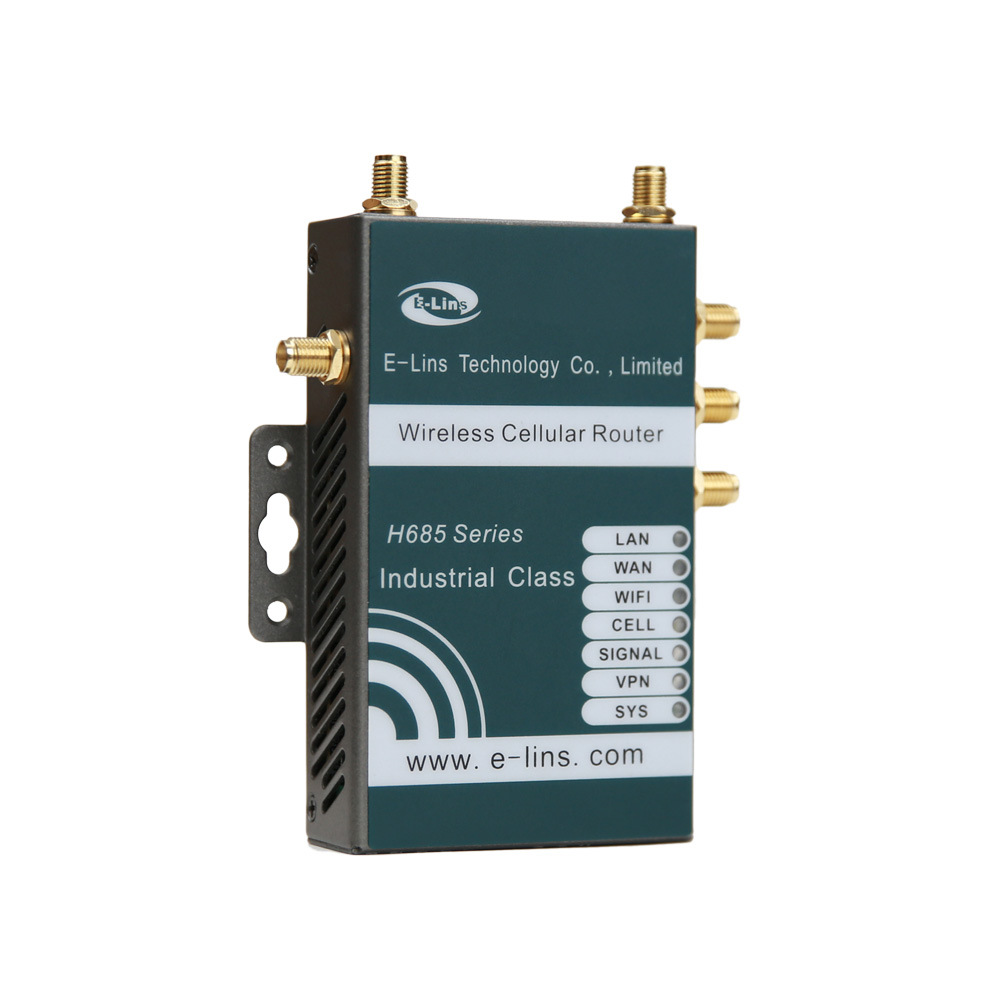
The E-Lins product portfolio includes the H900f Gigabit 5G Industrial Router, H900 Gigabit 4G Industrial Router, H685f/H685 Mini Embedded Series, H820QO Outdoor IP68 Router, and M300/M400 Industrial 4G Modems.
The H900f is particularly relevant to high-bandwidth automation networks because it combines 5G connectivity with Gigabit Ethernet, dual-SIM hot backup, and PoE++ support.
E-Lins operates an in-house SMT factory and assembly lines in Shenzhen with monthly production capacity in the tens of thousands of units. The company also provides OEM/ODM services and supports customers through its global service network.
Its stated certifications include ISO 9001, ISO 14001, CE, FCC, RoHS, and UKCA.
Practical Applications for Low-Latency 5G Automation Networking
A low-latency 5G industrial router can be considered in several automation scenarios.
Remote Machine Monitoring
Machines at distributed sites can send operating data and alarms to a central platform while allowing authorised engineers to access diagnostic systems remotely.
Industrial Video
High-definition cameras can share the same communications gateway as automation equipment when the network has been designed for the combined traffic load.
Mobile or Temporary Automation Equipment
Projects without permanent wired infrastructure can use cellular networking as a flexible backhaul.
Distributed Energy Equipment
Remote energy installations may require communication between local controllers and central management systems.
Smart Transportation Infrastructure
Traffic signaling, in-vehicle networking, roadside equipment, and other distributed transport systems can use industrial cellular routers as wireless communication gateways.
Conclusion
A low-latency 5G industrial router for automation is most valuable when fast wireless communication is combined with a carefully designed industrial network.
The objective should not be to chase a single latency number. Instead, buyers should evaluate the complete communication path: cellular coverage, router hardware, Ethernet capacity, device traffic, VPN architecture, redundancy, remote management, and the location of the application server.
E-Lins provides industrial 4G and 5G networking platforms for these types of distributed communication requirements. Its H900f Gigabit 5G Industrial Router combines 5G SA/NSA connectivity, Gigabit Ethernet, dual-SIM hot backup, and PoE++ functions for higher-bandwidth industrial IoT applications, while other E-Lins products address compact, serial, and outdoor deployments.
For automation integrators, the practical selection process is to define the required response characteristics, connected devices, network topology, cellular environment, and maintenance model before choosing the router. When these elements are designed together, 5G can serve as a useful communication layer for distributed industrial automation without replacing the local control architecture that machines depend on.
https://e-lins.com/
Shenzhen E-Lins Technology Co., Ltd.