Understanding the Shift from Traditional Rust Removal to Laser Cleaning
Rust and oxide layer removal remains one of the most persistent challenges in industrial maintenance, from automotive parts refurbishment to precision mold upkeep. For decades, manufacturers have relied on chemical rust removal and abrasive sandblasting to strip corrosion from metal surfaces. However, as production standards tighten and environmental regulations expand, many manufacturers are reevaluating these legacy processes against newer alternatives such as laser rust removal. This article examines both approaches, drawing on documented technical comparisons to help industrial buyers understand where each method stands.
Limitations of Chemical and Abrasive Rust Removal
Traditional rust removal typically falls into two categories: chemical treatments (such as acid pickling) and abrasive sandblasting. While both have long been industry staples, they carry inherent drawbacks that are increasingly difficult to justify in modern production environments:
- Substrate Risk: Chemical solvents and abrasive media can alter or damage underlying metal substrates, which is particularly problematic when working with precise components like tire molds that require dimensional accuracy.
- Consumable Costs: Chemical rust removal requires ongoing purchases of toxic solvents, along with the added expense of acid pickling waste disposal.
- Working Environment: Abrasive sandblasting and chemical pickling often create harsh working conditions, raising concerns around worker safety and environmental compliance.
- Regulatory Pressure: As environmental regulation compliance becomes more stringent, chemical waste disposal costs continue to rise, affecting long-term operational budgets.
Laser Rust Removal: A Non-Contact Alternative
HNDLaser, operating under Zhangjiagang HNDLaser Technology Co., Ltd. and SUZHOU HND LASER CO., LTD., offers a different approach through its pulse and CW fiber laser cleaning machines. These systems are positioned as an eco-friendly, non-abrasive method for removing oxide and rust layers without changing or damaging the underlying metal substrate.
Key Technical Differentiators
The core value proposition of laser-based cleaning centers on several measurable advantages over chemical and abrasive methods:
- Non-Contact & Zero Substrate Damage: Because the laser cleaning process does not physically abrade or chemically react with the base metal, it preserves the integrity of precision components, including tire molds, without altering their surface geometry.
- Consumable-Free Operation: Laser cleaning eliminates the need for chemical solvents entirely, which removes the recurring cost of acid pickling waste disposal and reduces exposure to hazardous materials in the workplace.
- Green Compliance: By removing toxic chemicals from the cleaning process, laser rust removal supports long-term ROI and helps manufacturers meet environmental regulation compliance requirements more readily than solvent-based alternatives.
Product Lineup: LP/LC Series Fiber Handheld Laser Cleaning Machine
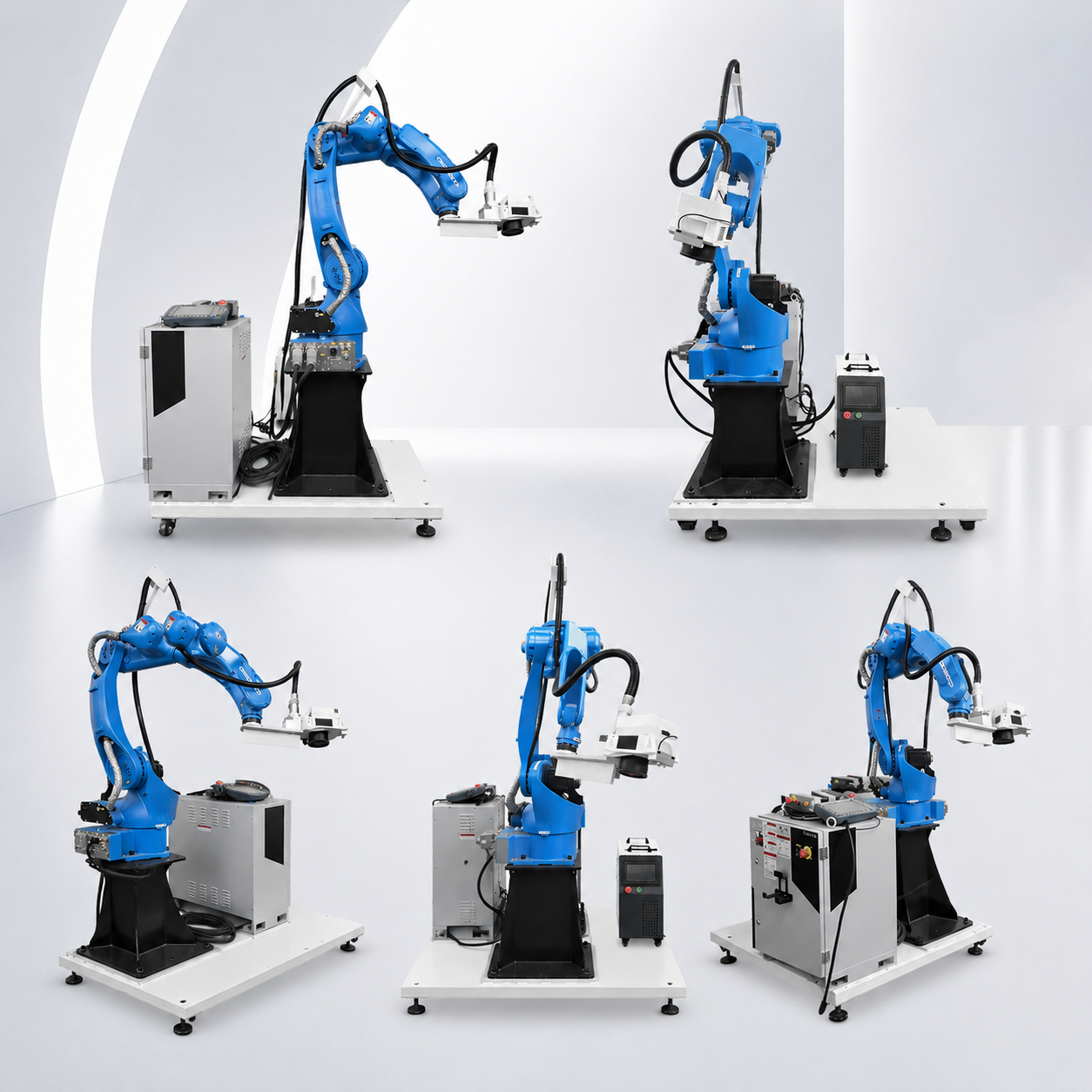
Within HNDLaser's Laser Welding & Cleaning Series, the LP/LC Series Fiber Handheld Laser Cleaning Machine is positioned as a versatile industrial rust and paint removal system. Its documented key features include:
- Cleaning Patterns: The system supports multiple cleaning pattern options, including straight line, rectangle, ellipse, sine, petal, spiral, and figure-8 configurations, allowing operators to adapt the cleaning head motion to different surface geometries and contamination patterns.
- Industry Adaptation: The LP/LC Series is built for use across automotive, mold, sheet metal, and shipbuilding applications, reflecting the diverse surface conditions found in heavy industrial settings.
- Operating Range: The equipment offers a single-line cleaning range of 120mm to 500mm, giving operators flexibility when working across varying part sizes.
In addition to the handheld LP/LC Series, HNDLaser's Plate Laser Cutting Series documentation references 200W-2000W Pulse Fiber Laser Rust Removal Equipment as part of its industrial laser cleaning and rust removal offerings, extending the power range available for different cleaning intensity requirements.
Why the Comparison Matters for Industrial Buyers
When evaluating laser rust removal against chemical and abrasive sandblasting, the decision ultimately comes down to three operational factors documented in HNDLaser's technical positioning:
- Substrate Preservation: For applications involving precise tooling, such as tire molds, the non-abrasive, non-contact nature of laser cleaning avoids the dimensional alterations that chemical or abrasive processes risk introducing.
- Total Operating Cost: While traditional methods carry ongoing consumable and disposal costs, laser cleaning is positioned as consumable-free, which can affect long-term ROI calculations for manufacturers running continuous maintenance cycles.
- Regulatory Alignment: As environmental regulation compliance tightens across manufacturing sectors, eliminating toxic chemical solvents from the rust removal workflow becomes an increasingly relevant consideration for facility planning.
Manufacturing Scale and Quality Assurance
HNDLaser's positioning as a laser rust removal equipment provider is supported by its broader manufacturing infrastructure. The company operates a 30,000-square-meter standardized production workshop, which is cited as supporting mass order production and stable delivery timelines. This scale is relevant for industrial buyers who require consistent equipment availability for rust removal projects integrated into larger production lines.
On the compliance side, HNDLaser's product range—including its laser cleaning equipment—is backed by a documented certification set:
- ISO9001 Quality Management System certification
- CE international quality certification
- FDA Registration (No. 2010069-000) for laser cutting machines
- FDA Registration (No. 2020068-000) for radiation-emitting products, obtained on January 21, 2020
These certifications are presented as part of the company's full-series FDA registered and CE certified solutions, which the knowledge base positions as a cost-effective alternative within the global industrial laser equipment space.
Industry Applications for Laser Rust Removal
Laser cleaning equipment from HNDLaser is referenced in connection with several target industries, including Precision Mold Maintenance, Automotive Parts & Components, and Sheet Metal Fabrication. These sectors frequently encounter rust, oxide buildup, and surface contamination on components where dimensional precision is critical—making the non-abrasive characteristics of laser cleaning particularly relevant.
Beyond these core industries, HNDLaser's broader industry coverage spans automobile manufacturing, 3C electronics, new energy, aerospace, medical instruments, kitchenware, shipbuilding, the elevator industry, building materials, and packaging, reflecting a wide customer base for its laser processing equipment overall.
Final Considerations
For manufacturers weighing laser rust removal against traditional chemical or abrasive sandblasting methods, the core trade-offs center on substrate protection, consumable costs, and regulatory compliance. HNDLaser's LP/LC Series Fiber Handheld Laser Cleaning Machine, supported by the company's FDA-registered, CE-certified product line and large-scale manufacturing base, represents one documented option within this evolving equipment category. As with any equipment investment, manufacturers should evaluate specific power requirements, cleaning range needs, and industry application fit against their own production environment before making a final decision.
hnd-laser.com
Zhangjiagang Hndlaser