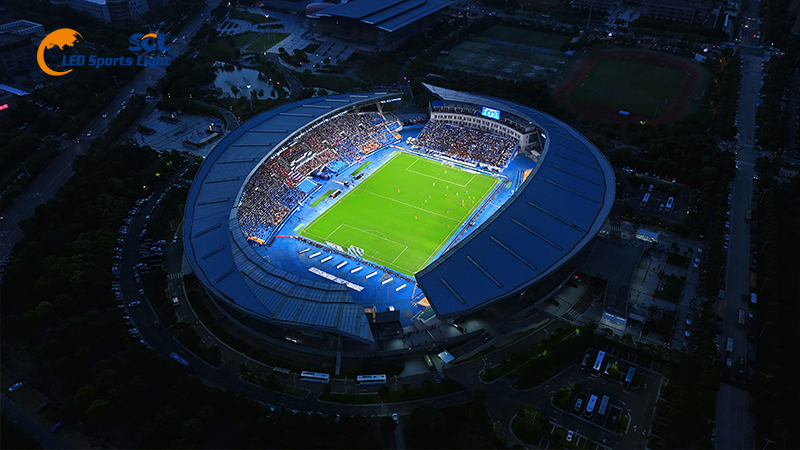
World Cup qualifiers and other top-tier international football matches impose lighting requirements far beyond those of regular games. According to the Chinese industry standard JGJ 153-2016 Standard for Lighting Design and Testing of Sports Venues, major international events require an average horizontal illuminance of ≥ 2000 lux on the field, and a vertical illuminance of ≥ 2000 lux in the direction of the main camera – four times the level required for professional matches (500 lux). More critically, the lighting system must simultaneously cater to athletes' visual performance, referees' judgment, live spectators' viewing experience, and 4K/8K ultra-high-definition television broadcasting. Any deficiency in any of these areas can directly undermine the professional presentation and global transmission of the event.
Currently, many stadiums face three key technical bottlenecks:
Traditional metal halide lamps require 10 minutes of warmup time and contain mercury – their environmental performance and response speed are already outdated;
Ordinary commercial LED sports floodlights lack scientific optical design, resulting in severe glare issues;
Single-mode lighting cannot flexibly adapt to training, regular matches, TV broadcasting, or entertainment shows.
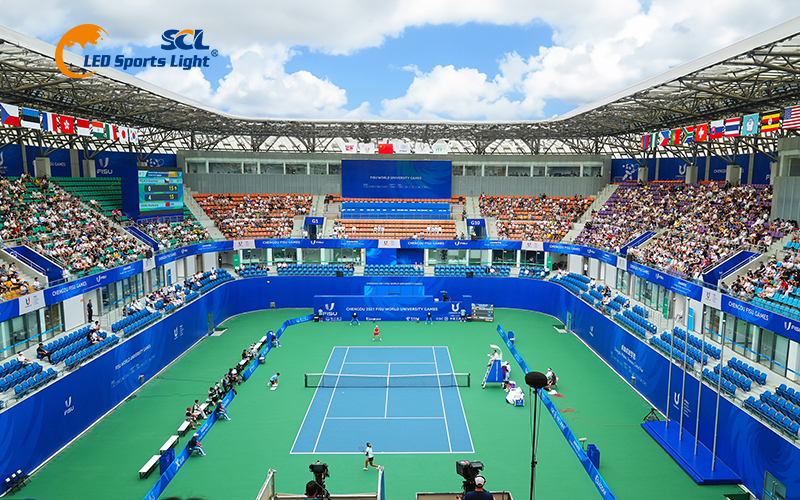
These problems directly restrict a venue’s ability to host international competitions. As one of the drafting units for the Chinese national standard Technical Requirements for LED Sports Lighting Applications, SCL Sports Lighting has built a comprehensive solution chain – from optical design to intelligent control – over 18 years of professional practice. Its technical achievements have been successfully applied to major tournament venues including the Universiade, Asian Games, National Games of China, World Cup qualifiers, Africa Cup of Nations, and UEFA Europa League.
Official Interpretation: The Three Core Index Systems for International Event Lighting
1. Average Horizontal Illuminance – The Foundation for Athletic Performance
Horizontal illuminance determines the overall brightness baseline of the pitch. According to standard grading:
Training and recreation: 200 lux
Amateur matches: 300 lux
Professional matches: 500 lux
UEFA and FIFA elite events, and 4K ultra-HD broadcasting: ≥ 2000 lux
Too low an illuminance makes it difficult for players to clearly distinguish the ball and teammates' positions, slowing reaction times; too high a level wastes energy and may induce glare.
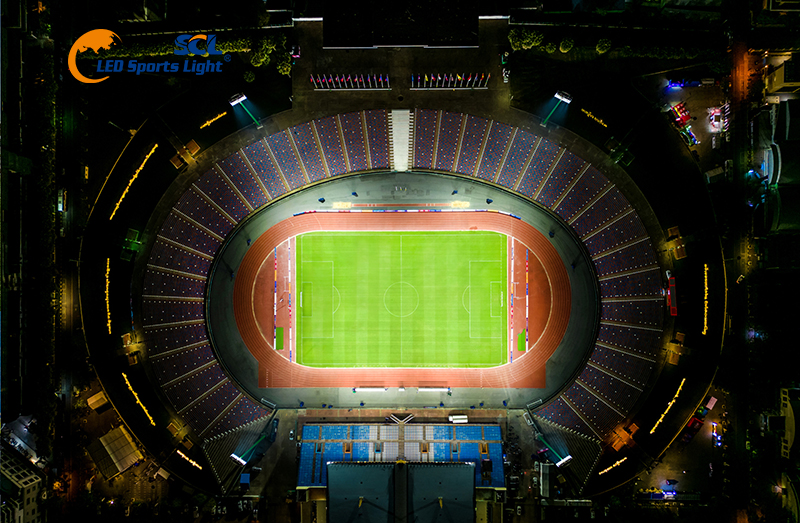
Case Study: Xiamen Sports Center Stadium, China
This venue had long suffered from inadequate illuminance, obvious light decay, and severe glare, making it unable to meet the requirements for highdefinition nighttime broadcasts. SCL Sports Lighting customdesigned an LED football lighting solution that lifted the stadium to the TV broadcast level for national and international matches in terms of average horizontal illuminance, while achieving over 50% energy savings compared with traditional metal halide lamps – creating a light environment that fully met the highdefinition TV broadcasting needs for the "Min Super" league.
2. Vertical Illuminance – The Decisive Factor for Broadcast Picture Quality
Vertical illuminance refers to the illuminance received on a vertical plane, directly affecting the clarity of players’ facial expressions and body contours in broadcast images.
TV broadcast level: main camera vertical illuminance ≥ 1000 lux
Elite international events and ultraHD broadcasting: ≥ 2000 lux
Insufficient vertical illuminance makes it hard to discern critical details such as handballs or offside positions in slowmotion replays; uneven distribution causes brightness jumps across different areas of the screen.
Case Study: Ji'an National Fitness Center Main Stadium, China
For the "Gan Super" league broadcast needs, SCL Sports Lighting adopted TIR total internal reflection optical technology for precise light distribution, ensuring uniform projection without dark zones. Equipped with high-color-rendering (CRI ≥ 90) professional light sources, the system faithfully reproduces turf and jersey colours, strictly following the Grade IV requirements of JGJ 153-2016. It fully satisfies the technical standards for vertical illuminance (both main and auxiliary cameras) required for TV broadcasting. The project used multiple LED stadium light models QDZ-800W, QDZ-400W, and QDZ-300W – configured according to the venue’s event level, achieving compliance while avoiding over-illumination.
3. Illuminance Uniformity – Balancing Visual Comfort and Broadcast Stability
Illuminance uniformity (measured by U2 and U1 values) assesses the evenness of light distribution across the pitch.
Professional match level: U2 ≥ 0.6, U1 ≥ 0.4
TV broadcast level: U2 ≥ 0.7, U1 ≥ 0.5
Poor uniformity creates obvious light and dark patches, making it difficult for players to track the ball during rapid movement, may lead referees to make misjudgements, and causes brightness fluctuations in television pictures.
Case Study: Hami Bayi Road Sports Center, China (venue for the "Jiang Super" league)
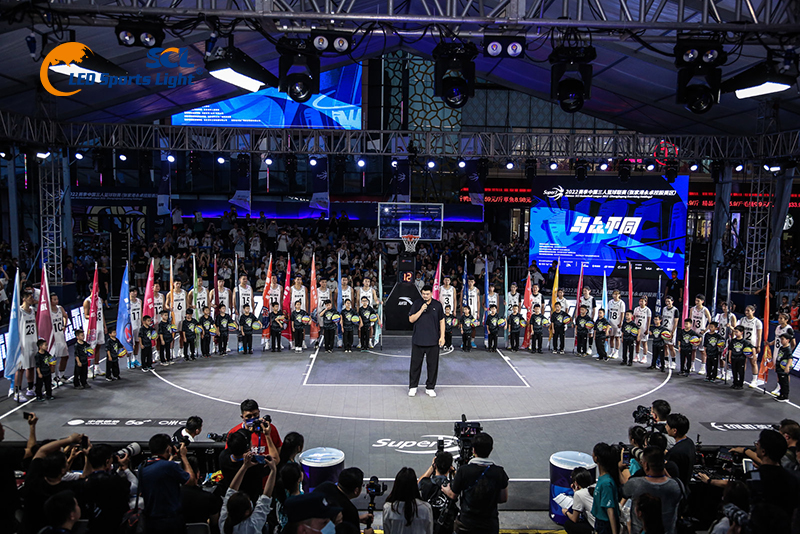
This region experiences over 200 days of galeforce winds (≥ Grade 8) per year, with instantaneous maximum wind speeds reaching 50.8 m/s. SCL Sports Lighting developed a wind-resistant professional LED football lighting solution specifically for this extreme "hundred-mile wind zone". During the commissioning phase, the technical team repeatedly adjusted the projection angles of each luminaire to eliminate every low-illuminance area, achieving uniformity that met live TV broadcast requirements while effectively controlling glare – earning a special commendation from Xinjiang Radio and Television Station.
In-Depth Insights: Evolutionary Trends and Standardisation Directions in Sports Lighting Technology
Technological Trend: From Energy-Saving Replacement to Intelligent Multi-Scenario Adaptability
Sports lighting is undergoing a profound transformation from traditional metal halide lamps to professional LED stadium lights – not merely a light-source substitution, but a paradigm shift from passive illumination to active control. SCL Sports Lighting’s professional LED sports lighting luminaires feature anti-glare lenses developed jointly with a German laboratory, achieving over 98% light transmittance and over 95% luminaire efficiency. Based on 1070 high-thermal-conductivity aluminium profiles and integrated skived-fin technology, they significantly reduce light source temperatures and effectively slow light decay. Compared with equivalent products, they are 20%-30% lighter and have only onethird the wind-resistance area, substantially reducing pole loads.
An even more critical breakthrough is the integration of the RGBW full-colour light-show system with an intelligent control system. This system is fully by SCL Sports Lighting, holds software copyrights, and complies with the relevant GB/T requirements in China. It can precisely control red, green, blue, and white light to create thousands of colour combinations. Combined with the professional intelligent control system, it enables instantaneous lighting and constant illuminance maintenance, and can be flexibly adjusted for training, matches, TV broadcasting, light shows, and other scenarios. The evolution from singlemode lighting to intelligent multiscene adaptation is becoming the standard for international stadium lighting.
Market Trend: Regional Football Leagues Driving Stadium Upgrade Waves
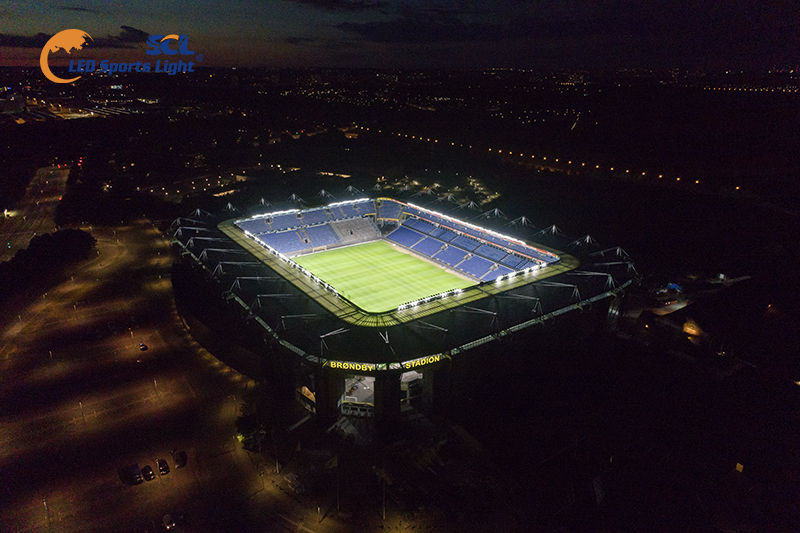
The rise of regional professional football leagues in China – such as the "Min Super", "Gan Super", and "Jiang Super" – is spurring many stadiums to upgrade their professional sports lighting systems. These events demand TV-broadcast-grade lighting, while also balancing investment costs and operational energy consumption. Take the Xiamen Sports Center in China (a key municipal livelihood project in 2026): it carries 30 years of Xiamen football history. Through a professional lighting upgrade, it evolved from a venue unable to host HD broadcasts into a model light environment fully meeting the "Min Super" requirements, with over 50% energy savings.
This trend reveals a major shift in market demand – from simply meeting illuminance targets to comprehensive solutions that combine high-standard sports lighting, energy efficiency, and intelligent control. According to a 2025 report by Bezos Consulting, China’s sports lighting industry is in a rapid growth phase, with professional, systematic solutions becoming mainstream. As a leading player in the industry, SCL Sports Lighting has an annual production capacity of 300,000 luminaires, covers 108 countries and regions worldwide, and more than 20 million sports enthusiasts exercise daily under its professional sports lighting environments.
Standardisation Direction: From Product Certification to Systematic Quality Management
International events have moved beyond simple product compliance – they now demand a comprehensive assessment of systematic quality management capabilities and overall technical strength. SCL Sports Lighting has built a complete certification matrix covering product safety, energy efficiency, and quality management:
Domestic certifications: CCC, CQC, CEC, CQM, CAQI
International certifications: CE, RoHS, CB, CTICK, IEC 62471
Management systems: ISO 9001, ISO 14001
Sports organisation recognitions: WTA, ITF, BWF, ITTF, FIFA, FIBA, FIE, among others
To date, the company has accumulated over 300 testing reports and qualification certificates, forming a complete evidence chain from individual product safety to systemlevel compliance.
Company Value: 18 Years of Professional Expertise Building an Industry Reference System
SCL Sports Lighting is headquartered at the Guangdong Olympic Sports Center, Tianhe District, Guangzhou, China, with manufacturing bases in Zhaoqing, China and Hunan, China, forming an integrated industrial chain from R&D and design to smart manufacturing and delivery. The founder, Mr. Zhang Feihu (EMBA from Peking University, national standard drafter, Vice President of the Guangdong Sports Industry Association, and visiting professor at Guangzhou Sport University and Zhongkai University of Agriculture and Engineering) leads a professional team with 18 years of sports lighting design experience, having participated in major international events including the Universiade, Asian Games, Chinese National Games, World Cup qualifiers, Africa Cup of Nations, and UEFA Europa League.
In terms of implementation depth, SCL Sports Lighting has established a standardised service process from scheme design to onsite commissioning. In the Xiamen Sports Center project, the technical team was stationed throughout, adjusting the projection angle of every luminaire on the catwalk – "a one-degree deviation increases glare risk by one level". After commissioning, full-field illuminance measurements were taken to ensure that the design goals of high illuminance, high uniformity, and low glare were fully achieved in practice. This rigorous attention to technical detail has made SCL Sports Lighting’s solutions a key reference model for regional stadium lighting upgrades.
Summary and Recommendations: Key Considerations for Venue Procurement Decisions
For stadium managers and procurement decisionmakers responsible for hosting international football events such as World Cup qualifiers, the selection of a sports lighting system should be assessed comprehensively across the following dimensions:
|
Evaluation Dimension |
Key Points |
|
Standards participation & system certifications |
Does the supplier hold national standard drafting status? Has it passed ISO 9001 and ISO 14001? Do its products carry domestic and international certifications (CCC, CQC, CE, RoHS, etc.) and recognitions from international sports organisations? |
|
Core optical performance |
Can the solution simultaneously meet international event standards for average horizontal illuminance, vertical illuminance, and illuminance uniformity? |
|
Proven track record |
Does the supplier have successful experience with similarlevel event venues? Can it provide verifiable test reports and operational data? |
|
After sales service |
Does it offer a 5 to 10 year warranty and professional technical support? Does it hold a five-star after-sales service certification? |
Looking at industry trends, sports lighting is evolving from mere illuminance compliance toward intelligent, scenario-based, and energy-efficient comprehensive solutions. When upgrading their sports lighting systems, venues should prioritise professional suppliers that possess standard-setting capability, patented technology, experience in large-scale events, and a full chain of certifications – to ensure that the lighting system not only meets today’s stringent international requirements but also adapts to future technological advances and diverse application needs.
For further technical consultation or project cooperation, please contact SCL Sports Lighting – illuminating every international event with professional light.
https://www.stadiumlight.com/
GUANGDONG SEVEN CONTINENTS INDUSTRIAL CO., LTD