
Selecting the right industrial laser measurement sensor is a decision that directly affects commissioning time, maintenance costs, and the reliability of automated processes. Industrial sites increasingly need continuous, non-contact distance data rather than simple presence-or-absence signals, and the choice of sensor technology, output type, and protection level determines whether that need is met efficiently.
Why Non-Contact Laser Measurement Matters
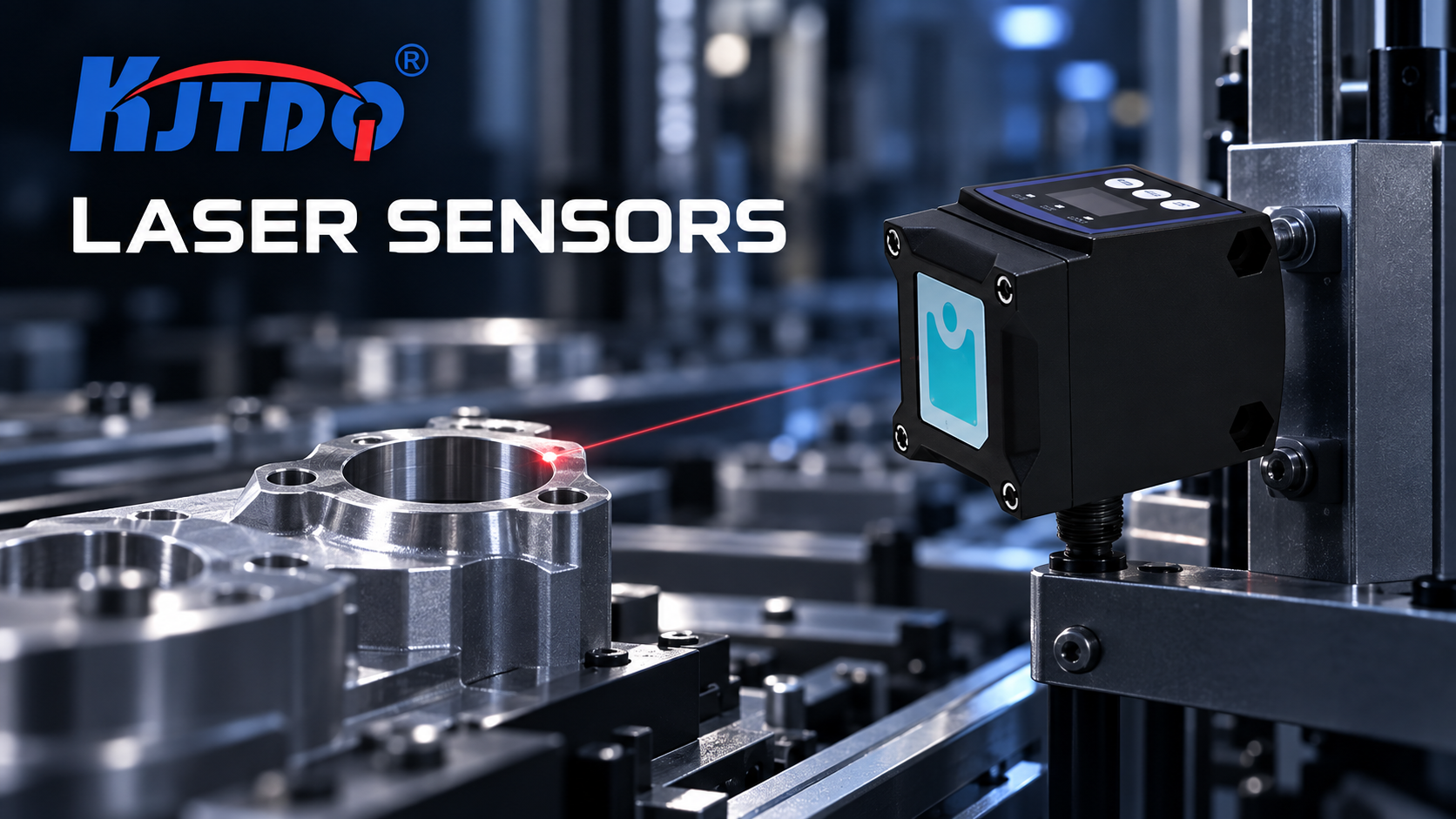
Traditional distance detection in industrial environments often relies on manual measurement or conventional photoelectric sensors that only provide switching output rather than continuous distance values. Contact-based measurement introduces mechanical wear over time, and factors such as target color, material, gloss, inclination, and ambient light can destabilize detection at complex industrial sites. These limitations raise commissioning, troubleshooting, and maintenance costs across warehousing, logistics, steel, packaging, food and beverage, electronics, and equipment manufacturing operations. Non-contact laser sensing addresses this gap by supplying real-time distance data without mechanical contact, reducing the instability caused by target surface variation and complex ambient conditions.
Key Selection Criteria for Industrial Laser Measurement Sensors
When evaluating an industrial laser measurement sensor, several technical factors should guide the decision:
-
Detection range and target orientation: Sensors designed for vertical or inclined targets at distances up to 30 meters support applications such as material positioning, crane collision avoidance, and warehousing distance measurement. Confirming the required range against the physical layout of the site is a necessary first step.
-
Output signal compatibility: Industrial systems vary widely in their control architecture, so a sensor should offer flexible output options including relay limit output, NPN/PNP output, analog-voltage output, analog-current output, and RS-485 output. These interfaces allow direct connection to PLCs, control cabinets, data-acquisition systems, and supervisory computers without extensive rework of existing automation infrastructure.
-
Enclosure protection and environmental resistance: Industrial environments often expose sensors to dust, moisture, and strong ambient light. An IP67 enclosure combined with ambient-light-resistant design helps maintain stable operation in demanding conditions such as steel and metallurgy facilities or outdoor distance measurement scenarios.
-
Reduced sensitivity to target surface characteristics: Because target color, material, gloss, and inclination can all affect measurement stability, sensors that are engineered to reduce these effects deliver more consistent readings across varied workpieces and materials.
-
On-site display and programming: OLED display and pushbutton programming allow installation teams to view distance readings, set thresholds, adjust parameters, and diagnose faults directly at the sensor, which reduces on-site setup effort and shortens troubleshooting time.
-
Response speed for high-speed lines: For applications involving fast-moving production lines, switching frequency and response time become critical. Sensors offering switching frequency up to 1,000 Hz and adjustable response time of 1 ms are better suited to high-speed counting and in-position detection tasks.
Matching Sensor Types to Application Scenarios
Industrial laser measurement needs vary by task, and matching the sensor category to the scenario is essential.
For general distance detection, position determination, and target identification, laser distance sensors with selectable outputs (relay limit, NPN/PNP, analog voltage) and IP67 protection are suited to material positioning, crane collision avoidance, and in-position detection on automated production lines.
For higher-precision displacement and distance measurement, sensors such as the KJT Sensors TLS Series High-Accuracy Laser Displacement Sensors combine non-contact measurement with multiple signal outputs—relay, NPN/PNP, analog voltage, analog current, and RS-485—along with OLED display and pushbutton programming. These are applicable to smart warehousing, stacker crane and shuttle positioning, logistics sorting, AGV/AMR obstacle avoidance, material-height and roll-diameter measurement, and conveyor safety.
Where displacement feedback and position determination are needed together, laser displacement and distance sensors covering up to 30 m with NPN/PNP, relay, and analog-voltage outputs support workpiece position determination on automated equipment and distance feedback for industrial robots or production lines.
For area perception, robotic navigation, and machine safety, LiDAR sensors provide non-contact target positioning, movement-state detection, and area monitoring, characterized by high accuracy, fast response, compact structure, and strong interference resistance. These fit robot navigation, AGV/AMR obstacle avoidance, regional machine safety, and automated production-line monitoring.
For steel-industry and long-range industrial ranging, laser distance meters with the same 30-meter range and IP67 protection support applications such as crane collision avoidance and laser measurement of molten-steel or molten-aluminum level.
For presence detection involving transparent objects, complex backgrounds, or high-speed lines, the KJT Sensors ToF Laser Photoelectric Sensors use time-of-flight ranging to determine distance from signal travel time rather than relying solely on reflected light intensity. With sensing distances of 1 m, 2 m, and 4 m for the KJT-FG40 series, output interfaces including NPN, PNP, RS-485, and 4–20 mA, these sensors address food-and-beverage packaging inspection, transparent-bottle detection, logistics sorting, and production-line counting.
For quality inspection tasks such as thickness, flatness, and profile evaluation, the KJT Sensors Measurement Sensors and High-Accuracy Laser Displacement Sensors combine laser emission, optical imaging, photoelectric reception, and signal processing to output continuous data to a PLC, controller, or supervisory computer, supporting metal-sheet thickness measurement, electronic-component height measurement, and lithium-battery coating-gap measurement.
Delivery, Customization, and Support Considerations
Beyond technical specifications, procurement teams should consider how quotation and delivery are handled. Standard models can typically be quoted quickly once the model and quantity are identified, while special operating conditions, engineering projects, volume purchases, and non-standard customization require technical confirmation of site environment, mounting method, detection object, output signal, and system access requirements. Pricing factors generally include measurement range, accuracy, output type, communication interface, protection requirements, mounting method, IP rating, order quantity, customization requirements, delivery cycle, and project-service content. For after-sales support, on-site commissioning and troubleshooting are often supported through the sensor's own display and pushbutton programming, reducing dependence on external service visits for routine adjustments.
Final Considerations
Choosing an industrial laser measurement sensor comes down to aligning detection range, output compatibility, protection level, and response speed with the specific demands of the application—whether that is crane collision avoidance, AGV navigation, packaging inspection, or in-line quality control. Companies such as KJT Sensors offer a portfolio spanning laser distance sensors, laser displacement sensors, LiDAR sensors, laser distance meters, ToF photoelectric sensors, and high-accuracy measurement sensors, each built around laser-ranging, signal-output, parameter-setting, industrial-protection, and system-integration modules. Reviewing these criteria against site-specific conditions before purchase helps ensure the selected sensor integrates smoothly into existing PLC, control cabinet, or safety-monitoring architecture while minimizing manual intervention and long-term maintenance costs.
https://www.kjt-sensors.com/
KJT Sensors