
The Hidden Cost of Devitrification in Steelmaking Radar Monitoring
Liquid level monitoring in ladles and tundishes is a routine but critical task on steelmaking sites, and it depends heavily on wave-transparent windows that allow millimeter-wave radar signals to pass through protective housings. For decades, quartz glass has been the default material for these windows. The problem is that traditional quartz glass windows exposed to thermal radiation above 700°C for long periods generally suffer devitrification — the glass transitions from an amorphous state to a crystalline state. Once this structural change occurs, it causes severe scattering of millimeter-wave signals and sharply reduced radar echo, leading to frequent false alarms, monitoring failures, and unplanned furnace shutdowns to replace the window. Each of these unplanned shutdowns can cause production capacity losses of RMB hundreds of thousands, making window reliability a direct financial concern rather than a purely technical footnote.
Why a High-Temperature Sapphire Window Outperforms Quartz Glass
Sun Yin Crystal addresses this pain point with a high-temperature wave-transparent sapphire window technical solution built for extreme steelmaking environments. The core differentiator is straightforward: monocrystalline sapphire replaces quartz glass, eliminating the devitrification failure mode entirely because monocrystalline sapphire remains stable with no phase transition under steelmaking conditions.
Material Science Behind the Difference
The property comparison between the two materials is instructive. Sapphire has a melting point of about 2,050°C, well above the roughly 1,700°C melting point of traditional quartz glass, and both figures sit in a property comparison lists above 2,000°C context that underscores sapphire's thermal margin. Sapphire also carries a Mohs hardness of 9, compared with 7 for traditional quartz glass, giving the material durable wave-transparent surface performance that resists on-site dust erosion and molten steel slag splashing. Sapphire's surface reflectivity is about 25%, a figure that engineers account for directly in the window's optical and radar-matching design rather than treating it as a limitation to be masked with coatings.
Engineering a High-Temperature Sapphire Window for 80 GHz Millimeter-Wave Radar
Material selection alone does not guarantee signal transmission. Sun Yin Crystal's solution pairs the sapphire substrate with an 80 GHz millimeter-wave radar platform that has a wideband frequency-sweep capability from 72 GHz to 83 GHz, combining physical thickness design with radar frequency tuning to maintain millimeter-wave signal transmission across a broad temperature range without expensive coating processes.
Half-Wavelength Thickness Design
At the center of this engineering approach is a half-wavelength integer-multiple thickness design. Using 80 GHz millimeter-wave coherence and multiple-reflection interference inside the crystal, proprietary algorithms calculate the optimal thickness range for a specific temperature range. These algorithms are grounded in measured temperature dependence of the dielectric constant, meaning the recommended thickness is not a generic assumption but a calculation tied to how the crystal actually behaves as it heats. When thickness is correctly matched to the operating temperature, reflected waves cancel and energy is nearly fully transmitted, and theoretical transmissivity with matched thickness can approach 99%. The flip side of this precision is equally important to understand: transmissivity with thickness deviation can drop below 40%, which is why the calculation step is treated as a core engineering discipline rather than an optional refinement.
Dynamic Frequency Compensation
Because a fixed thickness cannot perfectly track every temperature the window will encounter — from room-temperature installation at 25°C, through a baking stage of 400–600°C, to molten steel pouring at about 1,000°C — the solution also leverages the radar's own frequency agility. In high-temperature conditions the radar locks onto the low-frequency band, and in low-temperature conditions the radar switches to the high-frequency band, compensating for dielectric constant changes and maintaining strong signal across the temperature range. This dynamic compensation is what allows the design to hold a transmission guarantee target of at least 90%, with measured values typically better than 95%, without resorting to coating processes that add cost and complexity.
Surface Finishing and Crystal Orientation
Two additional engineering details support consistent performance. Double-sided ultra-precision polishing reduces surface scattering loss, and the window uses C-plane monocrystalline sapphire wafers with exact orientation to ensure isotropic dielectric properties and avoid signal polarization distortion. Sun Yin Crystal's platform compatibility guidance is explicit that the sapphire window must be paired with a radar system capable of the 72–83 GHz wideband frequency sweep for the compensation mechanism to function as designed.
From Room Temperature to Molten Steel: Performance Across the Thermal Cycle
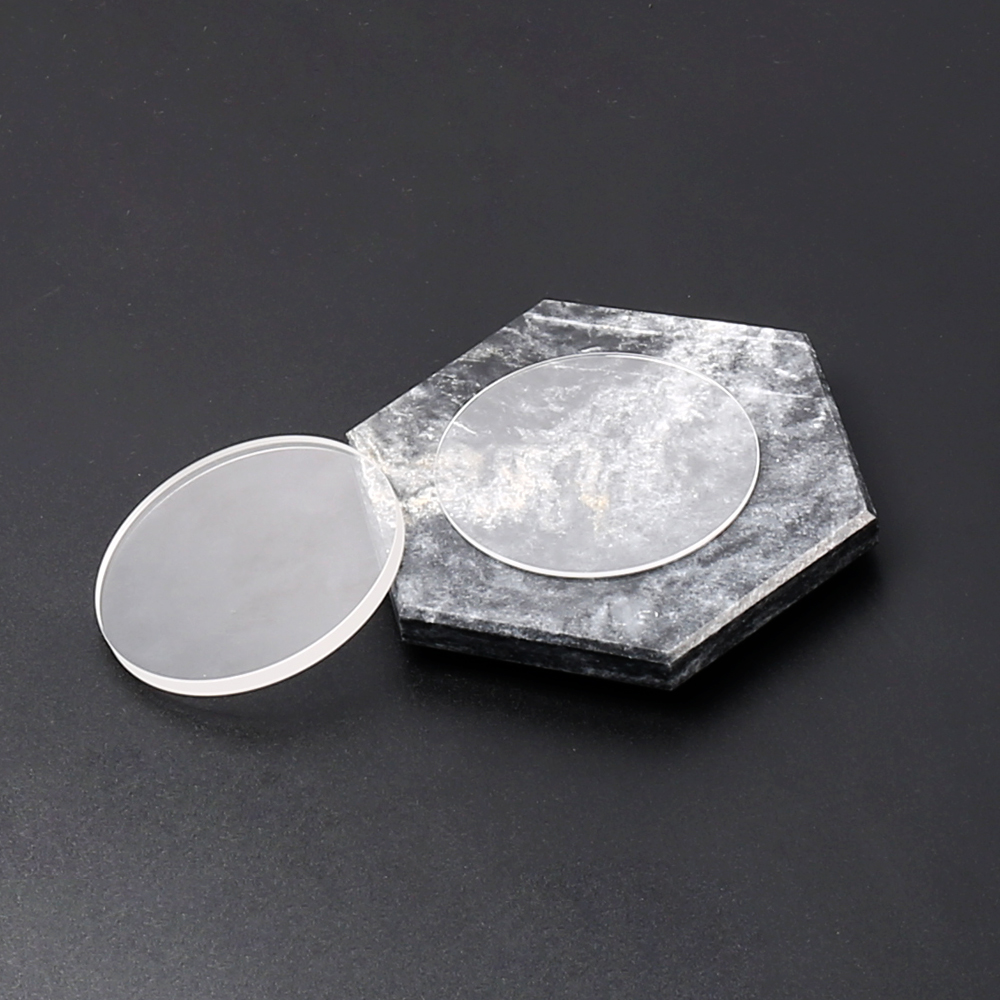
The practical value of this design becomes clear when tracing a window through a full operating cycle. During room-temperature installation at 25°C, the radar operates in its high-frequency band for commissioning. As the environment moves into the baking stage of 400–600°C, the frequency tracking adjusts automatically. When molten steel pouring reaches about 1,000°C, the system locks onto the optimal frequency point for that thermal state. Installation guidance further recommends that the radar beam be as perpendicular as possible to the window surface, with deviation below 5 degrees, to prevent transmission peak shift caused by oblique incidence. A complementary air curtain protection recommendation — compressed air cooling below the window — can reduce window temperature from 1,000°C to around 700°C while purging dust, extending service life and keeping the wave-transparent path clean.
Service and Deployment Approach
Sun Yin Crystal's service model centers on customized simulation for the actual flame baffle plus compressed air cooling process, paired with engineering implementation guidance. The scope covers material property evaluation, optimized window thickness design, double-sided ultra-precision polishing, and installation and operation recommendations. This end-to-end scope reflects the reality that a high-temperature sapphire window is not a drop-in commodity part; it is a calculated component whose thickness, orientation, and installation angle are all derived from the specific thermal and radar conditions of a given ladle or tundish site.
Who Benefits From This Solution
The solution is positioned for steelmaking production sites operating ladles and tundishes, where quartz glass windows have historically failed from long-term high-temperature exposure. More broadly, the same wave-transparent design logic applies to high-temperature industrial sensing applications requiring windows that withstand extreme heat, dust erosion, and slag splashing. For operators evaluating why their existing quartz glass windows produce inconsistent radar readings over time, the underlying explanation is devitrification, and the documented alternative is a monocrystalline sapphire window engineered jointly with radar frequency behavior — the approach detailed in Sun Yin Crystal's 80 GHz millimeter-wave radar high-temperature sapphire window technical solution.
https://www.sunyinsapphire.com/
SUN YIN CRYSTAL INDUSTRY COMPANY LTD