Understanding the Challenge of Gold Mineralization Detection
Where gold mineralization is buried, geophysical surveys can help exploration teams identify subsurface contrasts worth following up. Deep targets, poor electrode contact, and field noise can make reliable measurements difficult to obtain. Reviewing readings before the survey line is dismantled gives crews time to check questionable data and repeat measurements on site.
Founded in 2011 and headquartered in Shenzhen, China, Geomative develops geophysical instruments and software for field acquisition, data processing, and subsurface interpretation. The company reports serving customers in more than 50 countries and regions.
Electrical Resistivity and Induced Polarization as Core Methods
Electrical resistivity surveys map differences in how readily the ground conducts electricity. These contrasts can help trace rock contacts, structures, and alteration zones. Induced polarization (IP) measures the ground’s response to an applied current and can help map chargeable materials such as disseminated sulfides. The relevance of either response to gold mineralization depends on the deposit type and host geology.
Geomative’s field acquisition systems include the single-channel GD-10 and GD-12 and the multichannel GD-20, GD-22, and GD-32. The GD-12 has one receive channel and a maximum transmit power rating of 7.2 kW. The GD-22 and GD-32 have six and twelve receive channels, respectively, and each has a maximum transmit power rating of 15 kW. The GD-12, GD-22, and GD-32 specify 24-bit A/D conversion, a 140 dB dynamic range, and selectable 50 Hz or 60 Hz power-line rejection rated at ≥120 dB. The GD-22 and GD-32 support more than 1,000 addressable electrodes with compatible expansion hardware. Electrode capacity describes the array size the system can manage, while receive-channel count describes parallel acquisition capacity.
The modular GD-10 and GD-20 can be configured for surface, tunnel, borehole, or underwater surveys with compatible accessories. On supported configurations, field data review lets crews check questionable measurements and repeat them while the survey layout is still in place.
Supporting Accessories for Reliable Field Acquisition
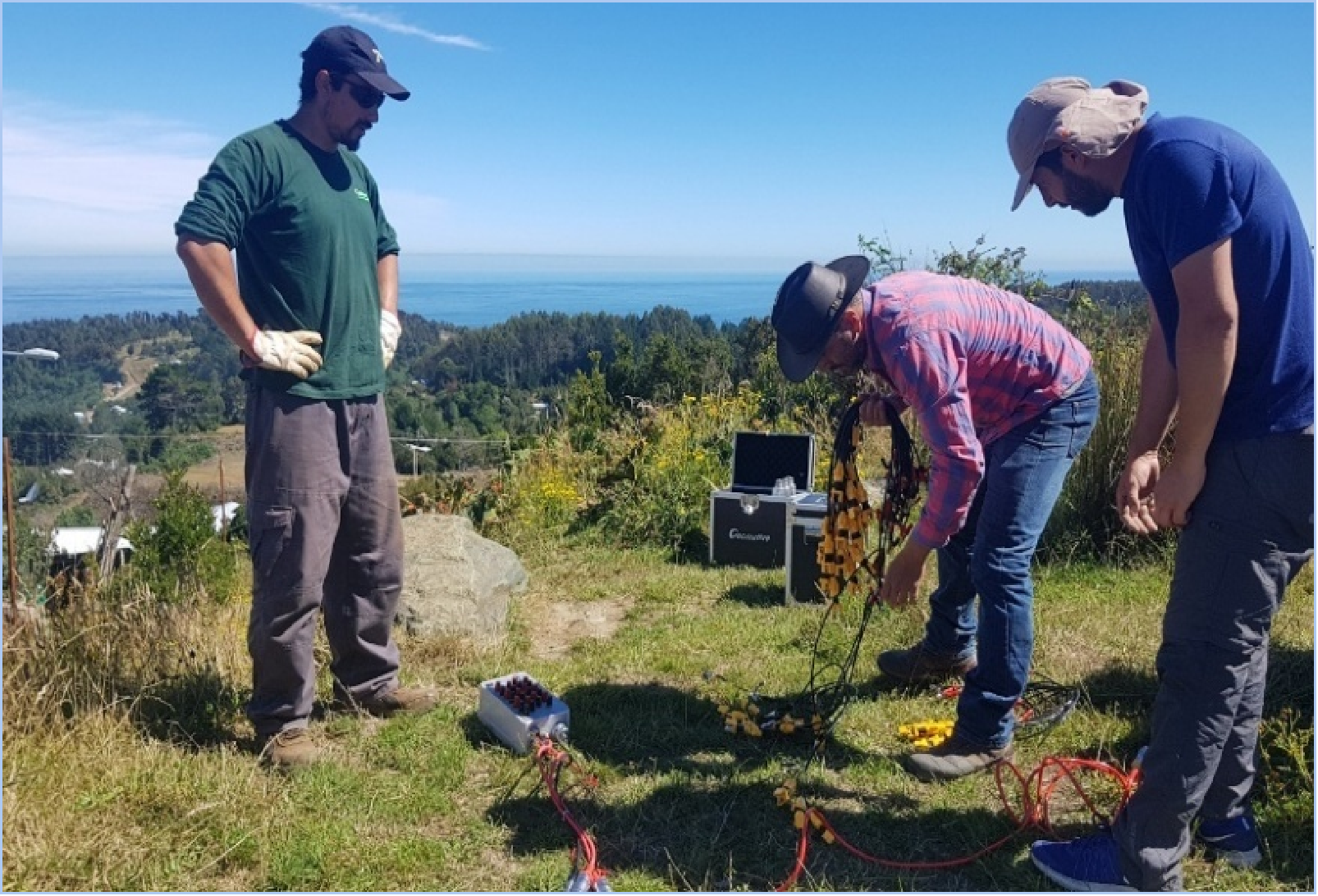
Geomative offers high-density cables for surface, water-based, and borehole layouts. Compatible SR-10 and SR-20 bidirectional cable heads support electrode switching in segmented survey layouts. For parallel acquisition, select the switching hardware and cabling to match the instrument’s receive-channel configuration.
The BP-600 and BP-1000 provide selectable or adjustable DC output and require an external power source. Check the input supply, output voltage and current, and expected field load against the proposed instrument and cable configuration.
From Field Data to Interpreted Targets: The Role of DIGspace
DIGspace supports electrical resistivity tomography (ERT) inversion, desktop 3D analysis, and web-based collaboration. Teams can compare supported ERT, ground-penetrating radar (GPR), and borehole logging data in a common 3D view. Confirm the supported workflow for the selected instrument and method module before planning online ERT inversion.
For GD-10 survey data, Geomative Studio supports export in TXT, Excel, DAT, and URF formats for downstream processing.
Field Evidence: Gold Ore Exploration in Brazil
In Pará, Brazil, Geomative documented a high-density resistivity and IP survey using a GD-10 Supreme 2D+/3D+ configuration with 24 non-polarizing electrodes. The survey investigated electrical anomalies in an area considered prospective for mineralization. The resulting sections provided a basis for interpreting those anomalies and prioritizing locations for follow-up.
Interpreting Results Responsibly
An electrical or IP anomaly identifies a contrast in subsurface properties. Its geological meaning depends on the local setting. Compare anomalies with geological mapping and available geochemical data, then use appropriate sampling, drilling, and laboratory assays to establish whether a target contains gold mineralization.
Who Relies on These Methods
Exploration geologists and mining operators can use resistivity and IP to prioritize targets where the geological model predicts measurable electrical contrasts. Research teams can use Geomative Studio’s programmable acquisition scripts to configure measurement sequences for specific survey designs. For teams evaluating geophysical methods for gold mineralization detection, the GD series offers a range of acquisition configurations that can be matched to the planned array, site conditions, and processing workflow.
https://www.geomative.com/
Geomative Co., Ltd.