 What Should Businesses Know Before Installing Battery Storage?
Commercial battery storage installation requires more than selecting a battery cabinet. Businesses must evaluate electricity demand, electrical infrastructure, installation space, grid connection requirements, and long-term operating objectives.
A well-planned commercial battery energy storage system (BESS) can support peak shaving, time-of-use optimization, solar self-consumption, and backup power when appropriately configured.
Integrated solutions such as the RENAC RENA5000 C&I BESS can simplify system planning by combining battery storage, power conversion, and intelligent energy management in a coordinated architecture.
However, successful installation starts with understanding the site's existing conditions.
1. Evaluate Electricity Demand and Battery Capacity
Before installing commercial battery storage, businesses should analyze historical electricity consumption.
Important information includes maximum power demand, daily energy consumption, peak electricity periods, and existing solar PV generation.
Two technical specifications are particularly important:
Battery Power (kW): Determines how much electrical power the system can deliver at one time.
Battery Energy Capacity (kWh): Determines how much energy the system stores.
For example, the RENAC ESS-261 offers 125kW rated power and 261kWh nominal battery capacity.
This configuration may be suitable for certain commercial applications, but actual sizing depends on the facility's load profile, usable battery energy, and operating strategy.
Businesses should also determine whether the main objective is electricity cost optimization, renewable energy integration, or backup power.
2. Check Commercial Battery Storage Installation Requirements
Installation Space and Site Conditions
The selected location must provide adequate space for equipment placement, maintenance access, and safe operation.
Project planners should evaluate equipment dimensions, foundations, access routes, environmental conditions, and clearance requirements.
Outdoor installations also require consideration of weather exposure and the equipment's specified environmental limits.
Electrical Infrastructure
Commercial BESS installations must integrate with the site's existing electrical distribution system.
Important considerations include transformer capacity, switchgear, protection devices, cable routing, and electrical connection points.
A qualified electrical engineer should verify system compatibility before installation.
Fire Safety and Protection
Battery storage safety is an essential part of project planning.
Installation requirements may include fire protection measures, emergency access, electrical isolation, and compliance with applicable local codes.
For example, NFPA 855 addresses stationary energy storage installation requirements in jurisdictions where it applies.
Businesses should confirm the relevant local regulations and manufacturer installation instructions rather than assuming one standard applies everywhere.
3. Choose the Right Solar and Battery Configuration
Commercial battery storage can be installed independently or integrated with solar PV systems.
Two common approaches are AC coupling and DC coupling.
AC-Coupled Battery Storage
AC coupling is often suitable for existing commercial solar installations.
Compatible original PV inverters can remain in operation while battery storage is added to the AC electrical system.
This approach may reduce unnecessary equipment replacement during solar system upgrades.
DC-Coupled Battery Storage
DC coupling can be considered for new solar-plus-storage projects.
A compatible system architecture allows solar generation and battery storage to be coordinated on the DC side.
The choice depends on project objectives, existing equipment, system design, and installation conditions.
The RENAC RENA5000 solution supports flexible AC/DC coupling configurations for different commercial and industrial applications.
4. Understand Commercial Battery Storage Installation Costs
The total cost of a commercial BESS project includes more than the battery equipment itself.
Businesses should consider several cost categories:
Equipment Costs: Battery cabinets, power conversion equipment, energy management systems, and required protection devices.
Electrical Integration: Switchgear modifications, cabling, transformers, metering, and grid connection work.
Installation and Commissioning: Foundations, equipment placement, electrical testing, configuration, and system verification.
Long-Term Operating Costs: Maintenance, monitoring, electricity losses, and potential equipment replacement.
Installation costs vary significantly according to site conditions and system complexity.
A detailed site assessment is necessary before preparing an accurate project quotation.
5. RENAC RENA5000: Integrated Commercial Energy Storage
The RENAC RENA5000 C&I Battery Energy Storage Solution is designed for commercial and industrial applications requiring flexible energy management.
Its ESS-261 all-in-one energy storage cabinet features:
| Specification | Details |
|---|---|
| Rated Power | 125kW |
| Nominal Energy Capacity | 261kWh |
| Battery Technology | LFP |
| System Architecture | All-in-One |
| Configuration | Modular |
| Energy Management | Intelligent EMS |
The integrated system design helps simplify equipment coordination and project deployment.
RENAC's intelligent Energy Management System (EMS) supports battery charging and discharging strategies for peak shaving, time-of-use optimization, and renewable energy integration.
For facilities requiring backup power, compatible configurations can incorporate STS equipment to support grid-connected and off-grid operation.
Final equipment selection should reflect the site's electrical requirements and operating objectives.
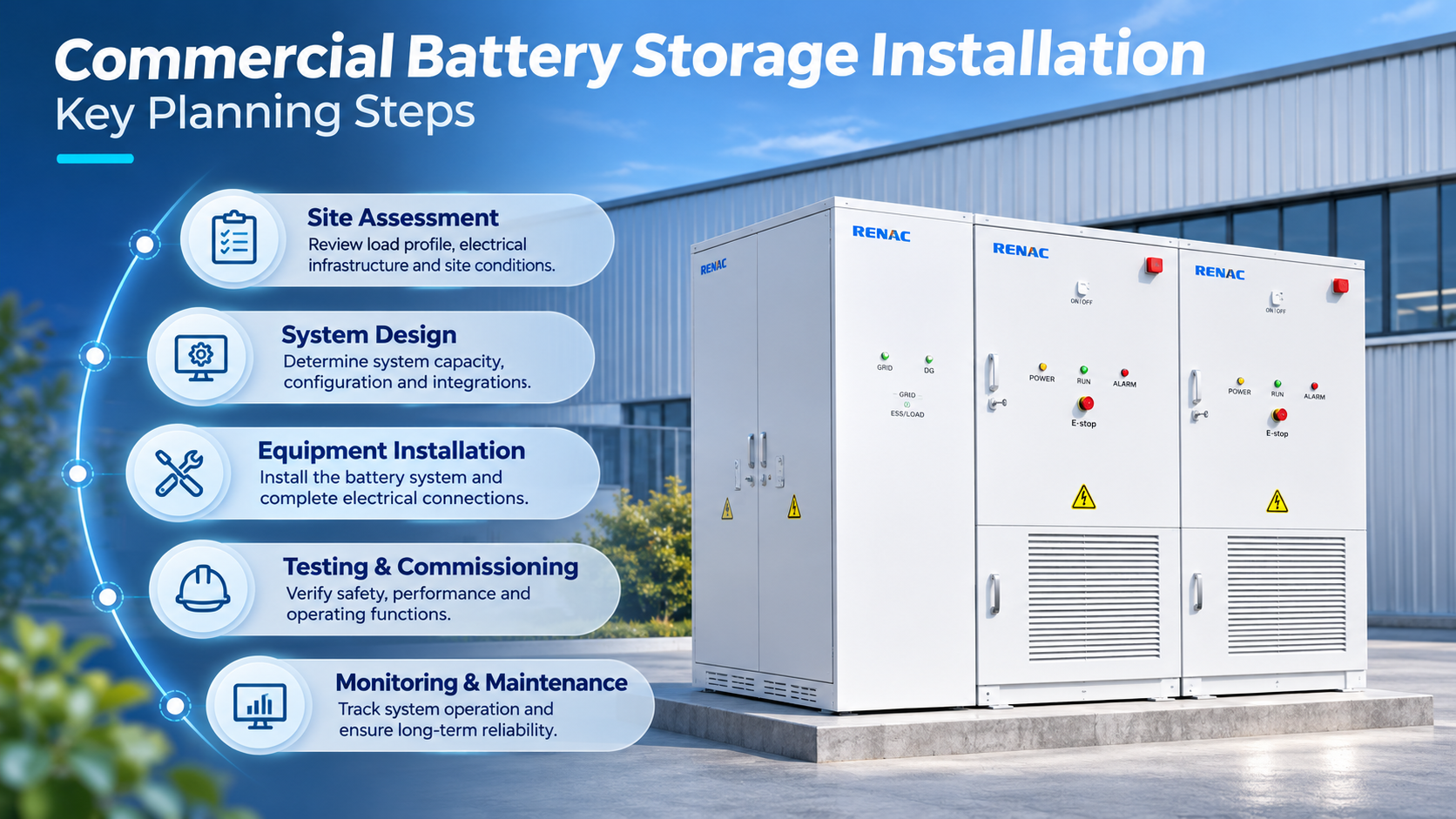
6. What Happens During Battery Storage Installation?
A typical commercial BESS project follows several stages.
Step 1: Site Assessment
Engineers review electricity consumption, electrical infrastructure, installation conditions, and project objectives.
Step 2: System Design
The project team selects suitable battery power, energy capacity, electrical protection, and energy management strategies.
Step 3: Equipment Installation
Qualified personnel install the battery system and complete the required electrical connections.
Step 4: Testing and Commissioning
The installation is checked for electrical safety, communication performance, control settings, and intended operating functions.
Step 5: Monitoring and Maintenance
After commissioning, ongoing monitoring helps identify abnormal operating conditions and evaluate system performance.
Actual procedures depend on the selected equipment and applicable local requirements.
Frequently Asked Questions
How long does commercial battery storage installation take?
Installation time depends on system size, site preparation, electrical modifications, grid approval, and commissioning requirements.
An integrated battery cabinet may simplify some installation activities, but the complete project schedule must be evaluated individually.
Can battery storage be added to an existing commercial solar system?
Yes. AC-coupled battery storage can often be integrated with compatible existing solar PV systems without replacing the original PV inverters.
Electrical compatibility and grid connection requirements must be verified.
Does commercial battery storage require grid approval?
Grid-connected battery systems may require approval or notification under applicable local utility regulations.
Requirements vary depending on the project location, system capacity, and connection arrangement.
Can commercial battery storage provide backup power?
Yes, when the system includes suitable switching, protection, and control equipment.
Backup power capability depends on the complete installation design, battery capacity, and connected loads.
What maintenance does a commercial battery storage system need?
Maintenance typically includes system monitoring, inspection of electrical components, review of alarms, and verification of operating conditions.
The maintenance schedule should follow the manufacturer's instructions and applicable safety requirements.
Conclusion
Successful commercial battery storage installation requires careful planning, suitable equipment, and professional system integration.
Businesses should evaluate electricity demand, installation space, electrical compatibility, safety requirements, and long-term operating costs before selecting a commercial BESS.
With its modular architecture, integrated ESS-261 battery storage cabinet, and intelligent EMS, the RENAC RENA5000 C&I BESS offers a practical option for businesses planning commercial energy storage installations.
Explore Commercial & Industrial Energy Storage Solutions:
https://www.renacpower.com/
RENAC Power