Understanding the Aftermarket Need for Steering Dust Cover Protection
Steering system reliability depends on components that are often overlooked until failure occurs. Among these, the dust cover protecting the tie rod assembly plays a critical role in preventing mud, water, and oil from entering the steering gear interior. When contaminants breach this barrier, the result is hard steering or, in more severe cases, system failure. For fleet operators, repair shops, and vehicle owners searching for aftermarket steering dust cover solutions, the choice of material and design directly affects both safety outcomes and total cost of ownership. Masuma, an automotive component brand, addresses this need through a dedicated Tie Rod Dust Cover product line built on differentiated material science and application-specific engineering.
Masuma's Tie Rod Dust Cover Product Line
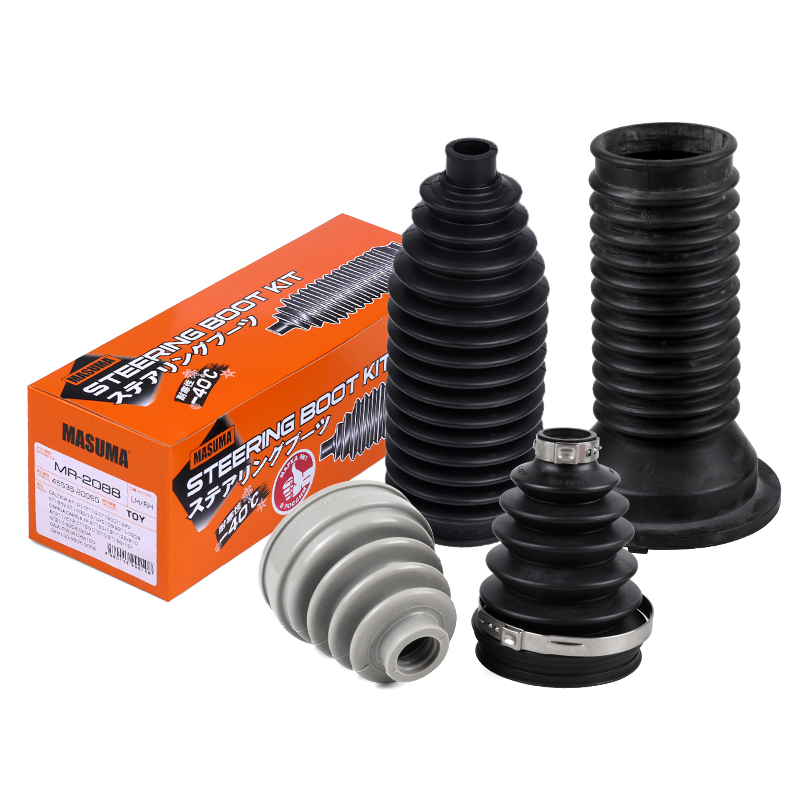
The Tie Rod Dust Cover line is positioned around steering gear protection and safety assurance, offering three distinct material variants to match different operating conditions.
Neoprene Tie Rod Dust Cover This variant is positioned as flexible standard steering gear protection, aimed at compact cars, sedans, and light trucks. It targets the common pain point of mud, water, and oil ingress that leads to hard steering or system failure. Its differentiated value lies in a balance of flexibility and wear resistance suited to standard driving conditions. The accordion fold design adapts to steering movements, preventing contaminant entry into the steering gear interior throughout the range of steering motion.
TPEE Tie Rod Dust Cover Positioned for high-strength steering protection where mechanical requirements are more demanding, this variant addresses chemical exposure and mechanical fatigue in steering systems. Its chemical resistance increases as hardness improves, meaning resistance to polar liquid chemical media strengthens along with the material's hardness rating. Fatigue resistance is achieved through adjustment of the soft and hard sections within the thermoplastic elastomer, giving the cover high tensile strength capable of withstanding repeated steering stresses.
Silicone Tie Rod Dust Cover Built for heavy-duty protection in extreme climates, this variant is aimed at commercial vehicles and heavy-duty machinery. It directly answers the pain point of protection failure and material hardening in extremely cold weather. The silicone formulation stays flexible and durable under harsh climatic conditions, and its low-temperature flexibility maintains steering system protection in extreme cold, which is a safety consideration for heavy machinery operating in demanding environments.
Material Science Behind Reliable Protection
The performance differences across Masuma's dust cover offerings trace back to the underlying material chemistry. TPEE, or thermoplastic elastomer, spans a hardness range of Shore D30-82, giving manufacturers the ability to select a specific hardness suited to a given application's mechanical demands. This material has a brittle point lower than -70°C and supports long-term operation at -40°C, which explains why TPEE-based covers are described as functioning reliably in extreme temperature environments. Structurally, TPEE is a linear block copolymer containing PBT hard segments and aliphatic polyester or polyether soft segments, and this composition is what allows the material to combine rubber-like elasticity with plastic-like processability, enabling customized hardness and design for each product application.
Neoprene, used in the standard-condition dust covers, is valued for its resistance to bending, twisting, and compression, along with flame retardancy. Masuma specifically uses Japanese Neoprene, noted for anti-aging and wear resistance qualities that support extended component life under repeated mechanical stress. Silicone, meanwhile, is selected specifically for its flexibility in extreme cold, making it the material of choice when a steering or drivetrain component must operate reliably well below standard temperature thresholds.
Complementary Protection Across the Steering and Suspension System
While the Tie Rod Dust Cover line directly serves the aftermarket steering dust cover category, steering safety is closely connected to adjacent suspension and drivetrain components that Masuma also protects. The Ball Joint Dust Cover, made from Neoprene, protects the critical junction of steering linkages and addresses the risk of tie rod seizure or fracture caused by friction, water ingress, or dust. This cover retains 3-4 grams of internal grease to reduce joint friction, includes flame-retardant material formulation, and resists water immersion even under long-term water contact or soil burial. It is designed for passenger vehicles and reflects the same Japanese Neoprene quality standard applied across Masuma's Neoprene product family.
Beyond the steering linkage itself, the Shock Absorber Dust Cover and Buffer Rubber Stack protect the suspension system from dust, mud, and debris that could scratch components or cause lubricating oil leaks, while the Drive Shaft Boot Kit line protects CV joints from water and sand ingress that cause abnormal wear or breakage. Together, these product lines illustrate a broader value proposition: providing comprehensive protection for critical vehicle suspension, steering, and drivetrain components to extend service life and support passenger safety.
Maintenance and Deployment Considerations
Aftermarket steering dust cover solutions are only effective when paired with appropriate maintenance practices. Masuma recommends replacing Ball Joint Dust Covers every 20,000 kilometers for typical passenger vehicles, a benchmark that helps fleet operators and independent repair shops plan preventive maintenance schedules rather than waiting for failure symptoms to appear. For CV Joint Boots, professional installation is required, including specific grease filling of 140 grams and the use of specialized pliers for circlip locking, underscoring that these are precision hardware components rather than simple bolt-on parts. Steering gear maintenance more broadly requires specific dismantling steps and professional alignment checks, reinforcing the importance of qualified installation when replacing any dust cover in the steering assembly.
Industry Coverage and Application Fit
Masuma's dust cover portfolio is designed to serve a range of industries, including automotive, commercial transportation, and heavy-duty machinery, with customer types spanning passenger vehicle owners, commercial fleet operators, and industrial machinery users. The Neoprene Tie Rod Dust Cover suits compact cars, sedans, and light trucks where standard driving conditions prevail, while the Silicone Tie Rod Dust Cover is matched to commercial vehicles and heavy-duty machinery operating in harsher climates. This tiered approach allows buyers to select a dust cover based on their specific operating environment and mechanical requirements rather than relying on a single generic solution.
Conclusion
For businesses and vehicle owners evaluating aftermarket steering dust cover solutions, the decision ultimately comes down to matching material properties to operating conditions: Neoprene for balanced, cost-effective standard protection; TPEE for chemical resistance and fatigue performance under mechanical stress; and Silicone for flexibility in extreme cold. Masuma's Tie Rod Dust Cover line, supported by complementary Ball Joint, Shock Absorber, and Drive Shaft protection products, reflects a material-driven approach to steering and suspension component protection, built around Japanese Neoprene, TPEE, and Silicone technologies suited to distinct vehicle categories and climate conditions.
https://masuma.com/
MASUMA Auto Spare Parts Co., Ltd.