Semiconductor and third-generation semiconductor manufacturers running high-temperature crystal growth and MOCVD processes face a persistent engineering challenge: how to protect graphite components from degradation when temperatures climb past 1600°C in corrosive hydrogen or ammonia atmospheres. VeTek Semiconductor, the brand under Wuyi Tianyao New Material Technology Co., Ltd., addresses this exact pain point through its CVD Tantalum Carbide (TaC) coating technology, applied to susceptors, covers, rings, and other graphite-based components used across PVT SiC crystal growth and high-temperature MOCVD equipment.
Understanding the CVD Tantalum Carbide Coating Technology
At the core of this product line is a protective coating engineered for environments where traditional silicon carbide coatings begin to degrade or react with hydrogen, causing graphite outgassing and crystal defects. VeTek's Tantalum Carbide Coating (Services & Components) is applied via chemical vapor deposition onto customer-specified or in-house machined graphite parts, with processing dimensions reaching up to 750mm in diameter.
Temperature Tolerance and Chemical Resistance
The defining technical characteristic of this coating is its melting point of up to 3880°C, which allows coated graphite parts to be utilized in process environments up to 2600°C. This is particularly relevant for PVT SiC crystal growth and high-temperature MOCVD, where reactive gases such as H2, NH3, SiH4, and Si vapors would otherwise attack unprotected graphite surfaces. The coating's chemical resistance profile is designed specifically to withstand these corrosive atmospheres without breaking down.
Conformal Coverage and Coating Adhesion
Beyond raw temperature tolerance, the coating maintains a uniform layer thickness of typically 30–40μm, even across complex geometries commonly found in susceptor and ring designs. VeTek also reports that its CVD TaC Purity reaches 99.99953%, an overall purity classification of 5N, which reduces the risk of impurity-driven contamination during crystal growth. For components using a buffer layer approach, such as the TaC Coating Guide Ring / Deflector Ring, bonding strength between the TaC coating and the graphite substrate exceeds 3 MPa, helping to prevent peeling during repeated thermal cycling. The coefficient of thermal expansion is matched to the graphite substrate, further supporting long-term thermal compatibility.
Susceptor and Component Applications
The tantalum carbide coating is not limited to a single component type. It spans several product forms built for different roles within crystal growth and epitaxy equipment.
Tantalum Carbide Coated Cover for MOCVD Systems
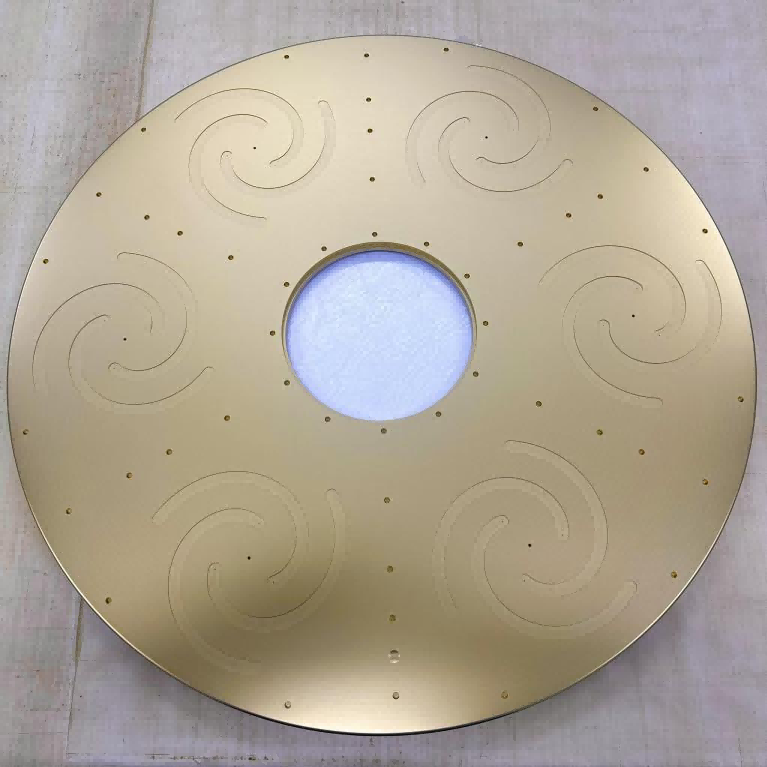
One notable application is the Tantalum Carbide Coated Cover, positioned as a susceptor cover for AIXTRON G10 MOCVD systems. Standard susceptor covers in this equipment class tend to degrade rapidly, requiring frequent replacements and causing downtime. VeTek's coated cover is built with refined thermal stability and custom dimensions to protect wafer carriers and extend preventive maintenance cycles. Purity control is also emphasized here: transition element impurities including Fe, Ni, and Cu are kept below 1ppm, and the covers are adaptable to multiple wafer sizes through custom configurations.
TaC Coating Guide Ring and Three-petal Ring
For physical vapor transport (PVT) crystal growth, graphite degradation can release carbon impurities that cause micropipes and edge defects in growing single crystals. The TaC Coating Guide Ring / Deflector Ring restricts this impurity migration through a high-purity TaC layer, supporting improved SiC and AlN single crystal yields. A related component, the TaC Coated Three-petal Ring, is a segmented support ring used in epitaxial reactors, where component cracking and gas leakage from high-temperature thermal gradients are common failure modes. VeTek notes that its tantalum carbide barrier on this component is 6 times more resistant to high-temperature ammonia than SiC, which is directly relevant to GaN MOCVD processes involving corrosive media. There is also Porous Tantalum Carbide, an advanced sublimation control material used to regulate source gas diffusion pathways in PVT furnaces, offered with custom pore sizes and purity verified below 5ppm.
Manufacturing Capabilities Behind the Coating
These coated components are produced within VeTek's vertically integrated manufacturing system, which spans prefabrication, hot pressing, purification, machining, and chemical vapor deposition, with dimensional capability exceeding 700mm. The company operates dual R&D centers — the Liufang R&D Center and the Yongjiang Laboratory Thermal Field Materials Innovation Center — and maintains an R&D investment level exceeding 30% of annual revenue. Quality verification relies on testing infrastructure including Glow Discharge Mass Spectrometry (GDMS), Dynamic Secondary Ion Mass Spectrometry (D-SIMS), Scanning Electron Microscopy (SEM), Energy Dispersive Spectroscopy (EDS), X-ray Diffraction (XRD), scratch testers, and coordinate measuring machines. The company's components are also built to be compatible with international equipment platforms such as Applied Materials (AMAT), ASM, Tokyo Electron (TEL), LPE, Aixtron, NuFlare, Veeco, AMEC, Centrotherm, and PVA TePla.
Proven Performance in Real-World Deployments
A documented benchmark case involves Rohm Group Company (SiCrystal), a global producer of silicon carbide substrates based in Germany/Japan, which required crystal growth furnace protection in highly corrosive, high-temperature PVT environments. VeTek supplied CVD TaC coated graphite components along with pyrolytic carbon coatings. The reported quantified results include extending graphite crucible reuse cycles to 200 hours, achieving zero weight loss in high-temperature environments, and reducing crystal defect densities such as micropipes and etch pits. Client feedback echoes this operational reliability, with one testimonial noting: "The supplier offers high quality at a reasonable price, making them a valued business partner," and another stating, "Their attention to detail and commitment to quality is excellent; we received satisfactory goods in a short term."
Quality Assurance and Certifications
VeTek's production facility holds ISO 9001:2015, ISO 14001:2015, and ISO 45001:2018 certifications, along with RoHS, REACH SVHC screening, Halogen-Free, and CNAS management system certifications. These frameworks underpin the consistency required for coatings destined for demanding semiconductor crystal growth applications.
Delivery and Support Model
For custom TaC-coated components, VeTek offers trial samples within 30 days, with custom precision items requiring CNC machining and CVD coating typically completed in 3 to 6 weeks, and bulk production orders finished within 45 days. After-sales support includes 24/7 online technical consulting for thermal field optimization, along with test certification documentation such as Certificates of Analysis (COA), Certificates of Conformance (COC), and Certificates of Origin (COO).
Taken together, the CVD Tantalum Carbide (TaC) Coated Susceptor and related component line from VeTek Semiconductor reflects a coating technology purpose-built for the extreme thermal and chemical conditions found in third-generation semiconductor crystal growth, backed by documented purity metrics, adhesion performance, and a real-world case demonstrating extended component life under sustained high-temperature operation.
https://www.veteksemicon.com/
Wuyi Tianyao New Material Technology Co., LTD