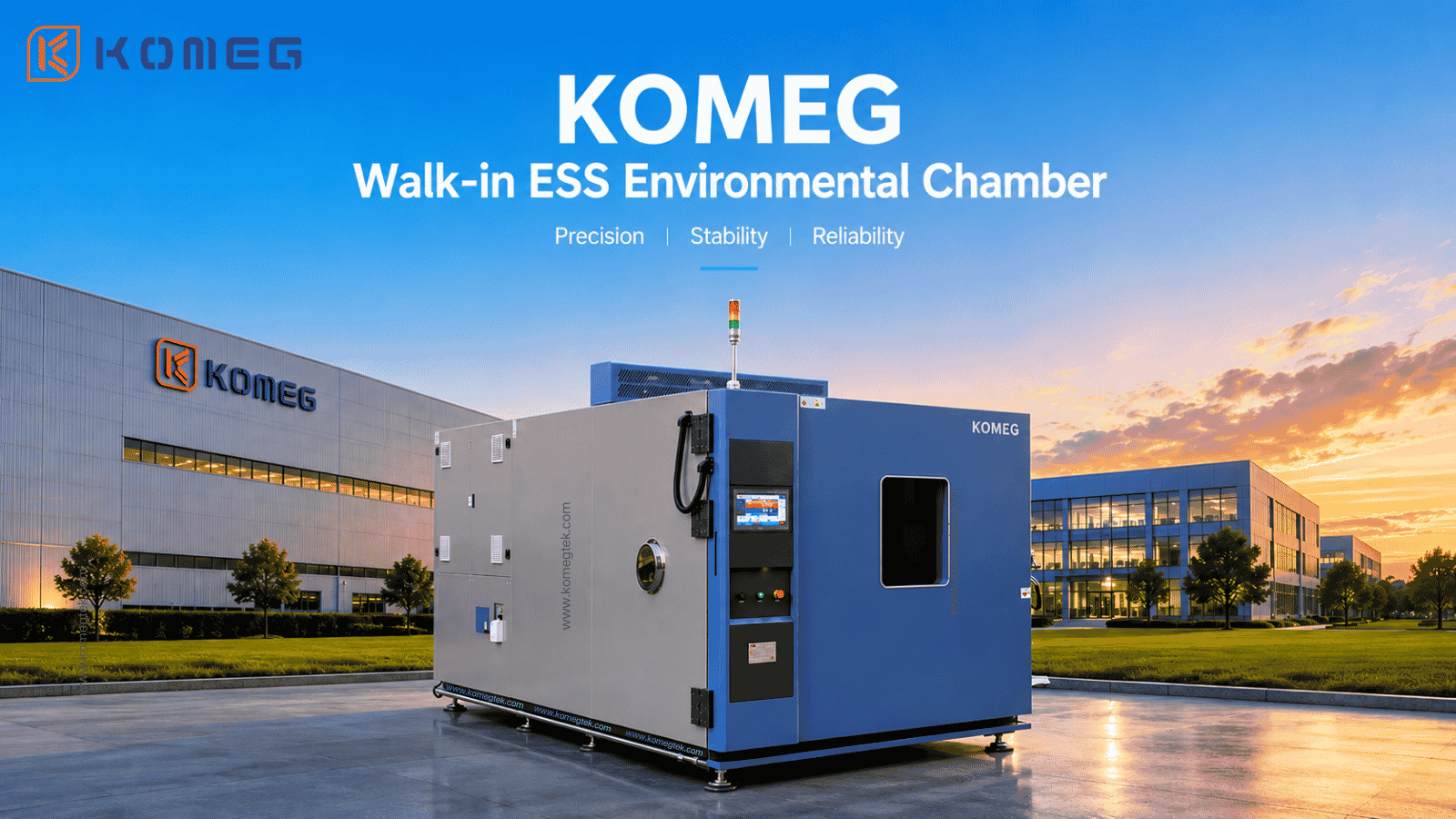
Walk-in test chambers provide a controlled environment for evaluating the reliability, durability, and performance of large products, complete assemblies, and multiple test samples under simulated environmental conditions. Compared with conventional benchtop or reach-in chambers, they offer greater testing capacity, more flexible product loading, and the ability to accommodate complex test setups. For manufacturers developing automotive systems, batteries, electronic equipment, aerospace components, and industrial products, a walk-in environmental test chamber can improve testing efficiency and support more comprehensive product validation.
However, the benefits of a walk-in test chamber extend beyond its size. Its real value lies in how well the chamber reproduces the required environmental conditions, accommodates the test specimen, and integrates into the manufacturer's quality and reliability testing process.
What Is a Walk-In Test Chamber?
A walk-in test chamber is a large environmental testing enclosure designed to simulate controlled temperature, humidity, or other specified environmental conditions. Its interior provides sufficient space for large products, assembled systems, production batches, and testing fixtures, allowing operators to enter the chamber for specimen installation, inspection, and maintenance when the design permits.
Depending on the application, a walk-in chamber may be configured for high- and low-temperature testing, temperature and humidity testing, rapid thermal cycling, environmental stress screening (ESS), or specialized testing requirements.
KOMEG offers standard and customized walk-in environmental chambers for different product sizes and test profiles. Its standard walk-in chamber range includes configurations from approximately 4 m³ to 55 m³, with temperature and humidity capabilities varying by model and configuration. Learn more about KOMEG Walk-In Environmental Chambers.
1. Accommodate Large Products and Complex Assemblies
One of the most important advantages of a walk-in test chamber is its ability to accommodate products that cannot fit inside conventional laboratory chambers. Large battery packs, automotive assemblies, industrial control cabinets, solar panels, and other oversized specimens may require a substantial testing space to reproduce their intended environmental exposure.
A larger test area also allows engineers to position fixtures, sensors, cables, and auxiliary equipment around the specimen. This is particularly useful when the test requires monitoring several locations or evaluating an assembled product rather than an individual component.
When selecting chamber dimensions, engineers should consider not only the external size of the product but also its weight, loading method, clearance requirements, airflow paths, and maintenance access. A chamber that is appropriately sized for the actual test setup is generally more practical than one selected on internal volume alone.
2. Test Multiple Samples in One Cycle
Walk-in test chambers can accommodate multiple specimens in the same test run, depending on the size of the samples and the chamber's usable working space. This creates opportunities to improve laboratory throughput and standardize test conditions across batches.
For example, an electronics manufacturer may need to evaluate several control units under the same temperature and humidity profile. A battery component supplier may need to test multiple assemblies or supporting components as part of a validation program.
Testing multiple specimens together can reduce repeated setup work and make comparisons easier. However, the chamber must be designed and loaded appropriately. Excessive loading, blocked airflow, or uneven specimen placement may create temperature or humidity differences that affect test results. Engineers should verify that the planned loading arrangement is compatible with the required uniformity and test procedure.
3. Simulate Realistic Environmental Conditions
Environmental reliability testing is intended to reveal how products respond to conditions they may encounter during transportation, storage, manufacturing, or operation. A walk-in test chamber can reproduce controlled temperature and humidity conditions over defined periods, helping engineers assess changes in product performance and material behavior.
Temperature testing can reveal issues such as thermal expansion, contraction, component instability, and temperature-related functional failures. Humidity testing can help identify moisture-related risks, including corrosion, insulation degradation, and changes in material properties.
When both temperature and humidity are required, the chamber must control these variables in coordination. The achievable conditions depend on the selected configuration, the test profile, the specimen's thermal load, and the chamber's operating limits.
The objective is not simply to reach a target temperature or humidity level. The chamber must also maintain the required conditions for the specified duration and provide sufficiently consistent conditions throughout the usable test space.
4. Improve Testing Efficiency and Laboratory Workflow
A walk-in chamber can simplify the testing of large or multiple specimens by reducing the need to divide a test program into several smaller runs. It can also provide more convenient access for loading and unloading products, installing instrumentation, and arranging complex fixtures.
For laboratories conducting recurring reliability tests, these advantages may reduce preparation time and make test procedures easier to standardize. Programmable controllers can execute predefined temperature and humidity sequences, while data interfaces can support monitoring, record retrieval, and integration with laboratory workflows.
The overall efficiency benefit depends on the application. A larger chamber is not automatically more efficient: heating, cooling, humidity control, specimen loading, and recovery after door opening all influence cycle time and operating cost. The chamber should therefore be selected around the complete test process rather than its capacity alone.
5. Support More Comprehensive Product Reliability Validation
Walk-in environmental test chambers can support product development, design verification, qualification, production quality control, and failure investigation. By exposing products to defined environmental stresses, manufacturers can identify weaknesses before products enter service.
For example, repeated temperature exposure may reveal problems associated with material expansion or contraction, while combined temperature and humidity conditions may help uncover moisture-sensitive electrical or mechanical failures. Environmental stress screening can also help identify certain manufacturing defects when the test profile is appropriately designed.
A chamber does not independently guarantee product reliability. Reliable conclusions depend on a suitable test plan, appropriate instrumentation, representative specimens, defined acceptance criteria, and accurate environmental control. The chamber provides the controlled conditions needed to carry out that plan consistently.
6. Adapt the Testing System to Different Industries
Another major benefit of walk-in test chambers is their flexibility across product categories and testing requirements. Although many industries use temperature and humidity testing, their specimen dimensions, thermal characteristics, operating conditions, and safety requirements can differ significantly.
Common applications include:
-
Automotive and electric vehicles: Testing battery packs, electronic control units, power electronics, and vehicle components under temperature and humidity exposure.
-
Battery and energy storage systems: Evaluating battery modules, packs, and related equipment under specified environmental profiles, with application-appropriate safety provisions.
-
Electronics and semiconductors: Assessing electronic assemblies, communication equipment, and other components for environmental reliability.
-
Aerospace: Testing selected avionics, electronic assemblies, materials, and components against defined environmental requirements.
-
Solar and renewable energy: Evaluating solar panels and related equipment under controlled climatic conditions.
-
Pharmaceutical and materials testing: Supporting stability studies and the evaluation of materials where controlled temperature and humidity are required.
The required chamber configuration should be determined by the product, test method, and applicable requirements rather than by industry category alone.
7. Enable Customization for Specialized Test Requirements
Standard walk-in chambers can meet many testing needs, but some applications require a customized solution. Customization may involve chamber dimensions, door openings, loading systems, cable ports, observation windows, shelving, airflow design, temperature and humidity performance, or safety interlocks.
Applications involving batteries or energy storage systems may require additional measures based on the specimen's hazards and the intended test procedure. Depending on the project, these may include gas detection, smoke detection, ventilation, emergency shutdown, pressure relief, or interfaces with external fire-protection systems. Such features should be assessed through application-specific risk analysis rather than assumed to be necessary for every chamber.
Customization should begin with a clear definition of the test specimen, environmental profile, loading arrangement, required performance, installation conditions, and safety requirements. This helps ensure that the chamber's mechanical structure, refrigeration capacity, airflow, controls, and protection systems are designed to work together.
8. What Should You Consider Before Choosing a Walk-In Test Chamber?
To obtain the full benefits of a walk-in test chamber, buyers should evaluate several engineering factors before selecting a system.
Chamber dimensions and usable space: Define specimen dimensions, weight, quantity, clearance, access, and loading equipment.
Temperature and humidity range: Specify the minimum and maximum setpoints, required humidity range, dwell times, and sequence of environmental conditions.
Temperature uniformity and stability: Confirm the required performance across the usable workspace and under representative loading conditions.
Thermal load and recovery time: Consider specimen mass, materials, internal heat generation, and the chamber's ability to return to the target conditions after loading or door opening.
Airflow and loading configuration: Ensure that racks, fixtures, products, and cables do not obstruct circulation or create unacceptable environmental differences.
Control, monitoring, and data: Review programming functions, communication interfaces, data recording, alarms, and the need for external instrumentation.
Safety and installation: Assess electrical supply, cooling utilities, drainage, floor loading, access routes, maintenance space, and application-specific hazards.
A clear specification makes it easier to compare chamber proposals on practical performance rather than price or chamber volume alone.
Why Choose KOMEG Walk-In Environmental Test Chambers?
KOMEG develops environmental testing systems for applications that require controlled and repeatable environmental conditions. Its walk-in environmental chambers are available in standard and customized configurations, allowing customers to match chamber capacity and performance to their test specimens and procedures.
Depending on the selected model, KOMEG walk-in chambers can provide temperature and humidity control, programmable touchscreen operation, communication interfaces, cable entry ports, and safety protection systems. Custom configurations can be evaluated when a standard design does not meet the required dimensions, environmental profile, loading method, or application-specific needs.
For a suitable recommendation, provide KOMEG with the specimen dimensions and weight, number of samples, required temperature and humidity ranges, test sequence, desired ramp rates if applicable, loading method, and installation constraints. These details help determine whether a standard chamber is sufficient or a customized design is more appropriate.
Explore the KOMEG Walk-In Environmental Chamber range or contact KOMEG to discuss your application.
Frequently Asked Questions
What are the main advantages of a walk-in test chamber?
The main advantages are the ability to test large products and assemblies, accommodate multiple specimens, simulate controlled environmental conditions, support repeatable reliability testing, and customize the test space for specialized applications.
What is the difference between a walk-in chamber and a reach-in chamber?
A walk-in chamber provides a larger working space for oversized products, assembled systems, or multiple specimens. A reach-in chamber is generally more suitable for smaller components and laboratory-scale samples. The appropriate choice depends on specimen dimensions, loading needs, environmental requirements, and available facility space.
Can a walk-in test chamber control both temperature and humidity?
Yes. Temperature-and-humidity walk-in chambers are designed to control both variables within specified operating limits. The available range and control performance depend on the chamber model, configuration, test conditions, and specimen load.
Are walk-in test chambers suitable for battery testing?
They can be suitable for battery modules, packs, and related equipment when the chamber is designed for the intended test profile and risk level. Battery applications may require additional safety engineering and protective systems based on the chemistry, energy level, specimen design, and test procedure.
Can a walk-in test chamber be customized?
Yes. Depending on the application, customization may include internal dimensions, door and loading arrangements, cable ports, airflow, temperature and humidity performance, control functions, and safety systems. The required configuration should be confirmed against the test specification.
How do I choose the right walk-in test chamber size?
Start with the dimensions and weight of the specimens, the number of samples tested simultaneously, the loading method, required clearances, and the space needed for airflow and instrumentation. Then verify that the chamber can meet the environmental performance requirements with the intended load installed.
The advantages and benefits of walk-in test chambers go well beyond providing a large testing space. A properly specified system can help manufacturers evaluate larger products, test multiple samples, reproduce controlled environmental conditions, improve laboratory workflow, and support product reliability validation. The best results depend on matching chamber design, environmental performance, airflow, loading, controls, and safety features to the actual application.
With standard and customized walk-in environmental chamber options, KOMEG supports manufacturers seeking practical environmental testing solutions for large products and complex assemblies. Defining the test requirements clearly is the first step toward selecting a chamber that delivers useful, repeatable results throughout the product development and quality assurance process.
https://www.komegtek.com/product-category/walk-in-environmental-chambers/
Walk-In Test Chambers