Factories have been wired with Ethernet and fieldbus for decades, and for good reason: cables are fast, deterministic, and well understood. Yet more and more of what happens on a modern shop floor does not sit still. Mobile robots move between stations, production lines are reconfigured for new products, machines are moved, rented, or added for a season, and older equipment needs connecting without opening walls and trays. For these cases, a 5G LAN router brings machines onto the plant network wirelessly, with more capacity and better mobility than older wireless options.
This article explains what "5G LAN" means in a factory context, which automation tasks suit 5G and which should remain on cable, how to design the connection, and how E-Lins 5G routers and boards fit.
What "5G LAN" Means
The phrase is used in two related ways.
A router that extends the plant LAN over 5G. The router connects machines on its Ethernet ports and links them to the plant network over a 5G connection, usually through a private network or a secure tunnel. To the plant's systems, the machines appear as part of the local network.
The 5G LAN-type service is defined by 3GPP. Release 16 introduced 5G LAN-type services, in which a group of devices can communicate as though they were on the same local network, including support for Ethernet-type sessions. Release 16 and 17 also added features for integrating 5G with Time-Sensitive Networking. These capabilities depend on the 5G network, typically a private or dedicated network, supporting them.
Many factories also use private 5G networks. Several countries have made spectrum available for local industrial networks; Germany, for example, allocated the 3.7 to 3.8 GHz band for local use. A private network gives the plant control over coverage, capacity, and which devices may connect.
Tasks That Suit 5G
Mobile robots and automated guided vehicles
Robots moving between stations need continuous connectivity for fleet management, task assignment and map updates. 5G handles mobility and capacity well, and a compact router or embedded board on each vehicle connects its controller.
Retrofitted and relocated machines
Older machines with Ethernet, serial or digital interfaces can be connected without new cabling, which is especially useful when machines are moved or when a hall is temporarily rearranged.
Flexible and temporary lines
Lines built for a product launch, a seasonal peak, or a pilot can be connected in days and reconnected elsewhere later.
Condition monitoring and quality data
Vibration, temperature, and energy sensors, and quality-inspection cameras uploading images, add data without adding cables.
Remote expert access
Vendors and in-house specialists can reach machines securely for diagnostics, without connecting them to the office network.
What Should Still Stay on Cable
Hard real-time motion control, with cycle times in the low milliseconds or below, and safety functions that rely on certified communication paths usually belong on wired industrial Ethernet or fieldbus today. The 5G standards include features aimed at low latency and time-sensitive traffic, but performance in a given plant depends on the network that is actually installed. A practical approach is to keep the tightest control loops local, on cable, and use 5G for supervision, mobility, data collection, and flexibility.
|
Task |
Suitable for 5G |
Notes |
|
Robot and AGV fleet management |
Yes |
Mobility is the main benefit |
|
Retrofitting legacy machines |
Yes |
Serial and I/O on the router help |
|
Temporary and flexible lines |
Yes |
Fast to connect and move |
|
Sensors and quality images |
Yes |
Upload capacity matters for images |
|
Supervisory control and HMI |
Usually |
Depends on latency targets |
|
Hard real-time motion control |
Usually not |
Keep on wired fieldbus |
|
Safety functions |
Usually not |
Use certified wired paths |
Designing the Connection
Layer 3 or Layer 2
Most router deployments are routed: each machine cell has its own subnet, and the router forwards IP traffic to the plant network. This is simple and scales well. Some industrial protocols, however, rely on Layer 2 broadcast or multicast for device discovery. Where that is needed, check whether the network offers Ethernet-type sessions, or whether a Layer 2 tunnel over the 5G link is supported by the router, and test it with the actual controllers.
Addressing and segmentation
Give each cell or vehicle a predictable address range and keep machine traffic separate from office and guest traffic. Firewall rules should allow only the flows each machine needs.
Electrical environment
Factories are electrically noisy: welding, variable-speed drives, and large motors generate interference. Routers need electrical isolation and protection. E-Lins specifies 15KV ESD protection and 1.5KV electromagnetic isolation, and its equipment has reached an online rate of 99.9% or higher on airport aprons with heavy electromagnetic interference from ground power units and air-conditioning equipment.
Management at scale
A plant with dozens of mobile robots and connected machines needs routers monitored and updated centrally, through protocols such as SNMP and TR-069 and a management platform.
A Phased Path Into the Plant
Few plants convert to 5G in one step. A practical sequence starts with a single use case that has a clear benefit, such as the mobile robot fleet in one hall or a group of machines that move often. Measure coverage, round-trip delay, and its variation at the actual working positions, not only at the access points, and agree on the targets with the automation team before production depends on the link. Involve both operational technology and IT staff from the start, since the router sits at the boundary between their networks. Once the first use case runs reliably for several months, extend the same router model, addressing scheme, and firewall template to the next area. Each step then builds on proven settings rather than starting again.
E-Lins Options for Factory Automation
H900f industrial 5G router: 5G SA/NSA, three Gigabit and two Fast Ethernet ports, a serial port, four DI/DO, dual SIM, Wi-Fi 5 or Wi-Fi 6 and PoE In and Out, designed for a cloud-edge collaboration deployment model. Suits machine cells, line cabinets, and retrofits.
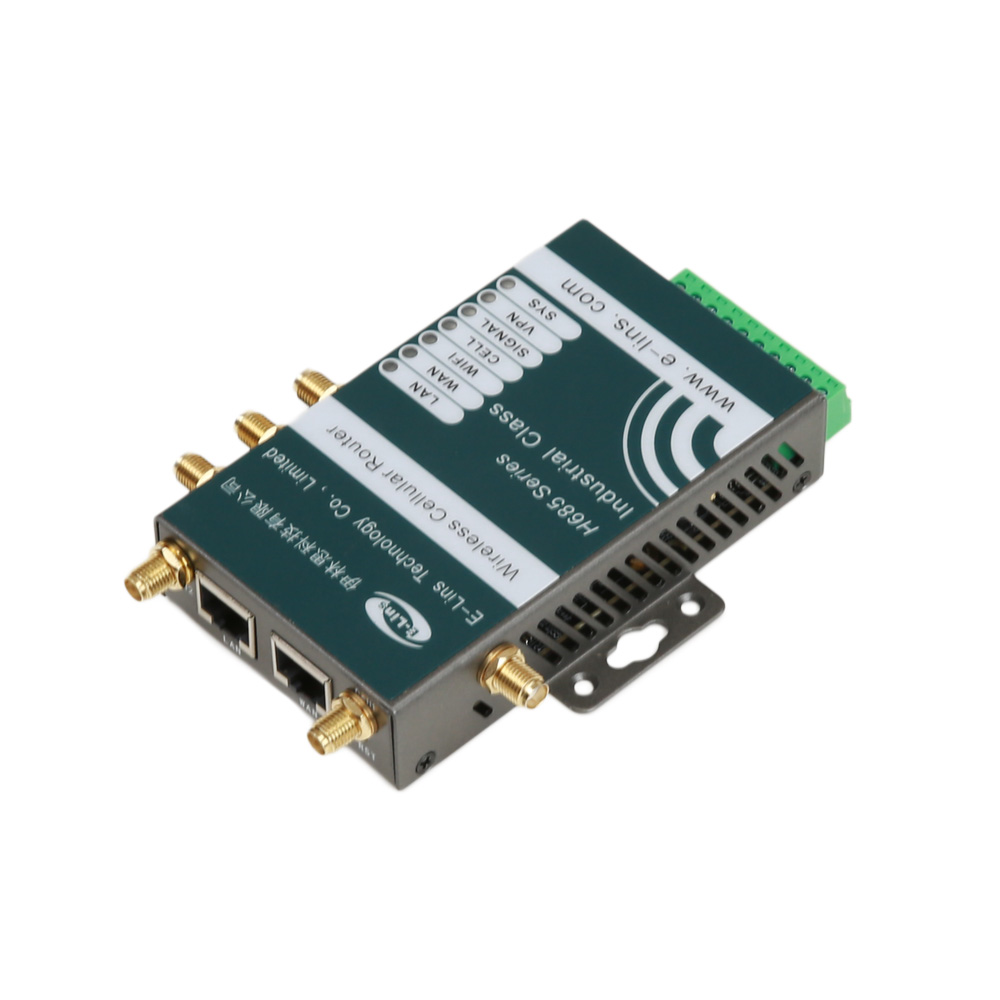
H685f mini 5G router: a super-mini format with 5G SA/NSA, Gigabit Ethernet, RS232, four DI/DO, and PoE In, for small machines and vehicles. E-Lins describes the H685f as EN 18031 compliant.
H685f-B and H900f-B embedded boards: for robot and machine builders who want 5G inside their own equipment, with Gigabit Ethernet, PoE and, on the H900f-B, dual SIM.
RedCap models such as the H685frc and H820frc: for sensor gateways and moderate-data machines on standalone 5G, at lower cost and power than full 5G; the H820frc also lists SD-WAN.
Across the range, E-Lins lists Modbus support and MQTT for cloud platforms, VPN options including WireGuard, IPsec, OpenVPN, L2TP and GRE, and management through TR-069, SNMP, SSH and the E-Lins NMS cloud platform. E-Lins has also released edge computing gateways since 2019, for plants that want some processing next to the machines.
The Manufacturer
Shenzhen E-Lins Technology Co., Ltd. has worked in industrial wireless communication since its industrial roots in 1999 and builds its 5G routers and boards in its own Shenzhen factory, with firmware developed in-house and lifetime free upgrades. Use a 5G LAN router for factory automation where mobility and flexibility create value, keep the tightest loops on cable, and the plant gets the best of both.
https://e-lins.com/
Shenzhen E-Lins Technology Co., Ltd.