Pigment dispersion is one of the key factors determining the stability and print quality of UV inks. A formulation may have suitable curing speed and adhesion, but still fail during production if pigments are not properly wetted and stabilized. Problems such as poor color development, viscosity changes, sedimentation, nozzle blockage, surface defects, and inconsistent print density can often be linked to dispersion performance.
Selecting a suitable dispersing agent therefore requires more than comparing product descriptions. Ink developers need to consider pigment chemistry, resin compatibility, pigment concentration, printing process, and the final performance requirements of the cured film.
1. Identify the Actual Dispersion Problem
The first step is to determine whether the main issue is pigment wetting, particle stabilization, viscosity, or incompatibility with the surrounding formulation.
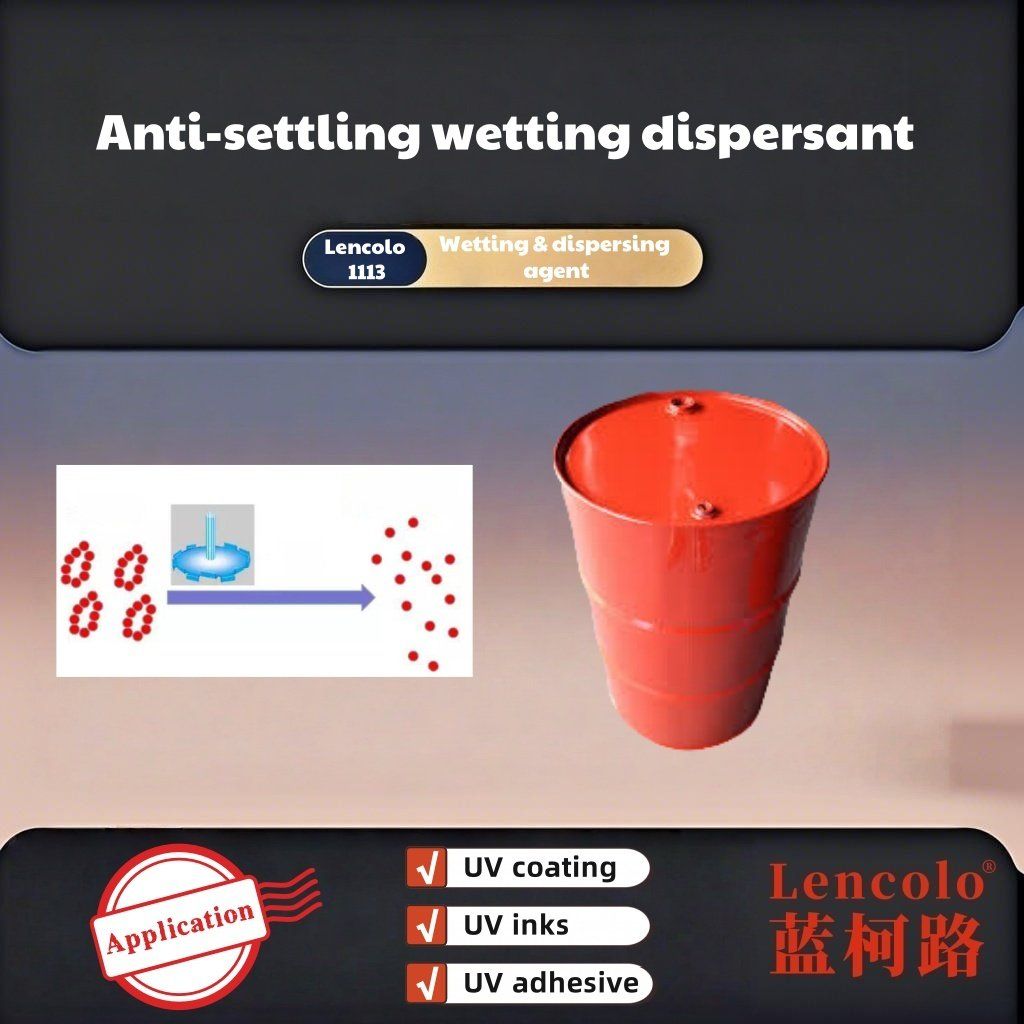
During pigment grinding, the dispersing agent helps the liquid phase wet the pigment surface and supports the separation of pigment particles. After dispersion, the agent must also help prevent particles from re-agglomerating during storage and application.
Poor pigment wetting may result in weak color strength, unstable viscosity, and uneven appearance. Insufficient stabilization can cause flocculation, sedimentation, or changes in particle size distribution. These problems may become more noticeable after the ink is diluted, stored, or combined with other components.
A dispersing agent that works well with one pigment may not provide the same results with another. Organic pigments, inorganic pigments, carbon black, and matting powders can have different surface characteristics and require different dispersion strategies.
2. Match the Dispersant to the Ink Process
The application method influences the requirements for dispersion and viscosity.
UV inkjet inks generally require carefully controlled viscosity, stable particle size, and reliable storage performance because the ink must pass through a fine nozzle system. Even small agglomerates or unstable viscosity can affect jetting behavior and print consistency.
Screen, flexographic, and offset UV inks may allow different viscosity ranges and pigment loadings, but they still require good wetting, color development, and storage stability. The selection should reflect the specific grinding process, printing equipment, and film thickness.
For matte coatings or inks containing matting powders, a dedicated wetting dispersant may be needed in addition to the base resin. Lencolo 1108/1109 is positioned as a wetting dispersant for matte powder, with good wettability as a key performance feature. Its suitability should be assessed through compatibility testing with the selected powder, resin, and additive package.
3. Understand the Difference Between Resin and Dispersing Agent
A UV resin and a dedicated dispersing agent may both influence pigment wetting, but they do not perform exactly the same function.
The resin contributes to film formation, adhesion, flexibility, hardness, and curing behavior. A dispersing agent is primarily used to improve pigment or powder wetting and stabilization. In some formulations, the resin itself may provide favorable pigment compatibility, while other systems require additional dispersant support.
For example, L-6121 is described as a low-viscosity UV polyester resin with good pigment wettability. L-6211 is a low-viscosity, two-functional UV polyurethane resin also positioned for pigment wettability. These materials may be considered when the resin system needs both suitable flow and dispersion-related performance.
However, good pigment wettability does not automatically guarantee complete dispersion stability. The final result depends on pigment surface treatment, resin polarity, additive concentration, grinding energy, and the complete formulation.
4. Balance Dispersion With Curing and Film Performance
A dispersant should not be evaluated only by its initial wetting effect. Its influence on curing, adhesion, gloss, surface properties, and long-term stability should also be examined.
For flexible printed films or substrates that may bend after printing, resin selection must support the required mechanical performance. L-6105 is positioned as a low-viscosity, high-elasticity UV polyurethane resin for applications requiring flexibility. L-8412A is described as a UV polyurethane resin for PET substrates, with high flexibility as a key feature.
When curing speed is a priority, L-6111 is positioned as a low-viscosity UV epoxy acrylic resin with fast-curing characteristics. Nevertheless, increasing curing speed or changing resin chemistry may affect pigment compatibility, shrinkage, adhesion, or surface appearance. Any adjustment should therefore be validated in the complete ink system.
5. Consider Substrate and Adhesion Requirements
A well-dispersed pigment system must ultimately produce a printed film that adheres to the target substrate. Glass, metal, PET, plastic, and flexible films can require different resin and additive combinations.
L-8400A/8400B is positioned as a UV resin for glass and hardware applications, with good adhesion as a key feature. L-6030/6040 is described as a UV pure acrylic resin for ink applications, also targeting adhesion performance.
These products illustrate why dispersion and adhesion should be evaluated together. A pigment may disperse effectively in the liquid ink but still require a different resin structure to achieve reliable adhesion after curing.
6. Evaluate Foam and Defect Control
High-shear mixing and pigment grinding can introduce air into the formulation. Foam may interfere with grinding efficiency, cause surface defects, and affect the appearance of the cured ink film.
A suitable defoamer can be evaluated alongside the dispersing agent, but compatibility is essential. Lencolo 2108 is positioned as a UV defoamer with good compatibility, while Lencolo 2190 is a silicone defoamer described as offering strong defoaming ability.
The objective is not to use the strongest defoamer available, but to achieve foam control without negatively affecting recoating, adhesion, gloss, or surface uniformity.
7. Use Application Testing to Confirm the Selection
A practical evaluation should include pigment wetting, grinding efficiency, viscosity, color strength, particle size, storage stability, and final print performance. Depending on the application, developers may also need to test curing, adhesion, flexibility, gloss, and resistance properties.
The recommended addition level should be established through a controlled dosage study rather than assumed from another formulation. Testing should compare the dispersant alone, the resin system without additional dispersant, and combinations of both where appropriate.
Conclusion
Selecting a dispersing agent for UV inks is a formulation optimization task rather than a simple product-matching exercise. The best choice depends on pigment type, resin compatibility, printing process, viscosity requirements, substrate adhesion, curing conditions, and storage stability.
Lencolo's UV material range includes resins positioned for pigment wettability, flexibility, adhesion, and curing performance, together with dedicated wetting dispersants and defoamers. These materials can provide different starting points for formulation development, but their suitability should always be confirmed through pigment-specific and application-based testing.
A systematic approach helps ink developers identify the real source of dispersion problems and build a more stable UV ink system without compromising print quality or cured-film performance.
https://www.lencolo37.com/
Guangdong Lencolo New Material Co., Ltd.