The continuous development of the whole-house customization and premium furniture market has significantly raised expectations for furniture edge banding materials. Today's manufacturers require products that not only provide reliable bonding performance but also offer superior environmental protection, moisture resistance, durability, and an attractive finish. Conventional PVC edge banding has gradually revealed its limitations, including an overly synthetic appearance, weak texture, susceptibility to edge lifting, reduced adhesion in humid conditions, poor abrasion resistance, and a tendency to yellow and age over time. These shortcomings make it increasingly difficult to satisfy the demands of high-end residential furniture, kitchen and bathroom applications, hospitality projects, and international export markets.
To address these challenges, PVC WPC edge banding has emerged as an upgraded edge sealing solution developed through advanced composite modification technology. Manufactured by combining carefully proportioned wood fibers with premium PVC resin through a co-extrusion process, this innovative material blends the warm appearance of natural wood with the strength, stability, and processing advantages of polymer materials. As a result, it has become an ideal alternative to traditional PVC edge banding for modern furniture manufacturing.
From a manufacturing perspective, PVC WPC edge banding utilizes precision wood-fiber modification technology together with high-temperature co-extrusion molding. This advanced production process effectively overcomes common issues associated with conventional wood-plastic materials, including delamination, inadequate adhesion, and insufficient flexibility. The finished product features a consistent internal structure and uniform density, while its thermal expansion characteristics closely match widely used furniture panels such as MDF, particle board, and plywood. It is fully compatible with existing automatic edge banding equipment, requiring no machine adjustments, and performs efficiently with both EVA and PUR hot-melt adhesives. The resulting edge finish is smooth, clean, and free from burrs, whitening, or edge cracking, making it suitable for straight, curved, and irregular furniture components.
Environmental performance is another important advantage of PVC WPC edge banding. Produced with a formaldehyde-free and environmentally friendly formulation, it contains no harmful heavy metals, halogen compounds, or low-quality plasticizers. The material releases extremely low levels of formaldehyde, produces no unpleasant odor, and generates virtually no VOC emissions during use. These characteristics make it a healthy and safe option for residential interiors, including bedrooms and children's rooms, while also meeting stringent environmental standards required for international furniture exports and commercial construction projects.
In terms of performance, PVC WPC edge banding provides significantly greater hardness than ordinary PVC alternatives, offering excellent resistance to scratches, impacts, and daily wear. It helps furniture maintain a clean and attractive appearance even after prolonged use. Outstanding waterproof, moisture-resistant, and mildew-resistant properties enable the material to perform reliably in demanding environments such as kitchens, bathrooms, balconies, and regions with consistently high humidity. Even after long-term exposure to moisture, it resists swelling, deformation, and mold growth.
The product also delivers exceptional bonding stability. Once applied, the edge remains firmly attached without lifting, cracking, or separation, while maintaining its appearance without discoloration or yellowing over time. Excellent resistance to temperature fluctuations, aging, and termite damage further extends its service life, making it considerably more durable than conventional PVC edge banding.
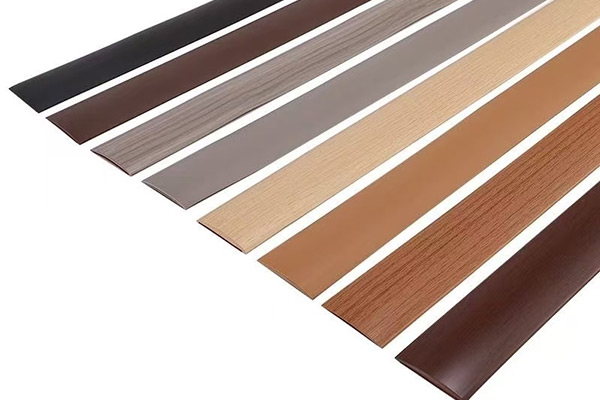
Beyond its functional advantages, PVC WPC edge banding also enhances the visual appeal of finished furniture. Its natural wood-like texture eliminates the cold, artificial feel often associated with traditional plastic edging. High-definition wood grain synchronization, excellent color consistency, and a wide range of available finishes—including matte, high-gloss, solid-color, and wood-grain designs—allow manufacturers to achieve a more refined and premium appearance that complements contemporary furniture styles.
Today, PVC WPC edge banding has become one of the preferred edge sealing materials for customized furniture, wardrobes, kitchen cabinets, bathroom vanities, office furniture, hotel furnishings, and export-oriented manufacturing. Supported by advanced production technology, reliable product quality, and well-balanced performance, it enables furniture manufacturers to improve product durability, aesthetics, and environmental performance simultaneously. As market expectations continue to evolve, PVC WPC edge banding is playing an increasingly important role in driving the next generation of high-quality, sustainable furniture production.
www.xc-edgetape.com
Chengdu Xincheng Decoration Materials Co., Ltd.