
What Is a Temperature Forcing System?
A Temperature Forcing System is a specialized thermal testing instrument that delivers controlled hot or cold air directly to a device under test (DUT). It enables engineers to evaluate the electrical performance, functional stability, and temperature-dependent behavior of individual semiconductor devices and electronic components under controlled thermal conditions.
Unlike a conventional environmental test chamber, which regulates the temperature of an entire enclosed space, a Temperature Forcing System focuses on a specific component or testing area. This localized approach is particularly useful for semiconductor characterization, integrated circuit (IC) testing, electronic component evaluation, and thermal-related failure analysis.
For laboratories and electronics manufacturers, selecting the right Temperature Forcing System can improve testing flexibility, support repeatable measurements, and help engineers identify temperature-related performance issues during product development.
How Does a Temperature Forcing System Work?
A Temperature Forcing System works by generating temperature-controlled airflow and directing it toward the target device through a nozzle. The system adjusts the air temperature according to the programmed test conditions, allowing the device to be evaluated at different thermal setpoints.
A typical testing process involves four steps:
-
Set the test temperature: The engineer defines the target temperature and testing sequence according to the device specifications and test objectives.
-
Generate controlled airflow: The system produces hot or cold air to achieve the required thermal conditions.
-
Direct airflow toward the DUT: An adjustable arm and suitable nozzle position the airflow around the target component.
-
Monitor device temperature and performance: External sensors and electrical measurement instruments can be used to monitor temperature and evaluate device behavior during testing.
The actual temperature response of the DUT depends on several factors, including package size, thermal mass, airflow rate, nozzle distance, sensor location, and the thermal properties of the surrounding test setup. Therefore, equipment specifications and actual DUT temperature response should be evaluated separately when developing a test procedure.
Key Applications of Temperature Forcing Systems
1. Semiconductor and IC Characterization
Semiconductor performance can vary with operating temperature. A Temperature Forcing System allows engineers to investigate parameters such as leakage current, switching behavior, electrical stability, and functional performance under defined thermal conditions.
It can support IC characterization, device validation, and temperature-dependent electrical testing during semiconductor research and development.
2. Power Semiconductor Testing
Power semiconductor devices, including silicon carbide (SiC) and gallium nitride (GaN) components, are widely used in power conversion and high-efficiency electronic systems.
Localized temperature testing helps engineers evaluate device behavior across selected temperature conditions and investigate potential temperature-related performance changes. The appropriate test range and measurement procedure depend on the device's ratings and the intended application.
3. Electronic Components and PCB Testing
Temperature-sensitive components, sensors, circuit boards, and electronic assemblies may exhibit intermittent faults or parameter changes under different thermal conditions.
A Temperature Forcing System can direct hot or cold airflow toward selected components while engineers monitor electrical behavior. This makes it useful for troubleshooting, component-level evaluation, and investigating suspected thermal-related faults.
4. Automotive and Aerospace Electronics
Automotive and aerospace electronic systems may experience substantial temperature variations throughout their service life.
Temperature forcing can support component-level characterization and engineering investigations under defined thermal conditions. It may form part of a broader reliability verification program, alongside environmental chambers and other specialized testing equipment.
The test profile, measurement method, and acceptance criteria should always follow the applicable product requirements and relevant testing procedures.
Temperature Forcing System vs. Environmental Test Chamber
Although both systems support temperature testing, they are designed for different testing objectives.
| Comparison | Temperature Forcing System | Environmental Test Chamber |
|---|---|---|
| Primary purpose | Localized thermal stimulation | Environmental conditioning of a larger test volume |
| Test target | Individual devices or selected components | Complete products, assemblies, or multiple specimens |
| Temperature delivery | Directed hot or cold airflow | Controlled temperature throughout an enclosed chamber |
| Typical applications | IC characterization, component testing, thermal troubleshooting | Temperature cycling, product qualification, and environmental reliability testing |
| Key selection factor | DUT access, airflow, response time, and sensor configuration | Chamber volume, temperature range, uniformity, and test profile |
A Temperature Forcing System is generally more suitable when engineers need to stimulate a specific device thermally while observing its electrical behavior.
An environmental test chamber is generally preferable when the complete product or assembly must be exposed to controlled environmental conditions. Depending on the configuration, it can also support humidity testing and programmed environmental cycling.
These solutions are complementary rather than interchangeable in every application. The correct choice depends on the DUT, test objectives, required thermal profile, and measurement setup.
How to Choose the Right Temperature Forcing System
When evaluating a Temperature Forcing System, engineers should consider the following technical factors.
1. Operating Temperature Range
Determine the minimum and maximum temperatures required by the test procedure. The equipment's operating range must cover the intended test conditions, with appropriate consideration of the DUT's temperature limits and measurement requirements.
2. Temperature Transition Time
If the test requires rapid changes between hot and cold conditions, examine the specified transition time and the temperature interval over which it is measured.
It is important to distinguish the equipment's airflow temperature transition from the time required for the actual device to reach thermal equilibrium.
3. Temperature Control and Measurement Accuracy
Review temperature control accuracy, setpoint resolution, sensor compatibility, and the measurement method used to monitor the DUT.
For meaningful comparisons between test runs, sensor placement and measurement procedures should remain consistent.
4. Airflow Rate and Nozzle Configuration
Adjustable airflow and flexible nozzle positioning help accommodate different component geometries and testing arrangements.
The nozzle should direct airflow toward the intended test area without obstructing electrical probes, fixtures, or other measurement equipment.
5. DUT Size and Test Integration
Consider the device dimensions, fixture design, electrical test connections, available laboratory space, and whether the system needs to integrate with automated test equipment.
For production and research laboratories, the ability to adapt the test setup to different device configurations can be an important selection criterion.
6. Cooling Requirements and Operating Environment
Check whether the system requires auxiliary cooling media, what utilities are needed, and whether its operating conditions suit the laboratory environment.
Maintenance requirements, operator access, safety features, and long-term service support should also be considered during equipment evaluation.
Why Consider KOMEG for Temperature Forcing Solutions?
KOMEG develops environmental testing equipment for semiconductor, electronics, automotive, and industrial applications. Its testing equipment portfolio supports a range of temperature and environmental reliability testing requirements.
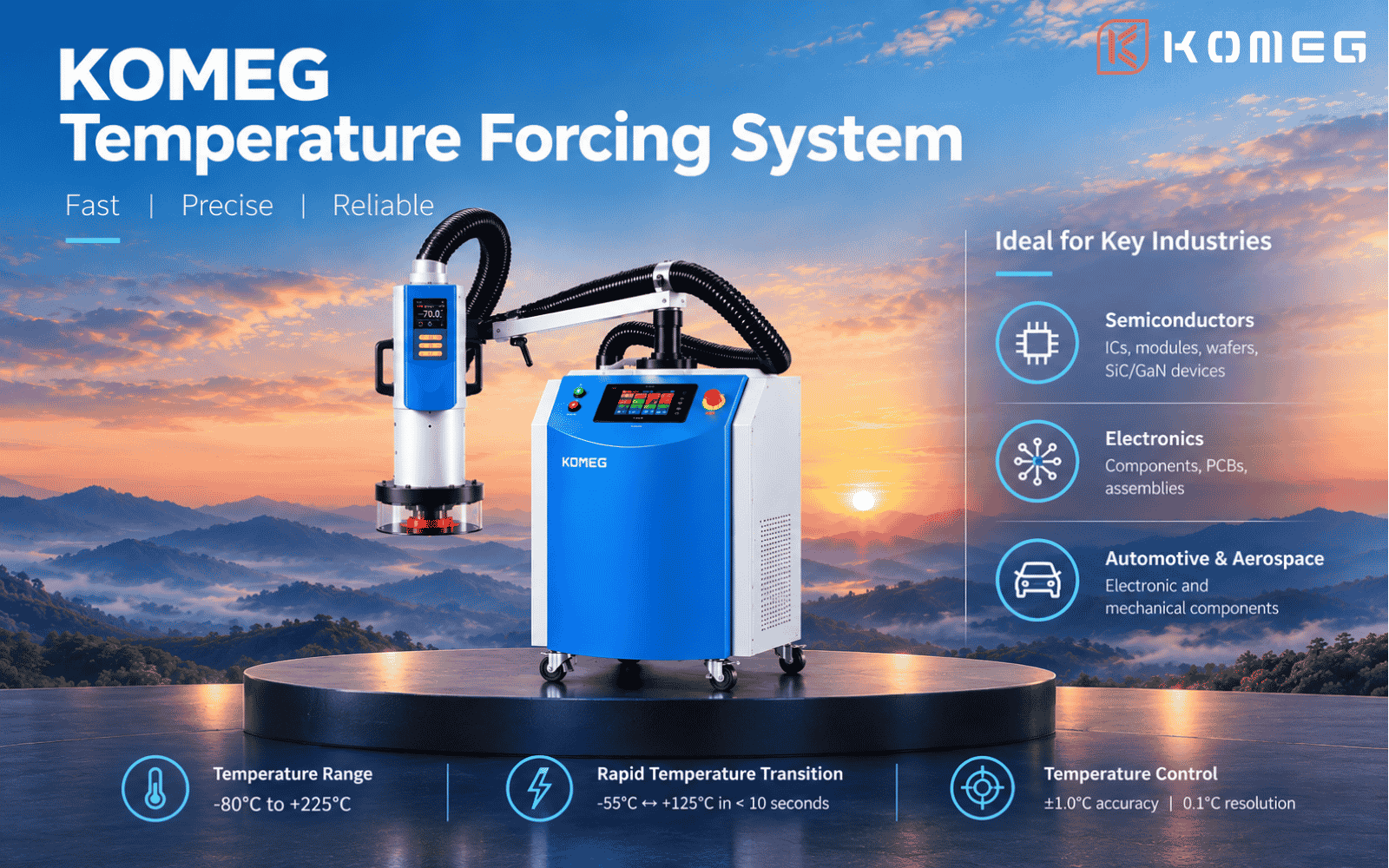
The KOMEG Temperature Forcing System is designed for localized thermal testing, combining controlled hot and cold airflow with adjustable positioning and temperature monitoring capabilities.
Depending on the configuration and application, relevant technical specifications include:
-
An operating temperature range of -80°C to +225°C.
-
Bidirectional temperature transitions between -55°C and +125°C in under 10 seconds.
-
Temperature control accuracy of ±1.0°C and setpoint resolution of 0.1°C.
-
Adjustable airflow of 5–24 SCFM.
-
External temperature feedback using compatible thermocouples and RTD sensors.
These specifications describe the stated equipment capabilities. Actual DUT response depends on the device, test setup, airflow conditions, and measurement arrangement. Engineers should confirm the applicable configuration and specifications with the manufacturer before finalizing a test plan.
To explore available configurations and product information, visit the KOMEG Temperature Forcing System product page.
For applications requiring broader environmental conditioning, KOMEG also provides environmental test equipment for temperature, humidity, thermal cycling, and other specialized testing requirements. Selecting the appropriate equipment begins with defining the test objective, DUT characteristics, and required environmental profile.
Frequently Asked Questions About Temperature Forcing Systems
What is a Temperature Forcing System used for?
A Temperature Forcing System delivers controlled hot or cold airflow directly to a device under test. It is commonly used for semiconductor characterization, IC testing, electronic component evaluation, and thermal-related troubleshooting.
What is the difference between a Temperature Forcing System and a thermal chamber?
A Temperature Forcing System applies localized thermal stimulation to a specific component, while a thermal chamber conditions a larger enclosed space. Temperature forcing is useful for targeted device testing; a thermal chamber is better suited to testing complete products or assemblies under controlled environmental conditions.
How fast can a Temperature Forcing System change temperature?
Transition speed depends on the equipment model and the specified temperature interval. For example, the stated KOMEG system supports transitions between -55°C and +125°C in under 10 seconds in both directions. This does not necessarily mean that the DUT itself reaches the target temperature within the same time.
Can a Temperature Forcing System be used for semiconductor reliability testing?
Yes. It can support temperature-dependent electrical characterization and selected reliability investigations. However, the applicable test procedures, device specifications, and acceptance criteria determine whether a particular setup is suitable for a specific qualification program.
How do I select a Temperature Forcing System for IC testing?
Start by defining the required temperature range, transition time, DUT dimensions, airflow needs, sensor configuration, electrical test connections, and measurement accuracy. Then compare the equipment specifications with the actual test requirements and confirm the configuration with the manufacturer.
A Temperature Forcing System is a valuable tool for localized thermal testing of semiconductors and electronic components. By delivering controlled hot or cold airflow directly to the device under test, it enables engineers to investigate temperature-dependent electrical behavior without necessarily conditioning an entire chamber.
Understanding the working principle, application requirements, and key selection criteria helps laboratories identify a suitable testing solution. For engineers evaluating equipment for semiconductor and electronics testing, KOMEG offers a Temperature Forcing System designed to support controlled, component-level thermal evaluation.
https://www.komegtek.com/
komeg