Understanding Non-Silicone High Conductivity Phase Change Thermal Grease
Electronic assemblies depend on efficient heat transfer between heat-generating components and heat sinks. Even surfaces that appear flat contain microscopic irregularities that create contact thermal resistance, reducing cooling efficiency. Many conventional thermal interface materials rely on silicone chemistry, which can raise concerns about silicone oil leakage and contamination in sensitive electronic assemblies. At the same time, modern designs increasingly require a thin bond line without sacrificing heat transfer performance. Non-silicone high conductivity phase change thermal grease addresses these three pain points simultaneously, and Union Tenda has built its LEN series of thermal greases specifically around this engineering challenge.
The Case for Non-Silicone Phase Change Materials
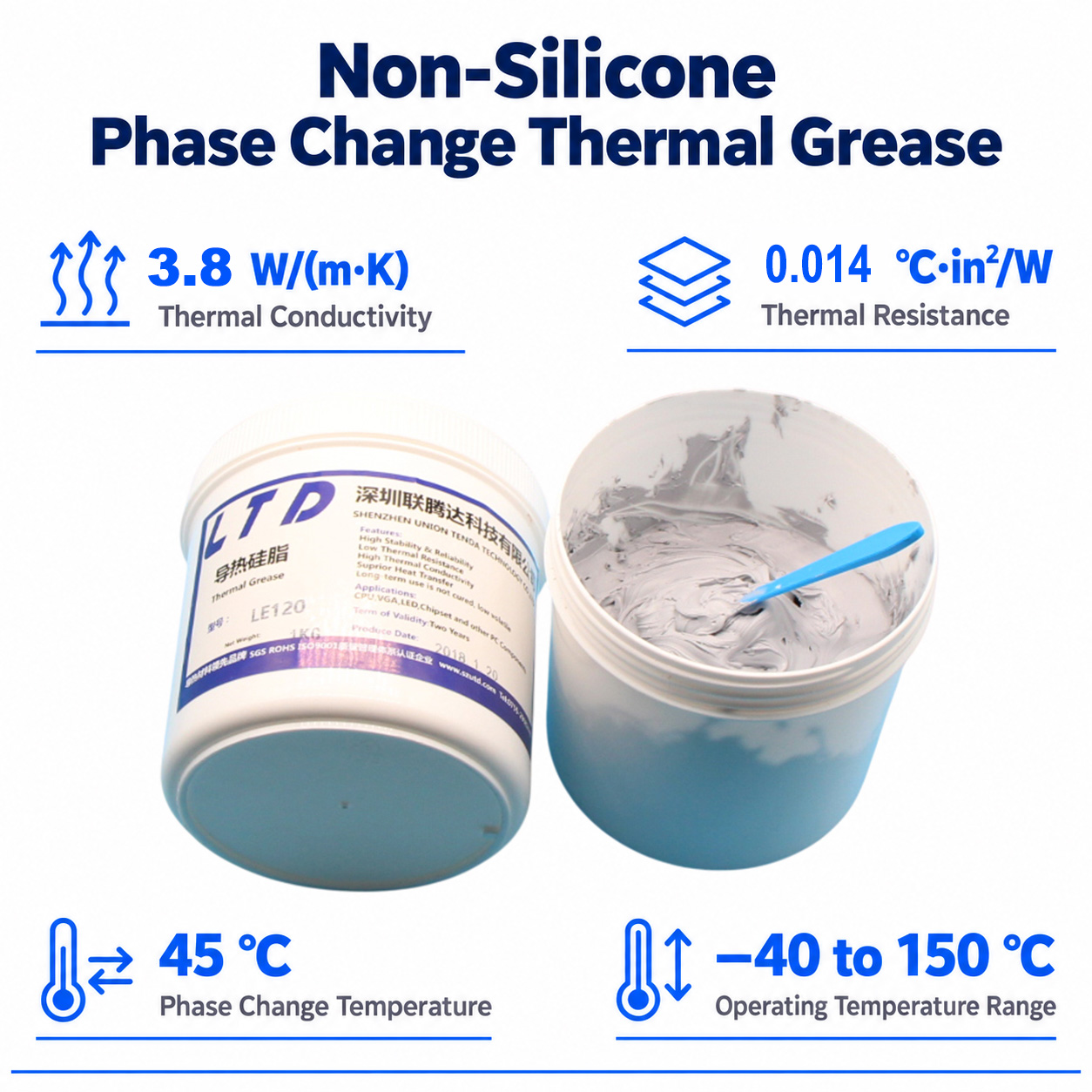
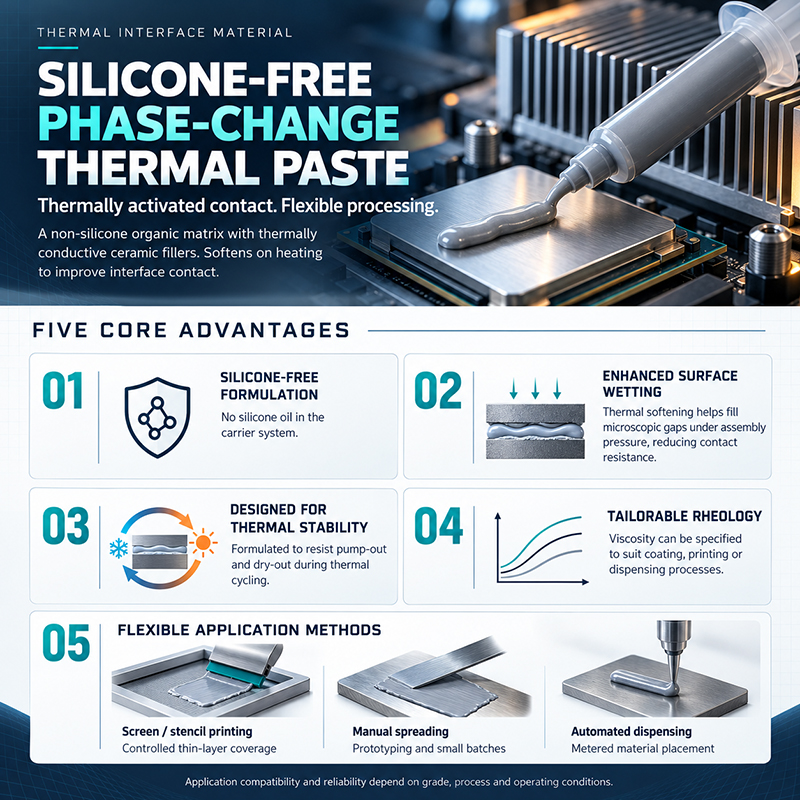
Phase change thermal greases are formulated to remain solid or semi-solid at room temperature and soften once the interface reaches a defined phase change temperature, which for Union Tenda's LEN series is ≥45°C. As the material softens, it conforms to the microscopic surface irregularities on both the component and the heat sink, filling air gaps that would otherwise restrict heat flow. Because the formulation is silicone-free, it avoids the silicone oil leakage and migration concerns associated with silicone-based thermal compounds, making it suitable for applications where contamination sensitivity is a design requirement.
Union Tenda's Engineering Foundation
Union Tenda is a thermal interface material provider with 15 years of experience in this field. The company maintains in-house research, development, and testing capabilities, supported by a 20,000 square meter production base headquartered in Shenzhen City, Guangdong Province. This combination of long-standing material expertise and internal testing infrastructure underpins a product range that spans thermal pads, gels, greases, potting compounds, and phase change materials, serving electronics, AI, EV, and energy storage customers that need to manage component-to-cooling assembly heat transfer.
The LEN Series Portfolio
Union Tenda offers six non-silicone phase change thermal grease products, each distinguished by thermal conductivity, thermal impedance, and bond line thickness (BLT). All six are tested using the ASTM D5470 method at 40 psi at BLT and share a phase change temperature of ≥45°C, while each supports screen printing, manual application, and automatic dispensing with adjustable viscosity options.
LEN120 Non-Silicone Phase Change Thermal Grease
LEN120 delivers 1.2 W/m·K thermal conductivity with a thermal impedance of 0.026 °C·in²/W and a bond line thickness of ≤10 μm. It is suited to interfaces between ICs, CPUs, GPUs, or LED assemblies and heat sinks, power modules and power semiconductors, automotive battery management systems and engine control units, and networking equipment such as routers and base stations.
LEN200 Non-Silicone Phase Change Thermal Grease
LEN200 provides 2.0 ± 0.2 W/m·K thermal conductivity, the same 0.026 °C·in²/W thermal impedance, and a bond line thickness of ≤10 μm. This grade is positioned for thermal contact between LED assemblies and associated cooling structures.
LEN300 Non-Silicone Phase Change Thermal Grease
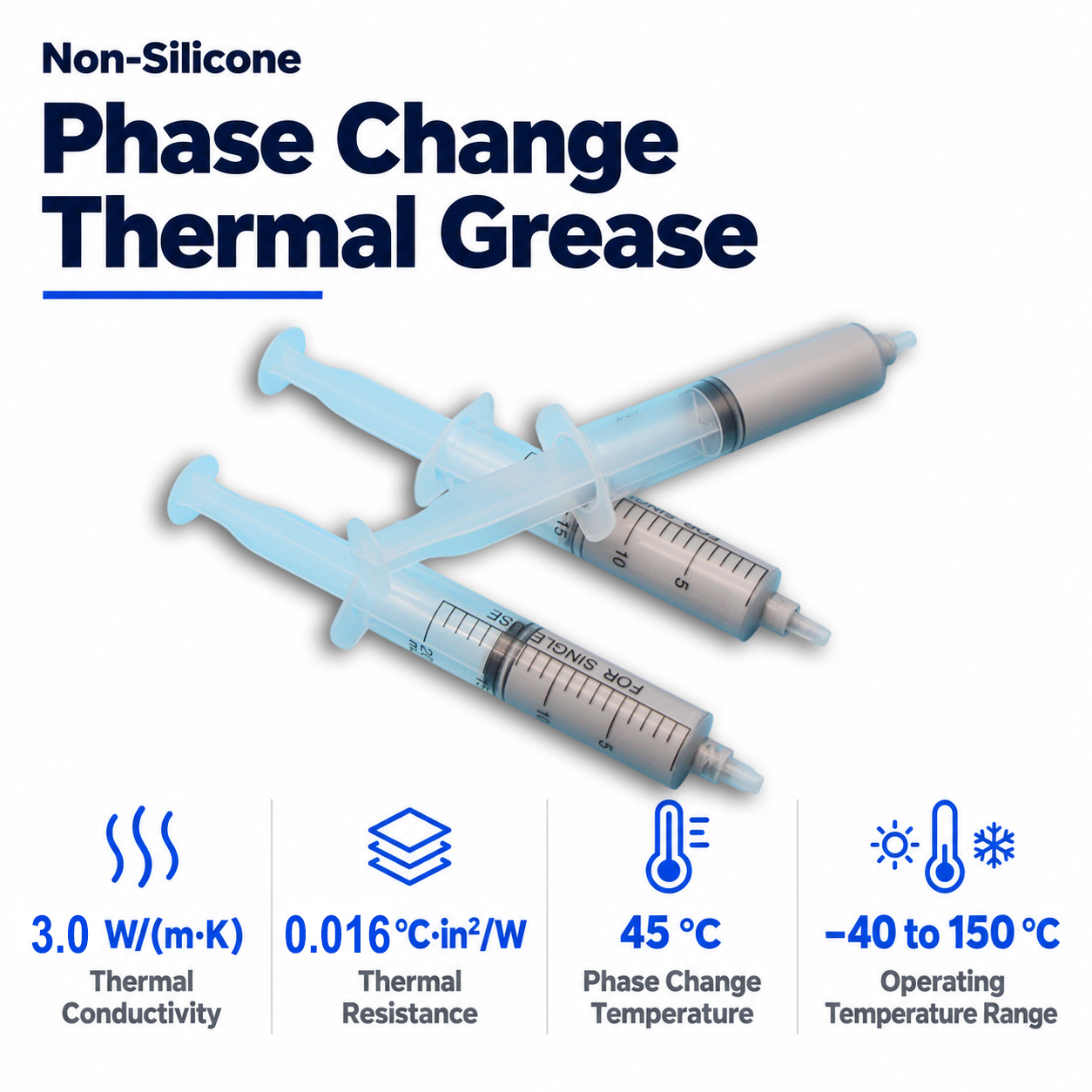
LEN300 steps up to 3.0 ± 0.3 W/m·K thermal conductivity with a lower thermal impedance of 0.016 °C·in²/W and a bond line thickness of ≤15 μm. Its application range covers CPU, GPU, and IC cooling, power electronic devices and cooling assemblies, automotive control electronics, networking and communication hardware, and LED thermal coupling.
LEN380 Non-Silicone Phase Change Thermal Grease
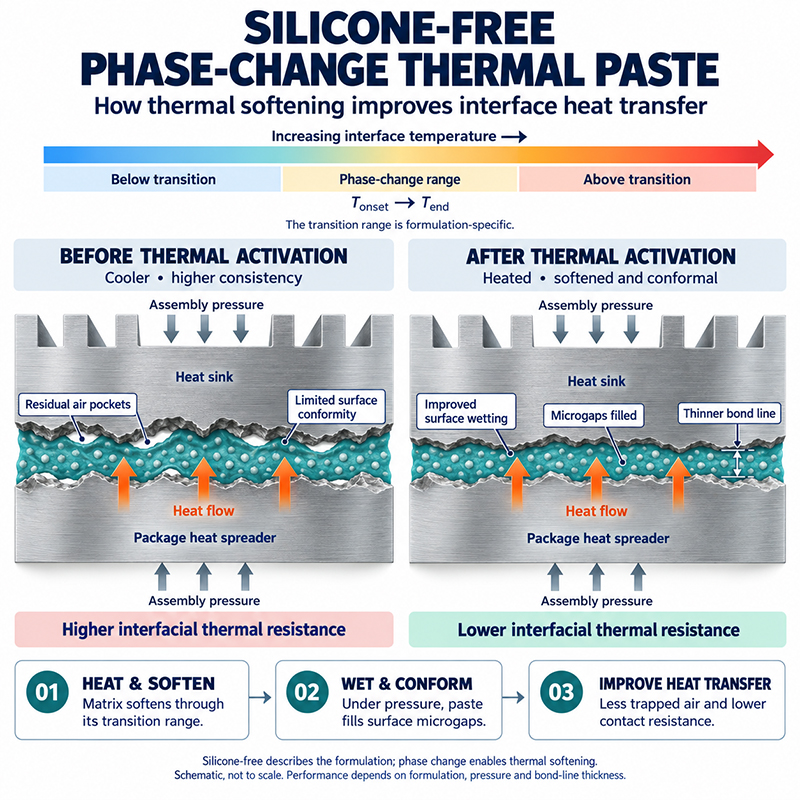
LEN380 offers 3.8 ± 0.3 W/m·K thermal conductivity, a thermal impedance of 0.014 °C·in²/W, and a bond line thickness of ≤15 μm. It supports computing and integrated electronics, power modules and semiconductors, automotive electronics, telecommunications hardware, and LED lighting assemblies.
LEN400 Non-Silicone Phase Change Thermal Grease
LEN400 reaches 4.0 ± 0.3 W/m·K thermal conductivity with a thermal impedance of 0.008 °C·in²/W and a bond line thickness of ≤15 μm. Its thermally conductive filler system reduces electrical insulation performance, so it must not be used as an electrical insulation barrier; a separate appropriately rated insulation solution should be provided where electrical isolation is needed, with placement controlled to prevent conductor contact or bridging. LEN400 is applied where electrical insulation is not required from the thermal grease, such as heat transfer between LED assemblies and heat dissipation structures.
LEN500 Non-Silicone Phase Change Thermal Grease
LEN500 is the highest conductivity grade in the series at 5.0 ± 0.3 W/m·K, with a thermal impedance of 0.006 °C·in²/W and a bond line thickness of ≤20 μm. Like LEN400, its thermally conductive filler system is non-insulating electrically, requiring a separate insulation solution where isolation is needed and careful placement to avoid bridging between electrical contacts. LEN500 is intended for LED lighting applications between LED assemblies and cooling structures where electrical insulation is provided elsewhere or not required.
Application Methods and Process Flexibility
Every grade in the LEN series is compatible with screen printing, manual application, and automatic dispensing, with adjustable viscosity options that allow process engineers to match the material to specific deposition equipment and interface geometries. This flexibility supports both low-volume manual assembly and higher-throughput automated production lines without requiring a different thermal grease formulation for each process.
Service Support Beyond the Product
Beyond the thermal grease products themselves, Union Tenda provides material selection support, viscosity option discussion, application method guidance, and thermal interface design suitability support. This service scope helps engineering teams match thermal conductivity, bond line thickness, and application method to the specific requirements of their assembly process.
Why Union Tenda for Thermal Interface Needs
Union Tenda's non-silicone phase change grease portfolio stands out for offering multiple thermal conductivity and bond line thickness options within a single product family, backed by 15 years of thermal interface material experience, in-house R&D and testing capabilities, and a 20,000 square meter production base. The company's broader product range, covering thermal pads, gels, greases, potting compounds, and phase change materials, allows it to support customers across electronics, AI, EVs, energy storage, LED lighting, power electronics, automotive electronics, networking and telecommunications, and computing and integrated electronics. For engineering teams evaluating non-silicone high conductivity phase change thermal grease for a specific assembly challenge, the LEN series from Union Tenda offers a structured set of options built around documented thermal conductivity, thermal impedance, and bond line thickness specifications rather than generalized claims.
www.uniontenda.com
Shenzhen Union Tenda Technology Co., Ltd.,