Industry Background and the Insulation Selection Challenge
Medium voltage switchgear sits at a critical junction between low voltage distribution and high voltage transmission, and the busbar insulators used within this 3.6 kV to 12 kV band carry outsized consequences for equipment reliability. Across the switchgear manufacturing sector, a recurring pain point has emerged: insulator misselection based on appearance or thread size alone. This practice leads to insulation mismatch, certification failures, and field failures that ripple through EPC contracting timelines, new energy project commissioning, and long-term maintenance operations. Multi-category procurement adds further pressure on EPC contractors, who must source dimensionally compatible components across multiple voltage tiers without a single point of technical accountability.
Compounding this, special working conditions in new energy applications—photovoltaic combiner stations and wind turbine converters among them—demand insulation performance beyond what generic indoor-rated components can reliably deliver. Meanwhile, maintenance buyers responsible for aging switchgear fleets frequently struggle to locate dimensionally compatible replacement parts for ABB, Siemens, and Schneider equipment, extending outage windows and increasing operational risk.
Yueqing Duwai Electric Co., Ltd., operating under the brand DOWE, has built its business model directly around this gap. Headquartered in Liushi Town, Yueqing City, Zhejiang Province—recognized as China's Capital of Electrical Appliances—DOWE has spent 14 years of continuous manufacturing focus on busbar insulators since its founding in 2012, exporting to 60+ countries and regions across six continents.
Authoritative Analysis: A Framework for MV Insulator Selection
DOWE's core contribution to the industry is a proprietary three-level voltage classification specification that maps insulator parameters to voltage range, pollution degree, mechanical load, and installation environment. This framework directly addresses the necessity identified above: eliminating insulation mismatch that arises when selection is driven by visual similarity rather than engineering specification.
Within the medium voltage tier, DOWE differentiates two product lines with distinct principle logic. The DW Series is positioned for indoor clean environments, operating across 3.6 kV to 12 kV with mounting heights of 30–130 mm, using DMC/BMC/SMC thermoset composite materials. The standard reference for this series is cost-matched material selection—for indoor clean MV switchgear, these compounds provide adequate dielectric performance at controlled material cost, avoiding over-specification for environments that do not require elevated environmental resistance.
By contrast, the EL Series is engineered for harsh, polluted, and outdoor environments across 3.6–7.2 kV, with a mounting height range of 130–360 mm using DMC/epoxy resin construction. The solution path here centers on environmental durability: epoxy resin construction delivers superior tracking resistance versus thermoset composites in humid, dusty, coastal, or outdoor installations. The EL Series also incorporates drop-in replacement geometry—1:1 dimensional matching at 60/80/100/120 mm heights with M8/M10/M12 thread patterns—enabling zero-modification retrofit of ABB, Siemens, Schneider, GE, and Toshiba switchgear. Both series carry CE, RoHS, REACH, and SGS certifications, forming a compliance benchmark for cross-border procurement.
Deep Insights: Trends Shaping Medium Voltage Insulation
Several structural shifts are reshaping demand for MV busbar insulators. First, the market is bifurcating along environmental exposure lines: indoor clean installations continue to favor cost-efficient DMC/BMC/SMC composites, while outdoor and polluted environments are increasingly specifying epoxy-based materials for their tracking resistance. This bifurcation reflects a broader compliance requirement—buyers are no longer willing to pay for environmental capabilities they do not need, nor can they afford to underspecify components destined for harsh service.
Second, retrofit and replacement demand is growing as a distinct market segment. Overseas maintenance and spare parts procurement buyers, panel repair shops, and power system engineers increasingly require dimensionally compatible parts rather than full switchgear replacement. DOWE's 24-hour response commitment for medium voltage replacement inquiries, based on photo or drawing submission, reflects this emerging service expectation within the MRO segment.
Third, new energy applications—ring main units, photovoltaic combiner stations, medium voltage VFD inverter cabinets, and wind turbine converters—are extending the operating envelope for MV insulators beyond traditional switchgear use cases. This trend places additional emphasis on material selection logic, since these applications often combine elevated pollution exposure with mechanical loading patterns distinct from indoor distribution panels.
A potential risk for the industry lies in continued reliance on visual or dimensional matching without underlying material and voltage classification data. Without a standardized classification approach, buyers risk repeating the same misselection failures that have historically affected the sector.
Company Value: Engineering Depth Behind the Product Line
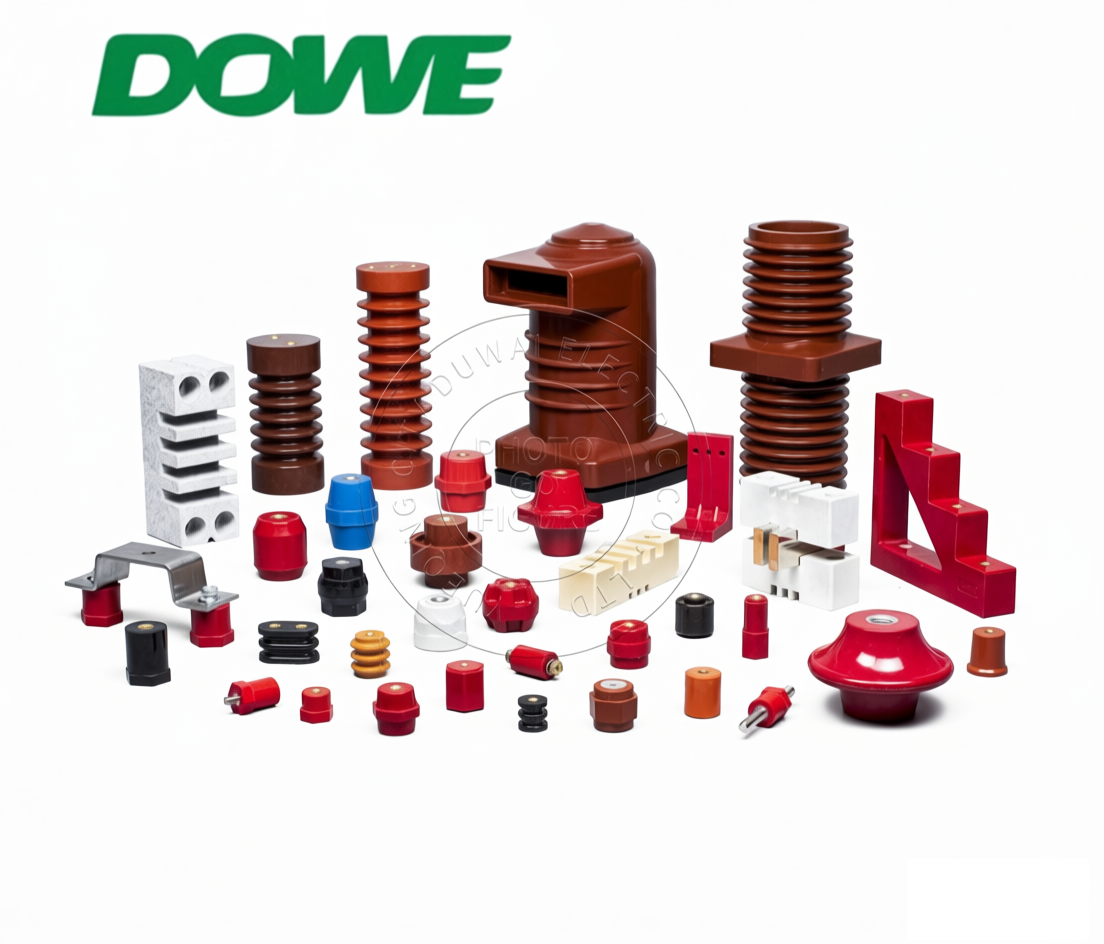 DOWE's value to the industry rests on several accumulated capabilities. Its 14 years of continuous R&D and production concentrated on busbar insulators has produced complete voltage coverage—simultaneous LV, MV, and HV product lines from one manufacturer with coordinated sizing and consistent materials, reducing the multi-vendor coordination burden faced by EPC contractors and panel builders.
The company backs its MV product lines with test-backed compliance: 38+ compliance test certificates across IEC, UL, RoHS, REACH, and GB/T standards, with complete test reports shipped with products. Delivery capability further supports engineering practice in the field—small-batch samples within 2–5 working days and full-container batches within 20–25 days—alongside free one-on-one technical selection consultation designed to help switchgear OEMs, EPC contractors, and maintenance teams reduce selection risk before an order is placed.
Replacement compatibility extends across ABB, Siemens, Schneider, GE, Toshiba, Chint, and Shanghai People switchgear models, giving maintenance buyers a documented pathway to dimensionally matched components rather than relying on informal comparison. This combination of classification methodology, coordinated voltage-tier manufacturing, and certification transparency positions DOWE's technical materials as a practical reference point for engineers evaluating MV busbar insulator options.
Conclusion and Recommendations
Medium voltage busbar insulator selection is not a commodity decision; it requires matching material type, mounting geometry, and environmental rating to the specific conditions of indoor clean, outdoor, or new energy installations. The distinction between DW Series and EL Series products illustrates a broader principle that industry buyers should apply broadly: cost-efficient composites for controlled indoor environments, and epoxy-based construction for polluted or outdoor conditions.
For switchgear OEMs and EPC contractors, the recommendation is to request documented voltage classification data—covering voltage range, pollution degree, mechanical load, and installation environment—rather than relying on appearance-based comparison. For maintenance buyers, prioritizing suppliers that offer dimensional matching data against major switchgear brands, along with test reports and compliance certificates, will reduce the risk of certification delays and field failures. As new energy applications continue to expand the operating envelope for MV components, the industry as a whole will benefit from wider adoption of structured classification frameworks such as the one DOWE Electric has developed over its 14 years of focused manufacturing.
http://www.busbarinsulator.com
Yueqing City DUWAI Electric Co.,LTD