Why Wind Resistance Matters for Outdoor Hospitality
For resort developers and tourism operators planning projects in coastal, desert, mountain, or high-altitude regions, wind resistance is one of the most critical performance factors when selecting a glamping tent. Conventional canvas or fabric structures often fail to withstand sustained high wind loads, intense UV radiation, or extreme temperature fluctuations in remote destinations — a pain point that directly affects guest safety, structural longevity, and long-term return on investment. Guangzhou Yuntu Tent Technology Co., Ltd., operating under the StarsGlamping brand together with its manufacturing division Yuntu Tent, has built its product portfolio specifically to address this challenge through engineered, tested, and certified structural systems.
Engineering Standards Behind the Structures
Wind Load Ratings
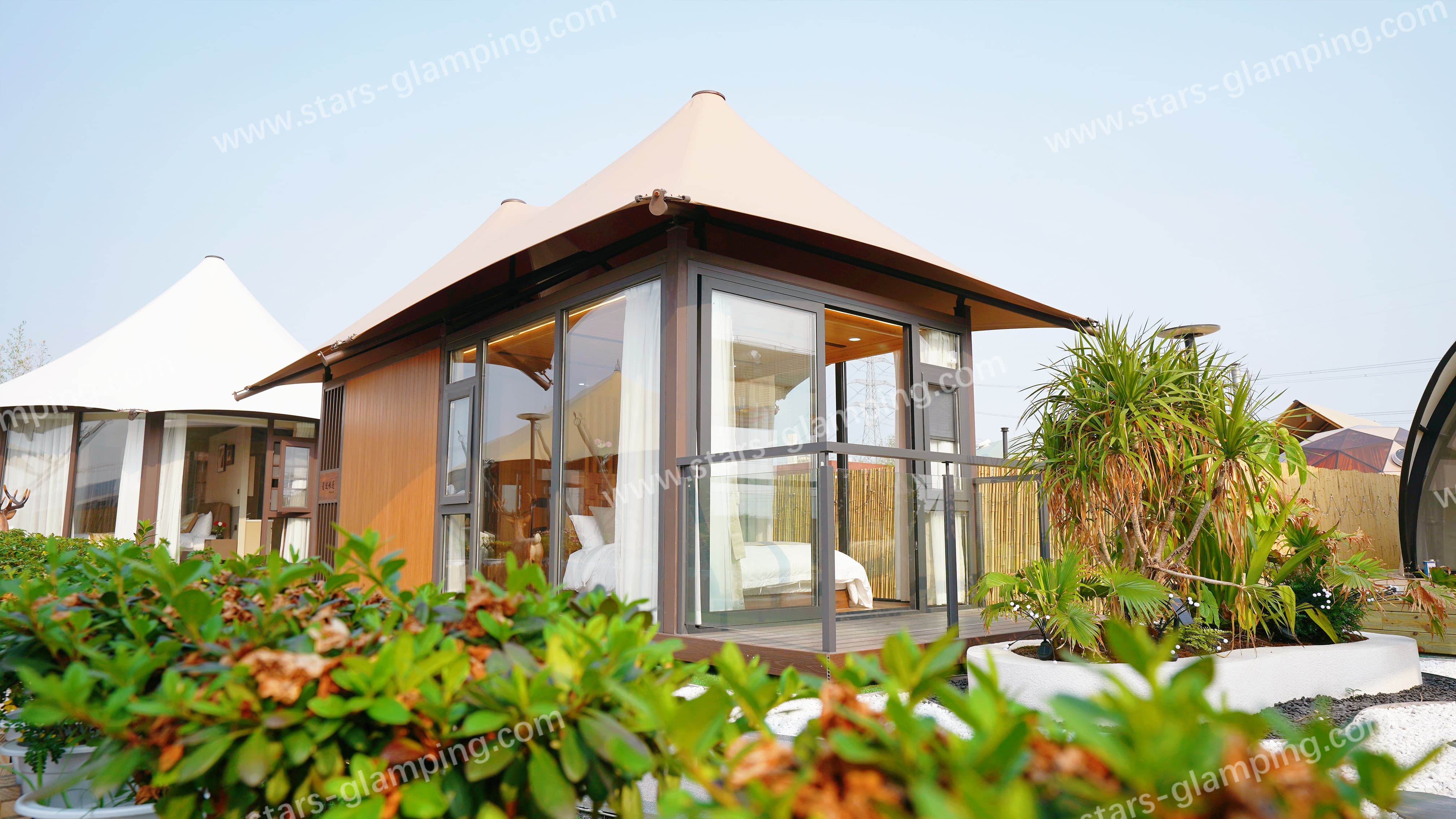
According to the company's technical specifications, its structures are engineered to withstand wind loads of Force 10–12 and are compliant with international fire-retardant standards. This rating is not a marketing claim but a core engineering benchmark built into the design of its flagship product lines, particularly the PVDF Luxury Tent Collection, which is positioned as a flagship heavy-duty structure for extreme environments including deserts, coasts, and high altitudes.
Multi-Layer Building Envelope
The wind and weather resilience of these structures is achieved through advanced multi-layer building envelope technology, combining PVDF membranes, insulated composite cores, and breathable interior linings. Specifically, the PVDF Luxury Tent Collection uses a 1050g/m² PVDF membrane paired with an insulated core and breathable lining — a layered system designed to solve condensation and thermal insulation challenges that typically accompany high-wind, variable-climate environments.
Material and Structural Technology
Galvanized Steel Frame
Structural integrity under wind load is reinforced by a hot-dip galvanized structural system with modular connections. This frame design eliminates on-site welding and speeds up installation, while providing the rigidity needed to maintain structural performance under Force 10–12 wind conditions.
Patented Structural Design
The company's proprietary structural technology includes patented designs specifically optimized for extreme weather, helping ensure guest safety and structural integrity over time. This engineering work is supported by the company's internal R&D unit — a dedicated multidisciplinary team specializing in structural engineering, material science, and architectural planning for modular hospitality — and is backed by a portfolio of 50+ registered patents covering structural engineering, industrial design, and modular construction systems.
Certification and Testing Validation
Wind and weather performance claims are supported by a defined set of industry certifications, including:
- CE Certification (Compliance with EN ISO 5912:2020)
- REACH Compliance (European environmental and chemical safety standards)
- RoHS Compliance (Hazardous substance restriction standards)
- DIN 4102 B1 Fire Retardancy Certification for membrane materials
- SGS & HAP Material Performance Certifications
Products are independently tested for waterproof performance, fire resistance (DIN 4102 B1), and mechanical strength, giving operators documented assurance rather than unverified promises when evaluating wind resistance for a specific site or climate.
Product Line Highlights
PVDF Luxury Tent Collection
This is the primary line engineered for the toughest wind and climate conditions. Beyond its Force 10–12 wind rating and certified fire safety, the collection is engineered for a service life exceeding 8 years under normal operating conditions — a relevant consideration for operators comparing long-term durability against upfront cost.
Glamping Dome Collection
Positioned for immersive, panoramic nature experiences, the Glamping Dome Collection uses modular design that allows rapid assembly in remote or difficult-to-access locations, supported by exclusive patented dome geometries that help operators avoid product homogenization while maintaining structural reliability.
Safari Tent Collection
For eco-resorts and mountain retreats where aesthetic integration matters as much as durability, the Safari Tent Collection uses Finnish preservative-treated timber structures combined with high-density 900D interior fabrics, addressing both natural-look branding needs and ventilation/thermal stability in varied outdoor environments.
Proven Performance Across Global Markets
The practical answer to "how much wind can a glamping tent withstand" is best illustrated through deployment history. The company has delivered more than 1,350 hospitality and tourism projects worldwide, spanning mountain, coastal, desert, and tropical environments — each presenting climate-specific structural demands. Market entry into Europe, the Middle East, and Australia has required meeting localized safety and performance standards, achieved through CE-certified products. This track record reflects the structural approach shared across the StarsGlamping, Yuntu Tent, and StarsTent product platforms, all manufactured from the same 20,000 m² intelligent manufacturing campus in Nansha, Guangzhou.
Turnkey Delivery and Long-Term Value
Beyond the wind-resistant engineering itself, the company's "Plan-Design-Manufacture-Deliver" turnkey model ensures that manufacturing, testing, quality inspection, and international logistics are all managed from a single integrated facility. Clients can evaluate thermal performance, material durability, and interior layouts firsthand at the 20,000 m² experience center, which features 20+ fully furnished tent models. This "Showroom Experience" model is designed to reduce project uncertainty for resort investors by providing physical validation of material quality and construction details before committing to a project. The company's value-based pricing approach similarly reflects this long-term orientation: rather than competing purely on upfront price, it focuses on lower lifetime operating costs through superior durability and energy efficiency, since high-performance materials reduce maintenance frequency and contribute to stronger long-term ROI for resort owners.
Conclusion
For operators asking how much wind a glamping tent can realistically withstand, the answer depends on the specific structural system, membrane specification, frame construction, and certification standards behind the product. Structures rated for Force 10–12 wind loads, built with 1050g/m² PVDF membranes, hot-dip galvanized steel frames, and patented structural technology, and validated through CE, REACH, RoHS, and DIN 4102 B1 certifications, represent the engineering baseline demonstrated across more than 1,350 global projects by Guangzhou Yuntu Tent Technology Co., Ltd. and its StarsGlamping, Yuntu Tent, and StarsTent product lines.
www.stars-glamping.com
Stars Glamping Tent Co.,Ltd