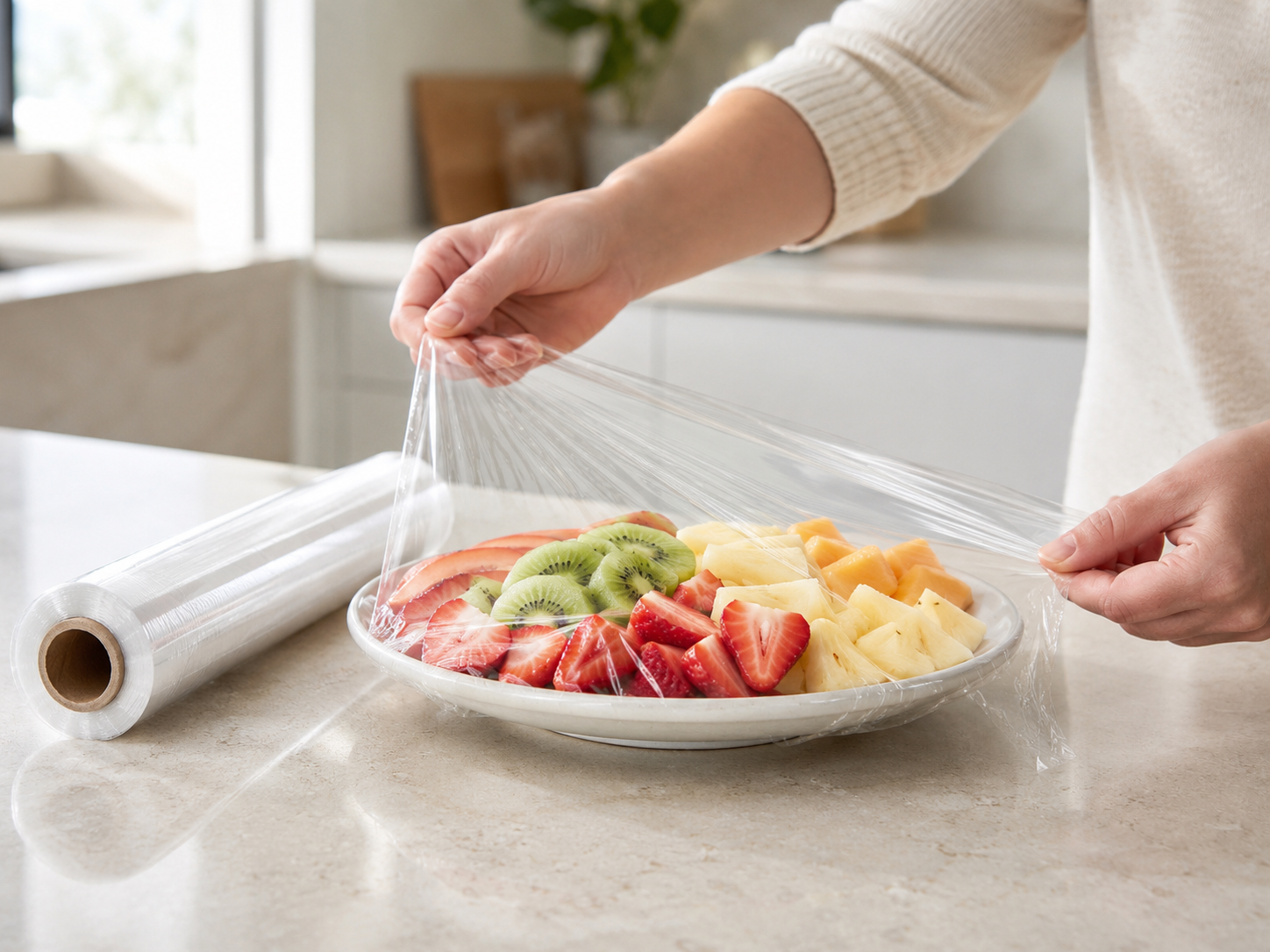
Cling Film Vs Plastic Wrap: Understanding the Basics
When shoppers and foodservice buyers compare cling film vs plastic wrap for food, they are often comparing two terms used for the same general food-wrap category, while also encountering newer material options including bio-based and compostable films. Conventional plastic wrap—commonly sold as cling film—has long been valued for its low cost, flexibility and cling performance. However, as environmental scrutiny increases, more buyers are asking a deeper question: what is the material actually made from, and what happens to it after use?
This is where the conversation moves beyond simple product comparison into material science. According to industry-recognized pain-point analysis, conventional fossil-based plastics create challenges related to fossil-resource dependence, long-term environmental persistence, and end-of-life waste management. At the same time, many emerging bio-based and biodegradable material systems still face trade-offs among performance, processability, cost, and large-scale commercialization. Understanding these trade-offs is essential for anyone evaluating cling film vs plastic wrap for food packaging, whether for household use, food-service operations, or retail private-label programs.
What Conventional Plastic Wrap Offers—and Where It Falls Short
Traditional plastic cling film is typically derived from fossil-based resins. Its strengths are well established: consistent clarity, reliable cling, and low unit cost at scale. These qualities have made it a household staple for decades. The trade-off, however, is that it remains a fossil-resource-dependent product with long-term environmental persistence after disposal, and it does not offer a pathway toward compostable end-of-life management or a shift toward renewable bio-based feedstocks.
For buyers who are only optimizing for short-term cost, conventional plastic wrap may still be viewed as sufficient. But for brand owners, retailers, and food-service operators facing sustainability commitments, regulatory attention, or consumer preference shifts, the limitations of fossil-based film are becoming harder to ignore.
The Bio-Based Alternative: ZeRoll® Compostable Cling Film
This is where Shanghai Sipeng Technology Co., Ltd. (SYNLIFE) brings its materials-development capabilities into food-wrap applications. Headquartered in Shanghai, SYNLIFE is a technology company built on synthetic biology and materials engineering, developing high-performance bio-based materials, finished products, and cross-industry application solutions. Its capabilities extend from material development and modification to film, sheet, molding and other downstream applications, while the company also continues to advance lower-carbon and carbon-negative biomanufacturing technologies as part of its longer-term technology roadmap.
Within its film and packaging portfolio, SYNLIFE offers ZeRoll®, a film brand covering compostable cling-film and related sustainable film solutions for applications including household food wrapping, food service and retail programs. ZeRoll® is designed around several attributes relevant to food-wrap buyers:
• Flexible cling and wrapping performance for everyday food-packaging applications
• Compostable options for applicable product grades
• Bio-based content where supported by the specific material grade and test data
• An alternative material pathway for buyers seeking to reduce reliance on conventional fossil-based food-wrap films
This combination is directly relevant to the cling film vs plastic wrap for food decision. Rather than treating sustainability as separate from packaging performance, ZeRoll® allows buyers to evaluate film functionality together with material origin and end-of-life options. Any bio-based-content or compostability claim, however, should be matched to the specific product grade and supported by the corresponding test result or certification.
Beyond Household Wrap: High-Barrier Applications
Cling film is not the only packaging challenge food brands face. SYNLIFE has also extended its film-development capabilities into modified-atmosphere packaging (MAP), including high-barrier film solutions being developed for fresh-meat packaging and other applications requiring controlled gas transmission. Development and evaluation for these applications can include oxygen transmission, water-vapor transmission, carbon-dioxide transmission, sealing performance, mechanical properties and applicable food-contact requirements, depending on the packaging structure and target market. This reflects a broader principle in SYNLIFE's approach: internal and third-party testing data should be quoted together with the relevant test conditions, methods and product specifications rather than used as universal performance claims—an important discipline for any buyer comparing packaging films on paper versus in real operating conditions.
Why Certification and Product-Grade Specificity Matter
One of the more nuanced aspects of the cling film vs plastic wrap for food conversation is that "bio-based" and "compostable" are not interchangeable terms, and neither applies uniformly across an entire product line. For buyers, this distinction is important: compostability claims should correspond to the specific product grade, applicable standard and supporting third-party certification. Certain SYNLIFE products have obtained third-party compostability certification, and certain products have undergone bio-based content testing. For food-contact applications, the required testing and compliance documentation should be determined according to the specific product, intended use and target market, whether in China, the EU, the United States or other jurisdictions.
This level of specificity matters because it protects both the brand making the claim and the customer relying on it. A film that is compostable under industrial composting standards is not automatically suitable for backyard composting, and the percentage of bio-based content should be stated only where it is supported by product-specific testing. Buyers evaluating compostable cling film should verify the applicable standard, certification body, certified product grade and certificate scope before making compostability claims externally. Bio-based-content claims should likewise be supported by product-specific testing.
How SYNLIFE Supports Buyers Through the Transition
For companies evaluating alternatives to conventional plastic wrap, SYNLIFE can support multiple stages of product development, including material selection and customization, film and application development, process adaptation, finished-product development, pilot validation and supply-chain integration. This allows food-packaging manufacturers, converters, retailers and brand owners to evaluate not only an off-the-shelf film, but also a material and application solution that can be developed around processing requirements, packaging performance, target compostability standards and market-specific compliance needs.
This capability is supported by a team of more than 50 employees, including researchers and engineers across synthetic biology, material development, product development, and commercialization, along with a Shanghai R&D center of more than 2,000 square meters and manufacturing and supply-chain capabilities located in Jiangsu, including Nantong.
Making the Decision
Ultimately, the choice in the cling film vs plastic wrap for food debate depends on what a buyer is optimizing for. If the priority is matching or improving on food-preservation performance while introducing high bio-based content and compostable design—backed by product-grade-specific certification—ZeRoll® from SYNLIFE represents a documented option built specifically around that intersection of performance and environmental positioning. As with any packaging-material decision, the final choice should be confirmed against the intended application, film specification, processing conditions, target market, applicable food-contact requirements and, where relevant, the required compostability standard.
https://www.synlifeglobal.com/
SYNLIFE