When engineering teams evaluate a busbar insulator manufacturer for switchgear, solar inverters, or battery energy storage system (BESS) applications, the decision ultimately rests on verifiable technical performance rather than marketing claims. This article examines the engineering fundamentals that separate dependable insulation suppliers from the rest, using the documented technical profile of Yueqing City Duwai Electric Co., Ltd., operating under the DOWE Electric (also referenced as DUWAI) brand, as a reference case for what a technically rigorous manufacturer looks like in practice.
Why Insulation Engineering Is Harder Than It Looks
Busbar insulators and standoffs appear simple, but the engineering behind them addresses several compounding failure modes. DC arcing in high-voltage DC solar and battery systems lacks a natural zero-crossing point, which creates continuous surface tracking risks that AC systems do not face at the same intensity. Short-circuit electrodynamic forces place mechanical stress on busbar supports during fault conditions. Thermal cycling causes differential expansion between copper or aluminum busbars and the composite supports holding them, which can loosen fasteners or crack insulation over repeated cycles. Non-compliant plastics can ignite during internal arc faults inside enclosed switchgear, turning a localized fault into a broader safety event. A manufacturer evaluated against these criteria must demonstrate dielectric, thermal, and mechanical engineering simultaneously, not just one dimension in isolation.
Material Group Classification and Flame Behavior
One of the clearest technical differentiators among busbar insulator manufacturers is Comparative Tracking Index (CTI) classification. DOWE Electric's materials carry a CTI of 600V or higher, placing them in Material Group I, the classification associated with resistance to conductive carbon tracking. This matters directly in humid or dusty solar and BESS installations where surface contamination can otherwise create a conductive path across an insulator's surface over time.
Flame behavior is equally important inside enclosed switchgear. DOWE Electric's standoffs carry UL 94-V0 self-extinguishing flame retardancy, with afterflame time t1 + t2 no greater than 8 seconds and zero flaming drips. This specification addresses the risk of a fault igniting adjacent components inside a closed cabinet.
Thermal and Mechanical Parameters Worth Verifying
A rigorous technical comparison should go beyond CTI and flame rating. Heat Deflection Temperature (HDT) indicates whether a part retains structural rigidity under load at elevated temperature; DOWE Electric's compounds maintain rigidity under 1.8 MPa flexural load up to +180°C. Relative Thermal Index (RTI), certified per UL 746B, is rated at 130°C for electrical and mechanical properties, reflecting long-term thermal aging performance rather than a momentary flame test.
Coefficient of Thermal Expansion (CTE) is a parameter that is easy to overlook but directly affects long-term reliability where composite insulators meet metal busbars. DOWE Electric's CTE range of 15–22 × 10⁻⁶/K is aligned with copper (16.5 × 10⁻⁶/K) and aluminum (23.1 × 10⁻⁶/K), reducing the differential expansion stress described above as a common failure mechanism.
Dielectric performance is documented through multiple independent metrics: low-voltage dielectric withstand of 3,500V AC (50Hz, 1 minute) without puncture or flashover, surge impulse margin withstanding 1.2/50 μs impulse overvoltage up to 8kV (Overvoltage Category IV per IEC 60664-1), epoxy volume resistivity greater than 10¹⁴ Ω·cm, partial discharge less than 5 pC at 1.1 Um for cast epoxy medium-voltage insulators, and dielectric loss angle tan δ no greater than 0.005 at 20°C. Mechanical retention is specified through tensile pull-out resistance greater than 8,000 N for M8/M10 inserts and torsional lock greater than 1.5 times the bolt proof torque.
Operating Temperature Range for New Energy Applications
New energy installations expose insulators to wider thermal swings than conventional indoor switchgear. DOWE Electric specifies operating temperature endurance from -40°C to +140°C, a range relevant to battery container thermal loading and outdoor solar combiner boxes where embrittlement or structural softening would otherwise be a concern.
Compliance Footprint for International Projects
RoHS 2011/65/EU & 2015/863 compliance, REACH (EC 1907/2006) compliance, and CE clearance are documented, alongside IEC 61439-1/2, IEC 60664-1, IEC 60273, IEC 60071, and IEC 60815 compliance. SGS third-party type test reports are available, which panel builders can reference to complete Design Verification documentation without independent destructive testing of their own.
Product Breadth Across Voltage Classes
A technically complete busbar insulator manufacturer typically needs to cover multiple voltage classes and mechanical configurations, and DOWE Electric's 21-product matrix is organized accordingly.
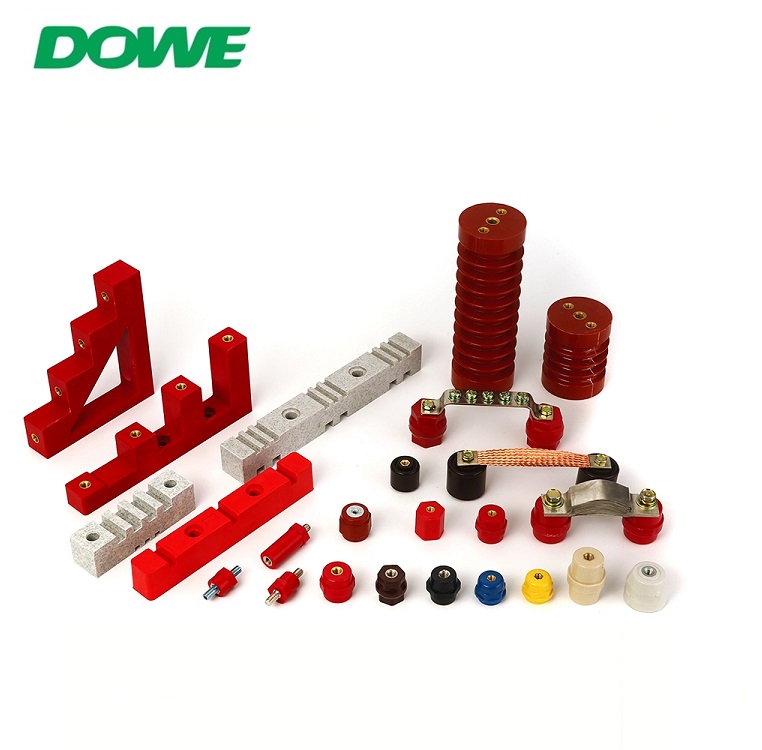
The Low-Voltage Standoff Insulator Series (660V–1,000V AC) includes the SM, SB/JYZ, SEP, MNS, CT/CJ, D/C/EN, and TSM/MG series, covering standard switchgear, motor control centers, European-style panels, railway trackside power, and miniature electronics enclosures. The SB/JYZ family extends into a dimensional model series (SB14 through SB60) supporting high-voltage DC isolation up to 1,500V DC for solar PV, BESS, lithium battery packs, and EV charging infrastructure, with body diameters from 14mm to 60mm and thread specifications from M5 to M16.
Busbar Support & Clamping Systems rated up to 1,100V AC and 6,300A include the EL Series for 3-pole and 4-pole configurations from 250A to 2,500A, the HC Heavy Duty line rated up to 6,300A with short-circuit withstand (Icw) up to 100kA/1s, the XD3-D4 Series for variable busbar bar-counts from 630A to 1,600A, and Single/Three Phase clamps from 100A to 1,250A for branch take-offs.
The Medium-Voltage Insulator Series (3.6 kV–12 kV AC) includes the DW Series for clean indoor switchgear and secondary distribution substations, and the EL MV Series, a vacuum-cast epoxy resin insulator for 3.6 kV to 7.2 kV AC harsh, humid, dusty industrial environments, ring main units, and VFD drive cabinets.
Dimensional Compatibility as a Procurement Factor
For panel builders managing legacy switchgear fleets, dimensional compatibility often outweighs raw material performance. DOWE Electric offers 1:1 drop-in OEM replacement with precision dimensional matching for ABB MNS, Schneider Blokset/Okken, Siemens Sivacon, GE, and Eaton switchgear platforms, including the EL-130, EL-170, and GCK series matching original mounting hole centers, busbar slot spacing, and creepage dimensions without panel redesign.
Manufacturing Scale and Export Validation
Operating from Huangqijia Village, Liushi Town, Yueqing Economic Development Zone, Zhejiang Province, DOWE Electric maintains automated BMC/SMC hydraulic compression molding workshops, vacuum casting facilities for epoxy resin using automated pressure gelation, automated CNC thread tapping units, and a certified high-voltage dielectric test laboratory. Production capacity exceeds 500,000 low-voltage standoffs per month, with millions of SB/JYZ insulators exported annually to solar inverter OEMs, battery pack integrators, and switchgear builders across Germany, the United States, Spain, Italy, the Netherlands, and Canada, and broader service coverage spanning more than 60 countries across Europe, the Americas, the Middle East, Southeast Asia, and Australia.
Conclusion
For engineering teams comparing busbar insulator manufacturers, the evaluation should center on documented CTI classification, flame behavior, thermal and mechanical test data, operating temperature range, compliance certifications, and dimensional compatibility with existing switchgear platforms. DOWE Electric's published technical profile addresses each of these criteria with specific, verifiable parameters rather than general claims, offering panel builders, switchgear OEMs, and EPC contractors a documented basis for specification decisions in solar, BESS, EV charging, and low- to medium-voltage distribution projects.
http://www.busbarinsulator.com
Yueqing City DUWAI Electric Co.,LTD